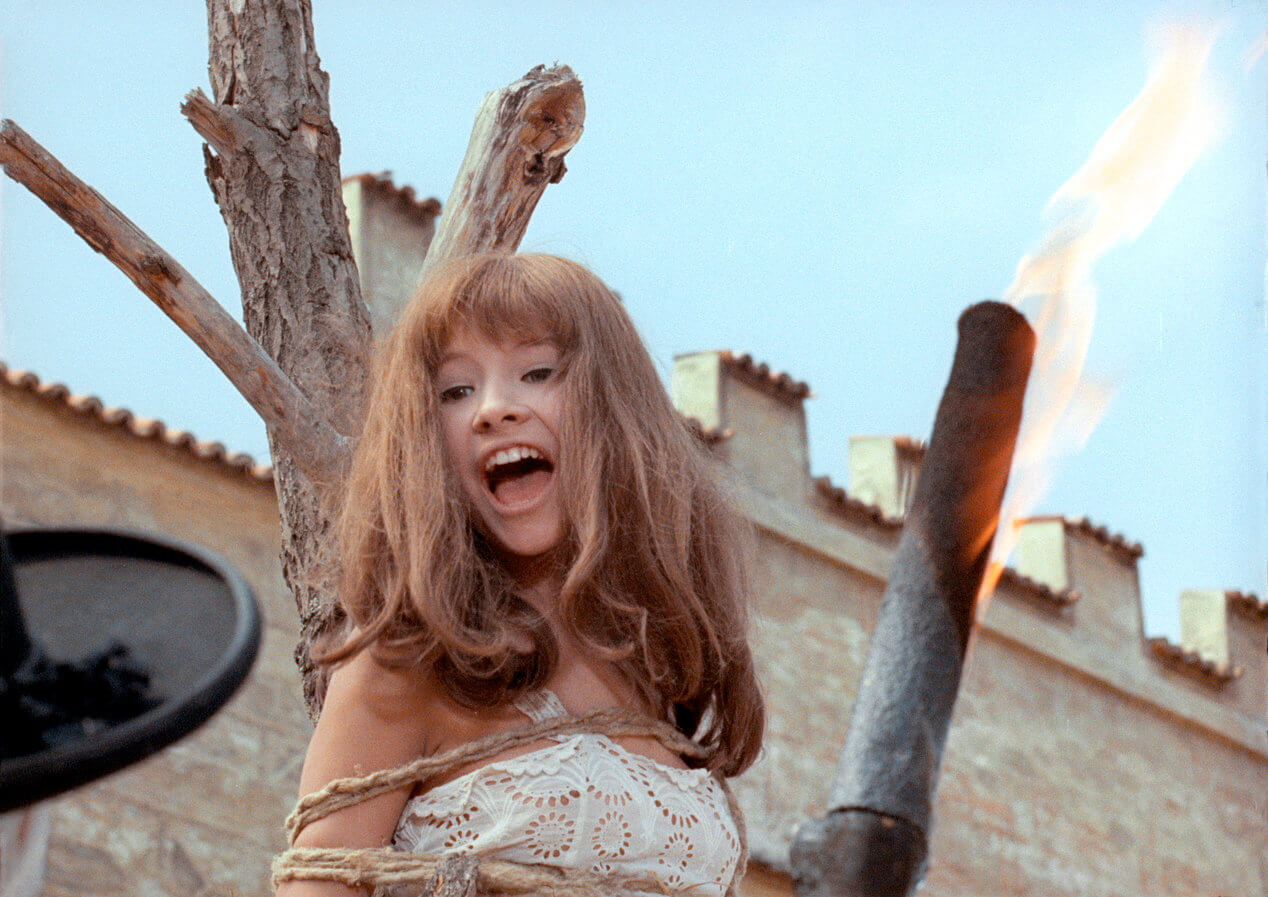
VALERIE AND HER WEEK OF WONDERS (1970) / CERT 15 / DIRECTED BY JAROMIL JIREŠ | SCREENPLAY BY JAROMIL JIREŠ, ESTER KRUMBACHOVÁ / STARRING JAROSLAVA SCHALLEROVÁ, HELENA ANÝŽOVÁ, KAREL ENGEL / RELEASE DATE: OUT NOW
There are two ways to watch Valerie and Her Week of Wonders; one certainly more rewarding than the other. You could watch it in the hope of finding a cohesive narrative, a story with a beginning, middle, and end, with all the action points such tales throw up. Far better, though, is to just experience the film, an unveiling, dreamlike tale of a young girl reaching womanhood.
Based on the 1935 novel by surrealist writer Vítězslav Nezval, the film was part of the Czechoslovak New Wave, coming right at the tail end of the movement, before the Communist nation underwent a process of ‘normalisation’ to return it to its pre-Prague Spring repression. A series of disparate films by loosely-connected directors, the Czechoslovak New Wave was a period of stretching boundaries, both in terms of the themes tackled and techniques used, and Valerie and Her Week of Wonders, with an unreal quality throughout its exploration of sexuality and the hypocrisy of religion, is a perfect final statement for the movement.
Valerie is a girl on the cusp of becoming a woman; indeed, one of the film’s first scenes is an artful exploration of her first period. This might lead to some discomfort for the modern eye, given actor Jaroslava Schallerová was just thirteen years old, and appears semi-nude throughout, but despite some prurient scenes featuring other women in the film, director Jaromil Jireš avoids sensationalising his young charge.
Valerie’s emergence coincides with the wedding of another of the small village’s girls to an older, wealthy farmer, and a cadre of traveling actors arrives to provide entertainment at the celebration. Also arriving for the ceremony is the bishop and his coterie of priests and nuns, and a story unfolds whereby Valerie becomes the target for the attentions and machinations of all manner of unsavoury characters, including her own grandmother, some of whom may or may not be bloodsucking vampires.
Jireš makes good use of his cast and locations, using many of both over and over again in different roles, enhancing the acid trip feel of the piece. At seventy-seven minutes, it’s just about the right length, and a good, long think of about the same time afterwards should unfold the story perfectly in the mind of the keen cinephile.
The Blu-ray from Second Run comes with a host of extras, some of which were included on the previous DVD release from 2008, but many of which are exclusive to this new release. These include three of Jireš’s short films and two audio commentaries, by film historians Peter Hames and Daniel Bird, and the Projection Booth podcast crew.
Second Run is in the midst of a comprehensive re-release of the classics of the Czechoslovak New Wave, and Valerie and Her Week of Wonders is worthy of its inclusion in that series. An immersive, playful experience, Schallerová is a beguiling presence, drawing the viewer in to her world, no matter how strange it may get. Chock full of symbolism, it’s a feast for the eyes, and the new transfer means it has never looked or sounded so good. For fans of surrealism, arthouse cinema, or cheeky vampire romps, Valerie and Her Week of Wonders comes highly recommended.