by Anne-Louise Fortune
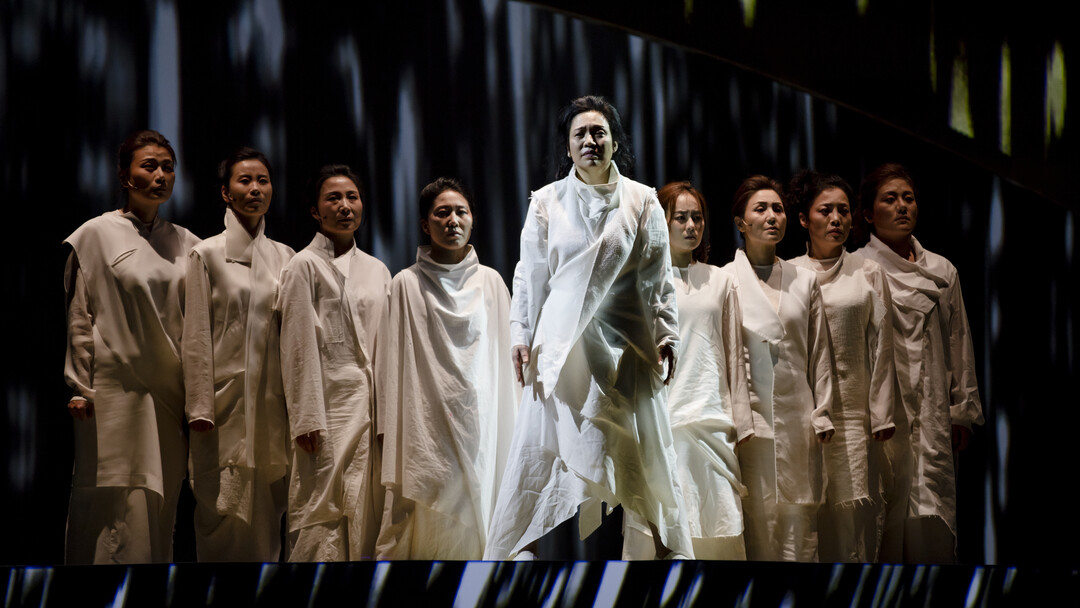
Trojan Women, staged at The Festival Theatre as part of the Edinburgh International Festival, takes the traditional Greek myth of the sacking of Troy and its aftermath and adapts it to be presented in a Korean theatrical tradition.
Directed by Ong Keng Sen, working with the National Changgeuk Company of Korea, the story is epic in scope. Presented in the pansori (Korean folk opera) style, the company of twenty-five, singing in Korean with English captions, delivers a mesmerising performance.
The Trojan War has endured for almost a decade. The Greeks have sent their sons across the sea to fight, and many of them have never returned to their homeland. As the action of the performance begins, almost all the men of Troy have been killed in battle, and any remaining in the city have been slaughtered by the Greeks who had hidden in the Trojan Horse. Those who remain are women and children, and the queen, Hecabe (Kim Kum-mi), is all too aware that both she and her female relatives will now be reduced to being held as slaves or concubines, depending on the decisions the remaining Greek men make for them.
As the narrative continues, we meet Hecabe’s daughters, including Cassandra (Yi So-yeon). Cassandra has the gift of foresight, but the curse to never be believed. Whilst the other women rightly fear their unknown futures, Cassandra has a sense of defiance that comes from the certainty of knowing the fate of the man who will be attempting to control her. The narrative is brutal, violent, and at times disturbing.
The performances of the entire cast are incredible. Contained in one moment and expansive in others, the cast makes the huge stage of the Festival Theatre seem alternatively intimate and overwhelming. The device of moving characters through the auditorium invites the audience to consider what their role in this story could be. It is clear that we are not just a passive audience. This participation, a trademark of pansori, may be confronting to a British audience used to placing distance between themselves and the performers.
Whilst superficially, this is a retelling of an ancient Greek myth, this story has been used for centuries to make broader points, often about the futility of war and the devastating consequences for its survivors. Here, it is also possible to read that the production is asking us to consider the plight of women who are having their human rights restricted, especially in relation to their own bodily autonomy. The production is not prepared to offer easy solutions, recognising that Hecabe has brought this situation on herself through her own actions.
Korean folk opera is perhaps a lesser-known theatrical form in the United Kingdom. If you are familiar with the conventions of Beijing Opera, then you will note similarities in the musical style and the delivery of the performance, but the music overall is less discordant: more melodic. There are references to the K-Pop music style weaved throughout the score. There are also elements that will bring to mind theatrical practices across the continent of Asia more generally, from the musicians framing the performance area to the stylised nature of individual performances. It is a fascinating mix, all of which blended superbly in this production.