With the plot of the first two episodes accelerating the inevitable coming confrontation between Maggie and Negan, episode three takes a sideways turn to explore an overlooked branch of the Manhattan ecosystem hidden deep within the overgrown wilderness of Central Park. To relocate the action to such a recognisable New York landmark is a clever idea, and offers up some evocative visuals. But it does little to bring the simmering antagonisms of the central storyline closer to the boil.
The survivors of the failed river crossing have hunkered down overnight after escaping on a lifeboat from the Liberty Queen before she sank under fire. But the group, a mix of New Babylon officers, conscripts and members of Maggie’s family, are being menaced by walkers. Fearing that their human enemies will also soon be closing in, they decide to regroup away from prying eyes and head off to the sanctuary of Central Park.
The group find walkers threaded throughout the first stretch of woodland, and are attacked, but hurry deeper towards an area of grassland that is now above head height and close to impenetrable. As they press on through the vegetation, walkers swarm them as they become separated. Director Ed Ornelas pushes the jeopardy of the moment as individuals become lost and disoriented amidst the screams of others. It is the episode’s most visually striking sequence, and a consequential moment as a distraught Maggie loses contact with both Gilly and Hershel. When the remnants regroup, they find themselves at the gates of a settlement hidden deep within the park, whose residents beckon them inside to safety.
The world of The Walking Dead is full of diverse settlements, shaped by different motivations and worldviews. When the show’s lead characters encounter them, their existence provides a narrative device to reflect anew on the appalling realities of their world. The Central Park settlers fulfil this role, but truth be told, they are neither that interesting nor particularly original. Pretty much every post-apocalyptic series includes the community that rejects the legacy of civilisation and embraces a fatalistic view of humans’ place in the natural world. The Foragers tick most of the required boxes.
Roksana, the Foragers’ leader, refuses all of the approaches of the New Babylon Federation, insisting on their right to live independently and showing no interest in the potential of methane-powered technology. They are content to live unmolested in the woods, surrounded by a ring of walkers that they see as a protective line of defence, and not a menace to be expunged. The Foragers’ key role in the plot is to support a side story in which Hershel is befriended by a young girl whose fate emphasises their distinctive philosophy.
More interesting is the development in some pivotal relationships. Negan persuades the Croat that he and enforcer Waylen should pursue the group into the park, securing a degree of autonomy outside The Dama’s clutches that Negan embraces for his own ends. When Negan returns alone, he assures The Croat that the survivors of the Liberty Queen will all have been taken by the walkers, even though he knows that’s not the case. Within Maggie’s group, losses within the New Babylon Federation lift the status of Perlie, and he acknowledges that his reliance on her wisdom and instincts has increased.
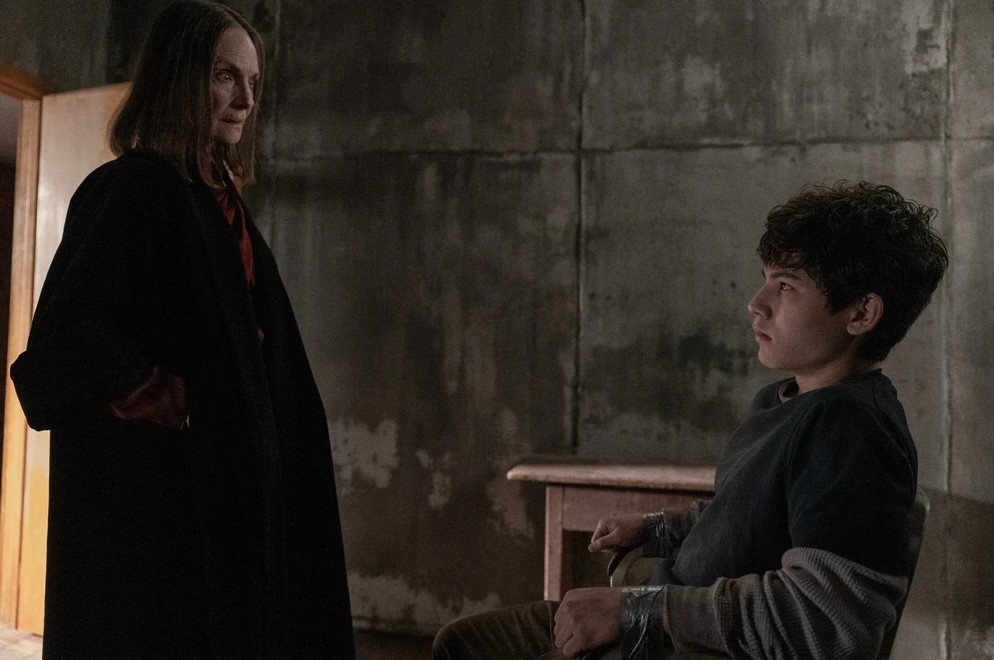
Most revealing of all is the backstory of Hershel’s incarceration in Manhattan after his abduction from Maggie’s settlement. Despite Logan Kim’s grounded performance, the taciturn and moody adolescent is perhaps not the most thrilling of characters to spend screen time with. But as The Dama, Lisa Emery continues to add new facets to her already layered portrayal of the inscrutable villainess. Through a mixture of flashbacks and time jumps, Brenna Kouf’s tautly constructed dialogue rewrites the dynamic between jailer and prisoner, undercutting long-cherished assumptions and bringing some welcome unpredictability into the season’s story arc.
A longer run of episodes would offer more space to inject interesting diversions from the main Dead City showdown. But after the impatience shown in the first two episodes to get everyone back to the island post haste, the key focus of this interlude injects an unexpected slowdown in pace. A bolder approach to this episode would have been to embrace that shift, and foreground the critical Dama-Hershel two-hander ahead of what appears to be, for now at least, the inconsequential Foragers’ story.

The second season of THE WALKING DEAD: DEAD CITY premiered earlier this month on AMC and AMC+ in the US
Read our previous reviews of the second season of THE WALKING DEAD: DEAD CITY below:
Season 2, Episode 1, POWER EQUALS POWER
Season 2, Episode 2, ANOTHER SHITTY LESSON