One entirely useless definition of art is anything produced with artistic intent that is heavy enough to break your foot should you drop it. On that logic, The Making of the Original Dungeons & Dragons 1970 – 1977 is art. That said, a book that lovingly reproduces the first ever tabletop roleplaying game ever published should be regarded as art anyway.
At 570+ pages, with four separated colour-coded ribbon bookmarks, this book is certainly a beast that fits awkwardly on the shelf. This is primarily a reproduction of treasures from the Dungeons & Dragons archives; books and documents from the start of D&D that would be impossible for most folk to obtain by normal means. It includes things such as the first draft of the game, photographs of the various handwritten notes between Arneson and Gygax (the game’s creators) and so on.
It starts at the very beginning, with an excerpt from a gaming fanzine, and explores Chainmail, the early wargame that would be adapted into the game we know today. Elements such as Peter Gaylord’s character sheet for a single wizard character are included; these provide context for how a humble strategy game would morph into the worldwide phenomenon it is today.
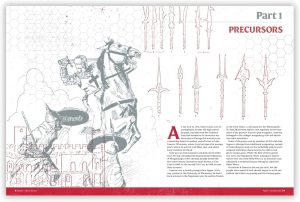
The next chapter reproduces early drafts of D&D, letters between creators, pencil-drawn maps, and so on. We even see idle doodles of monsters and the like. After that, we get a full reproduction of the original D&D boxed set, and the final chapter is further ephemera, including articles from the time and supplements, including Greyhawk, Blackmoor, and Eldritch Wizardry. A yes, that means the first appearance of Vecna is reproduced here.
Commentary is also provided, and it’s mostly neutral in tone with some context added. If you’re researching the history of D&D, this book should not be your only source, but it is a jolly useful one, as it reproduces a lot of hard to find archive material and puts it all in one place.
Some of the language is of its time, a reflection of the standards back then and of course, there is a note informing the reader the content is presented as originally created “because to do otherwise would be the same as claiming these prejudices never existed”. This has been the policy on this sort of thing for years. It’s entirely sensible and modern and should come as no surprise to any serious person.
The book is useful for many reasons. It tells you where D&D came from, providing perspective as to what the future may have in store. It also refutes the claim that the older editions were somehow better; they clearly weren’t. As wonderful as these old pages are, the modern game has much improved. So it’s a good defence against nostalgia-fueled foolishness, as well as being heavy enough to serve as an offensive weapon if required. (We are joking; do not use heavy books as weapons. Even if they do have illustrations of different types of polearms on page 420.)
Essential for some and a fun curio for others, The Making of the Original Dungeons & Dragons 1970 – 1977 is the ultimate book for the D&D fanatic.