by Iain Robertson
If you’ve heard the cast of Strange New Worlds talk about the show’s second season, the phrase you’ll have come across most frequently is “big swings.” We’ve been repeatedly told that they’d be shaking up the formula and pushing the boundaries of what Star Trek can be. It’s a fun idea – the seemingly most traditional of the current crop of shows (episodic, planet-of-the-week, starship out exploring the galaxy) pushing the franchise in new directions. And yet, while the initial batch of 6 episodes made available to review are entertaining, there’s little in terms of envelope-pushing to date. Admittedly, these episodes didn’t include the much-anticipated, part-animated Lower Decks crossover or whatever the hell Episode 9 is (there are rumours of a musical). What we have instead is a varied, fun, but hardly wild batch of episodes.
The initial episodes cover a number of well-worn Trek scenarios. There’s a courtroom drama as Una (Rebecca Romjin) goes on trial, time travel, Klingons, and a return to Rigel VII – last visited just prior to the events of The Cage. Starting things off is the season-opener, The Broken Circle. With Anson Mount’s Pike largely absent from the episode (he’s off trying to help Una), command of the Enterprise falls to Spock (Ethan Peck). So, when La’an (Christina Chong) – last seen taking a leave of absence from the Enterprise in All Those Who Wander – sends an urgent fate-of-the-galaxy-at-stake message, it’s up to the untried Spock to disobey orders and go to her aid. What follows is an entertaining if insubstantial season opener, with some of the show’s ensemble – in particular M’Benga (Babs Olusanmokun) and Chapel (Jess Bush) – getting a chance to shine.
The second episode sees Una on trial for concealing her Illyrian heritage and genetic modification. Starfleet’s blanket ban on allowing genetically modified personnel to serve was previously examined in DS9’s Doctor Bashir, I Presume? and more recently on Prodigy, and is something that, although understandable, has always felt at odds with the Federation’s utopian, inclusive ideals. It’s a classic Trek courtroom drama, no Measure of a Man. Still, it’s entertaining, thought-provoking, and one of Strange New Worlds’ strongest episodes to date, with both Romjin and guest star Yetide Badaki giving great performances.
The following four episodes include the La’an/Kirk time travel story, the return trip to Rigel VII, a Spock/T’Pring/Chapel episode, and a horror-tinged outing for Uhura. Of these, only the Spock-centric fifth episode really feels like it’s taking chances and is likely to prove divisive as a result. For the record, I thought this was the weakest of the 6 episodes, but tonally it’s similar to the first season’s body-swapping Spock Amok (which I also wasn’t a fan of) and those who liked that episode should find a lot to enjoy in it.
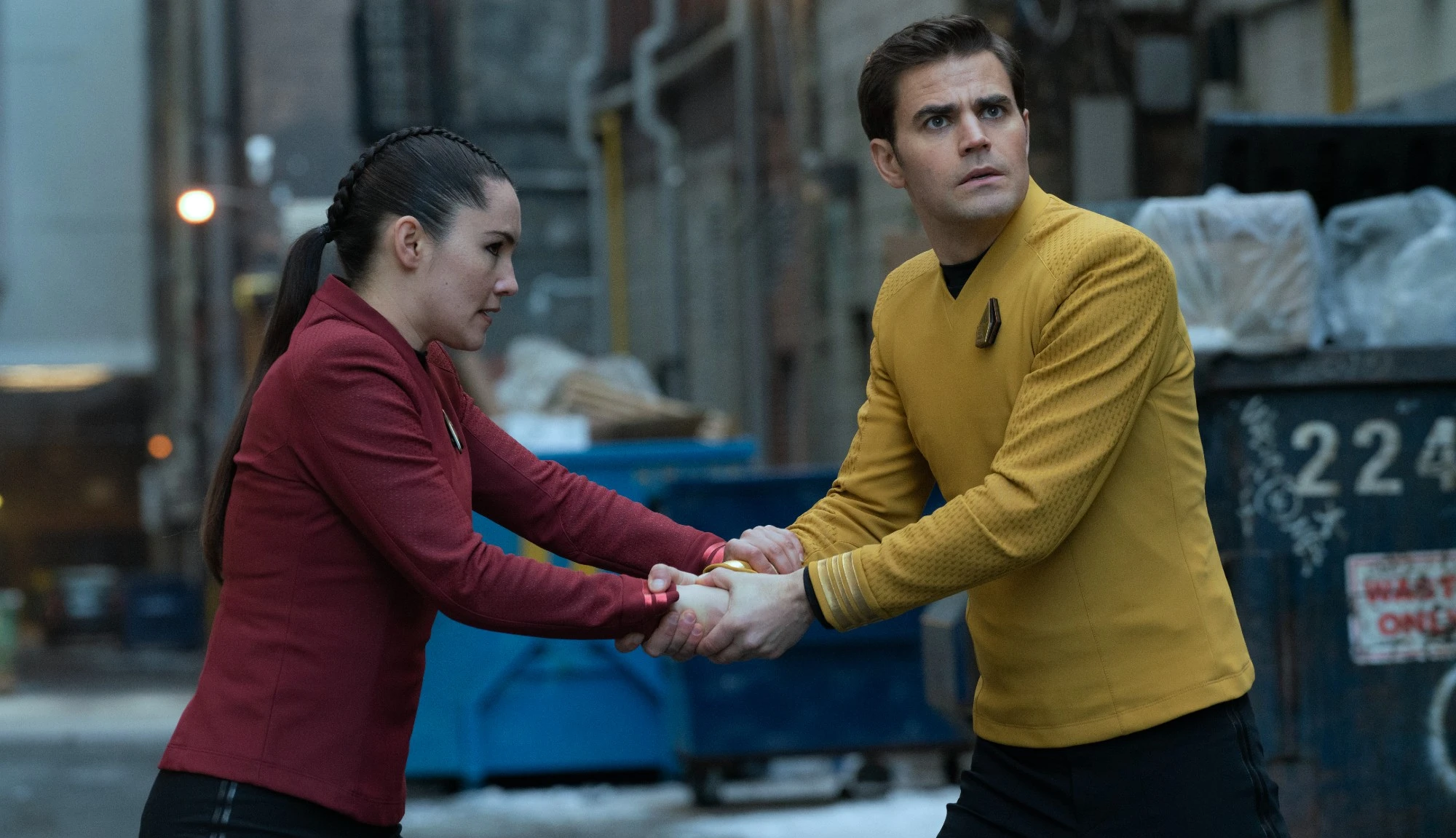
The time travel episode made headlines when Christina Chong was spotted filming on location with Vampire Diaries star Paul Wesley and Paramount had to confirm that, yes, he was playing James T. Kirk. Following his surprise alternate timeline appearance in the Season 1 finale, Wesley gets to play a different version of Kirk here, and he and Chong have good chemistry. It’s her largest role in the series to date, and we get to see a different side of the usually buttoned-down security officer. There’s an element of the episode that’s likely to provoke debate, but it’s an enjoyable time travel story. The remaining two episodes, featuring Pike’s return to Rigel VII and a spooky Uhura story, are both solid and make this an entertaining, diverse group of episodes that shows the scope the show’s format allows. If it’s not exactly taking the promised big swings so far (although they are coming), that’s fine. Shaking the formula up occasionally is no bad thing, but the show and cast are strong, and Strange New Worlds continues to provide a fun, modern take on classic Trek storytelling.
That’s not to say there aren’t some notable differences from the first season. Pike, having come to terms with his impending death, is lighter, less introspective than before, and seems determined to make the most of life (importantly, though – yes, the hair is still spectacular). It also feels more of an ensemble show, with the supporting cast getting more to do, particularly Christina Chong and Jess Bush. There are a couple of episodes where Pike hardly features, with the focus switching almost entirely to other crew members.
Most obviously, though, there’s the addition of two new cast members, with Carol Kane as the new chief engineer, Pelia, and Paul Wesley as James T. Kirk. Both are recurring characters rather than main cast, and both are likely to have as many detractors as they do fans.
Carol Kane brings her wealth of experience to Pelia and crafts a very different character to her predecessor, Hemmer (Bruce Horak). Although humanoid in appearance, Pelia’s an alien (we’re not giving any spoilers about her species), and Kane’s offbeat performance (and accent) won’t be to everyone’s taste. Like Neelix and Phlox, she looks set to be one of Trek’s alien characters that divide fans. And like those characters, we suspect that once they get used to the off-kilter performance, she’ll win most people over.
Paul Wesley has the more thankless task of reimagining Kirk. Although Chris Pine had previously played the role, the alternate Kelvin timeline allowed him to put his own spin on the character. Welsey, on the other hand, is following on directly from Shatner (or should that be proceeding him?), which is no easy task. Taking the wise route of not choosing to outright imitate him, his mannered performance just about walks the line between giving us shades of the Kirk we know while crafting his own take on the character. If you can put Shatner’s performance aside, he’s a lot of fun, even if he never quite escapes his predecessor’s shadow.
If you’re one of the people who baulked at some of the liberties season 1 took with canon and the use of certain characters, you’re not going to find anything here to reassure you. The show isn’t so much “finding gaps in canon” as showrunners Akiva Goldsman and Henry Alonso Myers claim, so much as driving a starship through it. So, the Gorn are still a thing, and considerable liberties are taken with the Spock’s relationships with both T’Pring and Chapel. As for the Klingons, they’ve now morphed into something close to the version we know – their unfortunate Discovery redesign entirely discarded without explanation. We do, however, finally get some things officially canonized, such as confirmation of both Kirk’s birthplace and his parents and an explanation (not entirely convincing) for Kirk’s claim in The Menagerie that he only met Pike “when he was promoted to fleet captain.” There are definite liberties taken with canon, but that’s the price you pay for having a 23rd Century-set show.
In conclusion, season 2 of Strange New Worlds is off to a fun start. While the promised big swings are (presumably) largely still to come, the initial run of episodes contains enough variety and shift focus among the crew that there should be something here for all but the most die-hard holdouts. While the final season of Picard may have shown us how to shake Trek up and reinvent it for the modern era, there’s something delightfully old-school about Strange New Worlds: traditional Trek with a modern twist. But Star Trek has always been a versatile format, and there’s more than enough room for multiple versions. And on the evidence here, Strange New Worlds looks set to continue honouring the past while looking to the future. Hit it.