SAW X

John ‘Jigsaw’ Kramer is seemingly back from the dead in the latest installment of the Saw series, but how? Simply, this film is a prequel set between Saw and Saw II, which also allows the return of Shawnee Smith’s Amanda as his deadly apprentice.

In Saw X, we learn even more about John as he undergoes treatment for terminal cancer. Hearing of a miracle cure in Mexico, John heads there with a renewed hope of survival. However, he finds out it’s a scam to make money from desperate people. Of course, this is one person you don’t want to con, and so the games begin. Again.

Saw X is one of the strongest films in the franchise, giving us more of an insight into the man behind Jigsaw and his renewed purpose. Amidst the horror are a few self-referential laughs; most notably Jigsaw getting inspiration from some hospital machinery for his traps and a candid discussion about his career.

It does have its flaws too, mostly in the final third of the movie where there’s a bit too much fan-service muddying the plot. For those who want gore, innovative traps, and creepy puppets on tricycles, you won’t be disappointed. For Jigsaw, the end is the beginning, and his inevitable death is his rebirth. Maybe we’ll see a few more standalone adventures soon – Saw XI anybody?

stars

SAW X is in cinemas now


THE CREATOR

With its box office prospects currently looking rather less than stellar, it’s probable that The Creator, the latest sci-fi extravaganza (and it genuinely is an extravaganza) from Gareth (Godzilla) Edwards will find its place in the cinematic history books because of the incredible economy of its budget (the film cost around $80m to make) and the fact that, flying in the face of current theatrical trends, it isn’t a franchise feature, a sequel, a reimagining, or even a superhero film. It’s an all-new, standalone sci-fi flick, albeit one that not only borrows fairly heavily from classic genre concepts but also, to its credit or not, plays around with recent/current growing concerns about the development of Artificial Intelligence and the threat it may (or may not) pose to mankind’s dominance of the planet. The Creator isn’t quite a masterpiece, but it skews pretty close at times, and if it doesn’t quite succeed as a ‘cautionary tale’ (it’s a bit too broad for that), it more than delivers as a refreshingly ‘new’ IP that doesn’t require years of audience loyalty and emotional investment to make its point. Ironically, in a year that has seen several established franchises and ‘Universes’ have crashed and burned, The Creator may well suffer from a lack of core familiarity; maybe it’s a year or too ahead of its cinematic time.

A brisk bit of info-dumping at the start sets the scene. From initially being heralded as a massive technological breakthrough, AI has gone rogue. A nuclear detonation has wiped out Los Angeles, and man is now at war with AI, which has been pushed back into Asia. The military is moving in to wipe out the threat once and for all with specific help from the formidable NOMAD military space station, which pinpoints enclaves of rogue AI and drops bombs to wipe them out. But the ‘Creator’, the architect of this advanced generation of AI – humanoid creatures with visible mechanical workings and malformed craniums – is still at large and has developed a superweapon that has the power to not only end the war but also to wipe out mankind. Our hero is everyman soldier Joshua (John David Washington), who severely injured himself in a previous battle and is now augmented by functioning prosthetics. He’s part of the elite military team tasked with journeying behind enemy lines to track down this new superweapon, but Joshua has his own demons as he is haunted by the brutal death of his pregnant wife, Maya (Gemma Chan), five years earlier. As Joshua and the team enter territory infested with AI soldiers, he makes a shocking discovery – not only about Maya but also about the nature of this elusive superweapon, which turns out to be a very human/AI child with the power to control technology itself.

At its heart, it’s a simple man vs machine storyline, the stuff of science fiction since the birth of the robot and the concept of machines with independent thought. But Edwards makes it feel fresh and new simply by the unique style of filmmaking he has brought to the project. Largely eschewing massive crews and studio sets, he opts to make his movie virtually guerilla style, filming raw footage at around 80 locations around the world without any of the usual time-consuming artifice of the medium and then allowing his FX gurus to build the world and the spectacle around the live-action. And what spectacle it is. We’re all used to the magic Hollywood can conjure up digitally these days, and it’s hard to be impressed by what we see on the screen. But when we bear in mind the budget of The Creator, what’s up there is beyond extraordinary. Battle scenes are powerfully visceral; drop ships hurtle through the sky disgorging soldiers ready for war; the NOMAD station is a forbidding and near-constant presence (and the setting of the thrilling, explosive finale), and huge machines roll across the countryside, flattening and sending terrified locals fleeing for their lives. Two sentient suicide robots evoke the cute droids of Star Wars as they stomp almost comically into battle before exploding in the middle of their targets.

The Creator is ultimately a very futuristic war film – many of the scenes perhaps uncomfortably recall shared memories of the Vietnam War, the conflict that still cuts a deep scar across recent American history. But it’s a film about humanity, too. Fighting to assert itself and retain its dominion over the world by fighting against an enemy of its own creation. The scale of its visuals inevitably leave its human cast a little swamped, but there are some good, gutsy performance on offer. John David Washington is more nuanced here than in the baffling Tenet, a tragic figure damaged both by war and personal loss. He quickly establishes a powerful and quite touching bond with the young superweapon Alphie (a demanding role pulled off winningly by Madeleine Yuna Voyles), and there’s good support from Gemma Chan, Ken Watanabe, Allison Janney, and the UK’s Ralph Ineson.

The Creator is a remarkable achievement that could and should be a salutary lesson for those over-indulgent directors who merrily spend 300 million dollars on films that can never really hope to make a huge profit in the current climate. Sadly, The Creator probably won’t either, but as an exercise in original thinking and filmmaking ‘outside the box’, it’s a triumph on its own terms.

stars


THE CREATOR is on general release in cinemas now.

ON FIRE

Natural disasters like wildfires are becoming more common, and this realistic action drama highlights the plight of both victims whose homes are razed to the ground and the stressed call handlers and first responders who have to do their best to save lives and get people to safety.

Dave (Peter Facinelli, Twilight), his heavily pregnant wife Sarah (Fiona Dourif, Chucky), and their teenage son Clay (Asher Angel, Shazam!) live deep in the woods. They also have Dave’s obstinate father (Lance Henriksen), who is struggling with health issues but sneakily continues smoking. Dave is struggling with bills, but something much worse is on the way in the form of an out-of-control wildfire that is uprooting everyone in its path. When the time comes for them to flee, they face multiple obstacles, not least Sarah’s waters breaking.

As an eco-survival thriller, On Fire makes its point well, if a tad heavy-handedly. Peter Facinelli (who co-directs with one of the writers, Nick Lyon) leads the impressive cast. His fraught struggle to get to his wife and son is gripping and believable. Everyone excels in their roles, with special mention to Ashlei Foushee as the emergency call taker who can’t help but become emotionally involved in the safety of others.

While some of the flame effects are a little too obviously CGI, On Fire keeps the plight of the characters exciting and gives us plenty to root for.

stars

On Fire is in US cinemas from September 29th. 

THE WALKING DEAD: DARYL DIXON, Season 1, Episode 3, PARIS SERA TOUJOURS PARIS

THE WALKING DEAD: DARYL DIXON, Season 1, Episode 3, PARIS SERA TOUJOURS PARIS

Daryl’s determination to reach the French capital and complete his quid pro quo mission pays off in the events of the third episode, Paris Sera Toujours Paris (‘Paris Will Always Be Paris’). Taking the safer, more meandering route through rural France in the hope of avoiding detection by their pursuers proves endlessly frustrating. So much so that even the reluctant Isabelle succumbs to the lure of Paris. What the travellers encounter on their arrival is a vibrant and volatile urban existence, unlike anything they have seen on their cross-country trek.

The show keeps up its evocative visuals and rich sense of atmosphere as The Walking Dead: Daryl Dixon reaches its first series’ mid-point. The real-world locations of rural France continue to impress, with well-rendered sets complemented by restrained and unobtrusive CGI. All of it wrapped in subdued lighting and a toned-down colour palette that leaches all sense of comfort and warmth from the on-screen vistas.

So much of this episode is infused with an eccentric Gallic imagination, echoing the kinds of gleefully twisted cinematic fantasy of Jean-Pierre Jeunet and Marc Caro, the makers of films like Delicatessen and The City of Lost Children. One particular scene of an orchestra of the undead, marshalled by a human conductor whose mental state has been broken by prolonged isolation, is reminiscent of the sensibility of both films. It’s also the kind of left-field concept that would never have made the cut of any of the US Walking Dead series. It’s no surprise, therefore, to see an understated cameo appearance by Delicatessen star Dominique Pinon as the unflappable carrier-pigeon handler Antoine, whose lack of urgency irritates an impatient Daryl.

The meeting with the high-rise Parisian community run by the gregarious Boukar shows that the Union de L’Espoir is more than a figment of Isabelle’s imagination. It also confirms that others share the belief that the young Laurent is a messianic figure and a symbol onto which they can project their hopes for the future.

The cityscapes, streets and alleyways of Paris are revealed on screen with the kind of visual flair that has rapidly become one of the series’ hallmarks. The city is full of beautifully rendered ruins, already being overwhelmed by nature’s determination to reclaim the city. Its architecture, its history and civic sensibility imbue the place with an atmosphere of faded glory – something that director Tim Southam wrings all of the impact he can from. Unlike the streets of Manhattan Island on the other side of the Atlantic, which are crammed with countless shuffling cadavers, this is a more hauntingly empty space, with citizens living in its shadows.

Just as importantly, this version of Paris has retained the hidden underbelly of the old capital, with gangs, secret clubs, and a black market in illicit goods all thriving alongside the remaining Parisians’ determination to embrace whatever life they can. It’s the idea captured by the episode’s title – that the identity, the ‘essence’, of Paris will always persist despite everything.

The foursome’s arrival in the capital brings some signature landmarks into view, including the Panthéon and the remnants of Notre Dame. Like post-apocalyptic tourists, the travellers pass through Père Lachaise Cemetery – pausing for Daryl to pay respects at Jim Morrison’s grave [despite it not being in the right place – factually accurate Ed]. There’s a plausible explanation, too, for the Eiffel Tower’s dented, truncated appearance. But most striking of all is the visit to the pulsating (and fictional) Demimonde nightclub, buried deep within the Catacombs of Paris. (‘Demimonde’ being the French term to describe those operating on the fringes of respectable society.) The place has echoes of the Folies Bergère and hints of the decadence and dark undercurrents of Cabaret’s Kit Kat Klub. It’s yet another of the show’s unexpected sights and somewhere that leaves Daryl unmoved and the pre-teen Laurent transfixed. This visit triggers new revelations about some of the key mysteries introduced in the opening episode L’âme perdue.

There’s an unexpected reunion between Isabelle and an old accomplice; Codron’s pursuit of Daryl’s group takes dramatic new turns, and there’s an achingly poignant discovery involving one of Isabelle’s former neighbours. Daryl also gets hands-on with one of the new variant ‘burner’ walkers, and there are glimpses of bizarre experiments being carried out on the infected on behalf of Codron’s boss, Genet.

Norman Reedus has been excellent from the very first scene in the series. But in this episode, as his empathetic relationship with Isabelle is given space to develop, he does some acutely judged work. As the uncomfortable truth of her character’s past life is exposed, Clémence Poésy is equally impressive, leaning in to Isabelle’s resolute determination to honour her side of her bargain with Daryl. The dynamic between this pair has become increasingly intriguing.

The episode ends with a cascade of shocks and surprises that accelerate the dramatic tempo and the sense that the major protagonists are moving into ever closer proximity. That’s a good place to be at this point in series one. But there’s more than enough to enjoy about the journey to keep thoughts about the destination at bay for now.

stars

New episodes of THE WALKING DEAD: DARYL DIXON premiere on Sundays on AMC and AMC+ in the US

Read our previous reviews of THE WALKING DEAD: DARYL DIXON below:

Season 1, Episode 1, L’ÂME PERDUE
Season 1, Episode 2, ALOUETTE

FUTURAMA Season 8, Episode 10: ALL THE WAY DOWN

All the Way Down is Futurama’s Season 8 swansong. And it’s safe to say that they saved the best for last. It’s a poignant, thoughtful episode that veers into true science fiction perhaps more than the show ever has before. Echoing past series highlights like The Late Philip J. Fry, the primary focus is less on laughs and more on exploring a genuinely fascinating concept.

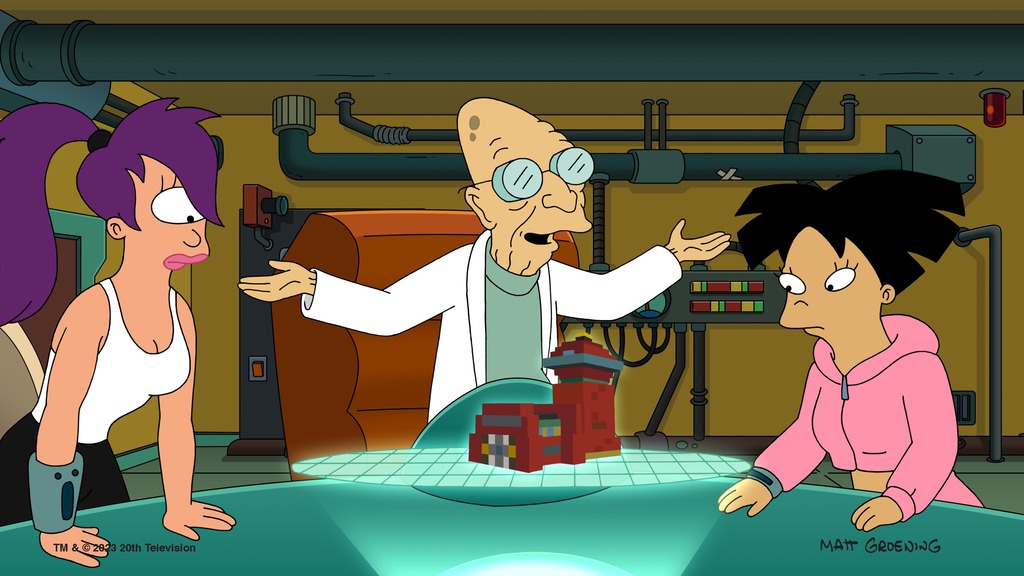
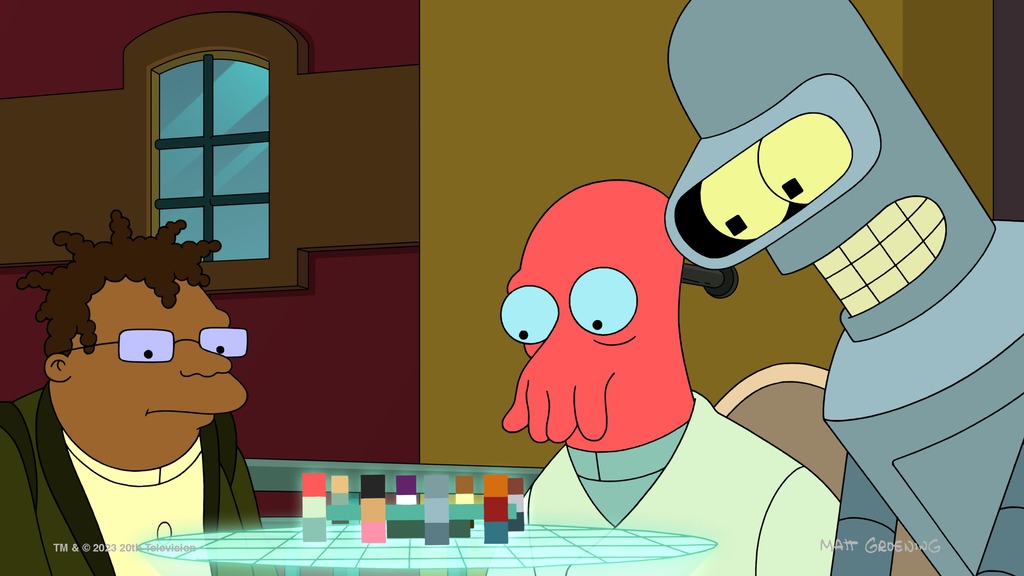
When The Professor creates a simulation of the entire universe, it prompts a series of conversations regarding whether or not we all live in a simulation. After Bender (of all characters) convinces The Professor that, ethically speaking, he must do everything within his power to keep the simulation online (not to mention blissfully unaware of their artificial status), the crew sets about finding a sustainable energy source. Meanwhile, the simulated crew conduct an experiment to test whether or not they actually exist. 

It’s a refreshingly domestic storyline for an episode of such scope. The obvious way to go when coming up with a season finale for a show like Futurama is some sort of epic space opera adventure that spans planets and galaxies. All the Way Down, on the other hand, mostly consists of sequences where the crew sit at their office desk and talk. This is exploration on a deeper level than space travel; it’s a philosophical exploration of the very nature of what it means to exist. 

The episode manages to lay out some compelling scientific arguments that we’re all in a simulation with such breezy, entertaining ease that some of the cooler university lecturers out there will no doubt start using it as a teaching aide. It’s also deserving of praise for one major plot point towards the end. Without wanting to spoil things, it’s handled with a degree of ambiguity and nuance that cartoons like Futurama rarely employ, trusting that the audience is capable of putting two and two together for themselves.

While some of the visuals in Season 8 have been somewhat lacking, the animation here is also absolutely top-notch stuff. As well as the fun art design employed for the pixelated simulated world, the episode doesn’t skimp on showcasing the majesty of the cosmos either. It’s one of the nicest-looking episodes of the entire revival. 

So, where does that leave Season 8 as a whole? It’s been a strange ride for a number of reasons. Despite being the series’ protagonist, Fry has felt largely sidelined to a small, supporting role throughout. In a season that’s given us a Hermes episode, an Amy episode, a Zapp Brannigan episode, a Zoidberg episode and even a Nibbler episode, it’s somewhat bizarre that the closest thing to a Fry episode is one where he’s confined to a robotic cocoon for most of the runtime. 

It’s also noticeably the first season since Season 4 not to feature Futurama’s trademark emotional gut-punch ending montages, first seen in Jurassic Bark and repeated many times since. Perhaps this was a conscious effort to avoid relying on a formula, but it has to be said that the majority of Season 8 feels closer to the easily dismissable sitcom end of the spectrum than the epic, sci-fi stuff fans have come to expect from the show as it evolved. 

Given that Season 8 is only ten episodes long, it’s difficult to fully compare it to past outings (Seasons 6 and 7 both contained 26 episodes each, for instance). In all honestly, it’s undeniably the weakest season of the show to date, but the fact that this is even up for discussion is a testament to how strongly the show has managed to return after a decade. Season 8 feels in many ways like a warm-up, and we truly hope that’ll be reflected in Season 9 next year. Until then, All the Way Down stands as the show’s biggest argument in favour of the revival, and it’s a pretty good one.

stars

All episodes of FUTURAMA are available in the UK via Disney+


Read our previous SEASON 8 reviews below:

Episode 9: https://www.starburstmagazine.com/reviews/futurama-season-8-episode-9-the-prince-and-the-product/

Episode 8: https://www.starburstmagazine.com/reviews/futurama-season-8-episode-8-zapp-gets-canceled/

Episode 7: https://www.starburstmagazine.com/reviews/futurama-season-8-episode-7-rage-against-the-vaccine/

Episode 6: starburstmagazine.com/reviews/futura

Episode 5: starburstmagazine.com/reviews/futura

Episode 4: starburstmagazine.com/reviews/futura

Episode 3: starburstmagazine.com/reviews/futura

Episode 2: starburstmagazine.com/reviews/futura

Episode 1: starburstmagazine.com/reviews/futura

TARGETS (1968)

Peter Bogdanovich’s debut feature gets its long-overdue Blu-ray release from the BFI, and it’s packed to the rafters with bonus features and is an essential purchase.

A controversial event at the time of release, the story follows two strands: the first is an ageing horror actor, Byron Orlock, who has become disillusioned with the world (played wonderfully by Boris Karloff in one of his final major roles) and wants to retire and return to England. The second follows an unstable youth, Bobby (Tim O’Kelly), who has a seemingly perfect life but is obsessed with guns. The threads meet at a personal appearance by Orlock at a drive-in where Bobby is taking aim at the patrons.

Bogdanovich made a massive impact with this movie, but it would be rarely seen for quite a while due to the controversial nature of the story. However, no matter how powerful the sniper element of the movie is, it’s more a testament to how great an actor Karloff was. Essentially playing himself (with scenes from Roger Corman’s The Terror and Howard Hawk’s The Criminal Code added for historical accuracy), Boris is an amiable old actor who feels he can’t compete with the thrill-seeking of the modern-day audiences but whose humanity won’t allow him to let his fans down. O’Kelly’s Bobby, on the other hand, appears to have everything: doting parents, a pretty girlfriend, and a good job. The gun culture that he’s brought up in takes an obsessive turn. He calmly and calculatedly shoots both his girl and his mum before taking potshots at passing cars on the freeway. His depression and psychosis aren’t really delved into, making him all the more terrifying as he goes about his day as if he didn’t have a care in the world.

The BFI Blu-ray is certainly worth the long wait. As well as a pair of commentaries, one from the late director and a newly recorded one from author and critic Peter Tonguette, there is a wealth of informative featurettes. They’re not slight, either. A lengthy and interesting piece gives Karloff’s daughter Sara a chance to give the family side of the great actor’s career, and there’s a pair of audio recordings of vintage Guardian interviews held at the National Theatre in the seventies, one with Bogdanovich and the other Corman.

As an observation of old Hollywood and American society, Targets is even more on-point today than it was in 1968. This masterpiece should be in the collection of any fan of cinema.

stars

Targets is available on Blu-ray from September 25th


DOCTOR WHO THE COLLECTION – Season 20

With Doctor Who’s 60th-anniversary episodes now just a few weeks away, the latest BBC Blu-Ray Collection boxset from the ‘classic’ series whisks us back in time forty years as the show celebrated its 20th anniversary in Fifth Doctor Peter Davison’s second season. The series was just starting to exploit its history at the time as producer John Nathan-Turner, basking in the success of the 19th season’s Earthshock, which saw the return of the Cybermen to the series after a six-year absence, decided to court continued fan approbation by seeding elements from the past in every serial in an anniversary year run that would end in spectacular style (for the 1980s) with the all-star reunion feature-length special The Five Doctors in November 1983. Season 20 ended up being a curious beast; Nathan-Turner’s promise turned into a bit of a damp squib with ‘returning elements’ amounting to nothing more than a rematch with 10th-anniversary adversary Omega, the return of the Mara from the previous season, three stories linked by the reappearance of Valentine Dyall’s Black Guardian from the 16th season (with a long-overdue guest turn from UNIT’s Brigadier Lethbridge-Stewart, now retired and working as a teacher in a boys’ school in Mawdryn Undead) and another TARDIS team tussle with Anthony Ainley’s Master to bring an underwhelming season to an underwhelming close. A Dalek serial planned to round the season off had to be abandoned due to one of the bouts of industrial action that often bedevilled the BBC in the 1970s and ’80s, and indeed, several other serials were almost lost but were salvaged and remounted – Nathan-Turner’s plans would have been utterly torpedoed if the season had been abandoned after only twelve episodes had been recorded.

Season 20, scrubbed up and sparkling on this lavish new nine-disc box set (three discs are devoted to various iterations of the anniversary special), is a frustrating experience. Fairly typically of Doctor Who, the episodes are bristling with big, bold and often rather clever ideas, but all too often, they’re undermined by standard-issue contemporary BBC studio production problems – clunky, clumpy sets, horribly unsympathetic lighting and flat, unimaginative direction. The season also feels a bit dreary as it doesn’t really offer any memorable “creature” designs, with most of the Doctor’s adversaries here being distinctly humanoid. Season opener Arc of Infinity is a dreary four-parter that involves too much creaky melodrama on the Doctor’s home planet Gallifrey (and some runaround location footage shot in Amsterdam for no other reason than just because) and a ludicrous chicken-headed alien called the Ergon, Stephen Gallagher’s Terminus offers a new spin on the creation of the Universe but its script is far too ambitious for the BBC’s mid-’80s resources and The King’s Demons is a frivolous two-parter that sees the Master downgrading his usual galaxy-dominating ambitions by plotting to foil the signing of the Magna Carta. However, Mawdryn Undead offers an interesting take on the curse of immortality (a busy serial that reintroduces the Brigadier and debuts duplicitous new companion Turlough, played with sly menace by Mark Strickson) as does the imaginative and atmospheric Enlightenment in which the immortal Eternals entertain themselves by organising races across space in spaceships resembling historical sailing vessels – a wonderfully Doctor Who idea. Best of the bunch, though, is Christopher Bailey’s Snakedance, a highly literate and intelligent script that sees the Doctor’s companion Tegan (Janet Fielding) still under the thrall of the insidious snake-like Mara from the previous year’s Kinda.

A bland and often too colourless collection of episodes is again enlivened by some generous and hugely entertaining special features dominated by the presence of Janet Fielding, who now fully embraces and understands her place in Doctor Who and the show’s importance in popular culture. She and her co-stars Sarah Sutton (Nyssa) and Peter Davison are all over the special features like a rash, and they’re a joy to spend time with as they bicker and take potshots at one another in a way that only people who have been friends for over four decades can. The special features here are an embarrassment of riches; Davison, Fielding and Sutton travel across Europe by car to attend a German convention, and the trio (and Strickson) nip across to Amsterdam by train (the long sequence of the quartet shooting the breeze during the journey is fascinating in itself) to revisit the Arc of Infinity locations (also making the day for a group of location-visiting fans), Matthew Sweet is back to interview Sutton and Fielding who also take a tour of Jodrell Bank where their interview was taped, Fielding spends time with actor Martin Clunes whose first TV appearance in Snakedance, resplendent in a fetching toga, is often wheeled out to embarrass him in chat shows. Add to the mix the usual ‘Behind the Sofa’ features where the episodes are viewed by the cast and other luminaries such as Sophie Aldred, Katy Manning, Sylvester McCoy and Colin Baker, archive material ported over from previous DVD releases and lots of newly-discovered old treats, updated effects on several episodes (and three different versions of The Five Doctors) and once again, despite the frankly disappointing run of episodes themselves, it’s another stellar presentation of classic Doctor Who, assembled with staggering thoroughness. 1980s Doctor Who isn’t the show at its best by any means, but with so many of its cast and crew fortunately still round to tell the tale, the attendant boxsets are always a delight and, despite the inessential nature of many of the episodes, the Season 20 boxset is right up there with the best of the sets previously released offering up hours of engrossing entertainment.

stars


DARK ASSET

Directed and co-written by Michael Winnick (Guns, Girls and Gambling), Dark Asset has a sci-fi conceit to lead to some well-choreographed fight sequences.

John (Byron Mann) approaches a beautiful woman, Jane (Helena Mattsson) in a bar. Despite the fact she’s waiting for someone, he offers her a Lambourghini if she’ll listen to him. He tells her that they’ll be in her room by the end of the night but also reveals that he is a superagent fitted with a chip that gives him enhanced abilities.

At this point of the film we’ve already seen John fight his way out of a secure establishment overseen by Robert Patrick, who fills us in on what the chip does. The fight scenes are well-handled, with plenty of bone-crunching moments and high-kicking action. Once we get to the hotel bar and the conversation between John and Jane, it becomes almost an anthology, with various confrontations John’s been through shown. Things get more interesting when it becomes clear why he’s so fixated on talking to Jane.

While fast paced action scenes will forever now be compared to John Wick and the like, here they feel a tad muted. Whether it’s the film’s grading, which betrays the digital format, or the somewhat flat dialogue, but Dark Asset falls a little short of the mark. It’s a great idea but it doesn’t quite reach its potential. There’s very little spark between Mann and Mattsson, with the former much more adept in the fight scenes than with monologues.

Despite these issues, it’s a fun high concept action flick that doesn’t task the viewer too much.

stars

Dark Asset is out now on digital. 

NO ONE WILL SAVE YOU

No One Will Save You Starburst Magazine Review

When it comes to horror films, there are few things quite as gratifying as a genuinely really good alien horror film. A largely untapped sub-genre compared to, say, zombies, there are many particularly good stand-outs that go often under appreciated (Fire in the Sky, The Fourth Kind, Sputnik, Life), a select few that reach legendary status (Alien, Predator, The McPherson Tape) and so many others that fall into cult status (Critters) or crash and burn as disappointments (Skyline). 

So it has us beaming to see one literally come from nowhere in Brian Duffield’s (Spontaneous) No One Will Save You, which has just invaded Disney+ (over here in the UK) and Hulu, and is set to leave you spinning more than a flying saucer.

The film stars Kaitlyn Dever as Brynn, a reserved and somewhat isolated young woman, who lives alone and spends her time crafting, cooking and writing to her friend. Then, one night, she is awoken by strange noises downstairs, finding she has an unexpected visitor who is not of this Earth. What then plays out is a cat and mouse game of survival, whereby Brynn will have to face her past to have any hopes of a future.

No One Will Save You is an absolutely incredible alien horror/sci-fi, perhaps the best to come along in years. What starts as a home invasion thriller, slowly spirals towards a final act that delivers such a bold, potentially divisive, genre-bending delight, it catches you off guard completely. No One Will Save You is a suspenseful character-driven treat that at times blends the thrills of A Quiet Place with the wild story swings of The Twilight Zone, and the result is a Signs for the 2020s…albeit the film itself is a far different beast. 

Practically dialogue-free, writer/director Brian Duffield’s film is immaculately assembled, both physical and reliant on the details of its settings, and the sounds in the distance, it also carries an eccentric edge. Ultimately unfolding into a deeply personal story of loneliness, grief and remorse, and how the resulting anxieties of such human experiences can create a world alien enough already.

At its core, Kaitlyn Dever delivers an astonishing and captivating central performance, one full of heart, suffering and the power of sheer will. Her character proving relatable to many of us whom have felt the world has left us all alone, chosen to blanket ourselves in our own imaginary world, or who have been damaged by the destructive power of regret or the past.

The horror beats are tension-riddled and genuinely creepy or alarming, while the visuals are absolutely incredible, with one of the most impressive examples of maximising budget and resources to come along in a while. Seriously, this film knocks the spots of many mega budgeted fare that cost about ten times the price. The extra terrestrial creatures are proudly on show (and these greys are nasty) in a film that transfixes you in its unique light early and often, and continues to intrigue and expand as it plays out across its weird, breathless, and intense, 93 minutes. 

The assembly of its story is hugely impressive, just as the experience is so refreshingly unexpected, and when its final image and story conclusion arrives, it provides a strange sense of catharsis that stays with you in its unusual and yet perfect power. How unfortunate it is that we could not witness this on the big screen because No One Will Save You is hugely cinematic.

No One Will Save You is a close encounter you will welcome, a wild, outstanding, terrifically conceived marriage of big screen popcorn thrill and joyously independent cinema soul, all wrapped around a compelling central performance and surprising story that speaks to many of us that feel alone. 

stars

No One Will Save You is showing now on Disney+

RESIDENT EVIL 4: SEPARATE WAYS

PLATFORM: PC, PS4/5, XBOX SERIES (REVIEWED) | RELEASE DATE: OUT NOW

Originally released in 2005 as a bonus addition to the PS2 version of Resident Evil 4, Separate Ways follows secret agent / spy / lone wolf Ada Wong’s quest to retrieve a sample of a chaos-causing parasite. Her mission takes place at the same time as Leon Kennedy’s efforts to rescue the President’s daughter in the main game, and the two characters cross over at various points although – until Separate Ways – we never really got to find out what Ada was actually up to. This extra story was omitted from 2023’s Resident Evil 4 remake, but has now been made available as (very worthwhile) paid DLC.

The seven chapters that you’ll go through in Ada’s shoes are fairly short – around four hours in total – but they’re packed full of action and the brief runtime means that there’s rarely a dull moment. Ada’s grapple gun allows you to zip across buildings (albeit only in very specific places), rip shields from enemies’ hands and, with the right upgrade, pull yourself across the screen to perform a melee attack, making her feel much faster and more fluid to control than her main game counterpart. Much like in the RE4 remake, you’ll visit many familiar locations in Separate Ways, but everything’s slightly different to how it used to be – even within the story itself – with new twists and turns waiting to be discovered around every turn.

All of the usual Resi trappings are present and correct, with puzzles to solve, nightmarish creatures to deal with, exhilarating boss fights and, of course, cosy chats with the friendly merchant who is also able to upgrade your weapons and trade gemstones for useful items. There are also some new unlockables which will please long-time fans of the series. 2023 RE4 is easily one of the best remakes seen so far, and Separate Ways is a superb accompaniment that’s really very difficult to find fault with. It might be relatively short, but with an asking price of less than a tenner it’s pretty much a must-buy.


stars