SÉANCE

SEANCE

There is something slightly unsettling, rather unnerving about watching Séance. Rather than being caused by a creepy atmosphere or some inventively scary moments, it’s because this is the type of film you didn’t think they were making anymore.

At the exclusive Edelvine boarding school for girls, a gang of ‘cool’ seniors call on the resident ghost as a spooky trick to play on the nerdy Kerrie, who then promptly falls out of a window. Which opens the door for Camille (Suki Waterhouse) to join, who is less of a pushover than her predecessor. For varyingly dull reasons all the girls end up in detention where, of course, they decide to hold a séance.

When students then start disappearing could it be the summoned ghost? Or is there a more physical explanation for the mysterious events?

Any one of a number of ’80s slasher films did this so much better. And you feel the filmmakers have seen those movies, as they’ve borrowed many of the genre tropes: actresses too old for their parts in skimpy clothing, ropey effects and a Giallo-esque soundtrack that bursts out unexpectedly from time to time being just a selection.

But the real problem is, does anybody involved really care?

The script has an awkward, generic feel made worse by performances that are either unenthusiastic (if we’re being charitable) or just plain bad (if we’re not). And there were obviously budgetary concerns as no one has bothered to turn any of the lights on. Or is that supposed to be atmosphere?

By the time writer/director Simon Barrett (he did the much better You’re Next a few years ago so frankly should know better) gets around to the long-overdue reveal you probably won’t care either.

Séance is on Blu-ray and DVD from January 17th.

PETITE MAMAN

petite maman review

Céline Sciamma’s quieter, shorter follow-up to Portrait of a Woman on Fire is still an intimate affair. It explores a very simple yet fantastical idea that is well-written and beautifully executed. We are introduced to a little girl called Nelly (Josepheine Sanz) in the aftermath of her grandmother passing away.

As her parents – especially her mother (Nina Meurisse) – struggle to deal with their grief in their own separate ways, Nelly copes with it in a fascinating and mature way, upending stereotypes of a typical family hierarchy. She befriends a familiar girl her age (Gabrielle Sanz) in the woods and through this friendship the relationship and roles of mother and daughter are playfully explored.

An incredible performance by the twin Sanz sisters and an uplifting, yet brief soundtrack (essentially three songs remixed) played at just the right time make this both a heartwarming and heartbreaking film.

SWAN SONG

swan song

In the near future, Cameron Turner (Mahershala Ali) is a successful commercial artist suffering from a terminal illness. He is living his best life – he met his wife Poppy (Naomie Harris) following an amusing chocolate-related confusion during a routine train commute – and the pair are now married with a young son. Poppy is pregnant again. The family has already been touched by tragedy following the death of Poppy’s devoted younger brother and he can’t bear the thought of visiting further grief upon his loved ones. An option presents itself which might avoid the whole issue; he signs up reluctantly for a revolutionary new medical procedure whereby he can be replaced by an identical clone programmed with all his thoughts, memories, dreams, fears and ambitions, a being that will quickly forget his own artificial origins and literally become the man he was created from.  Cameron will live on and his family need never know that he has died.

If the plot of Benjamin Cleary’s striking movie rings a bell then it’s likely you might well have seen the episode of last year’s Amazon Prime series Solos in which Anthony Mackie delivered a bravura performance as a dying man coming to terms with being replaced by an identical robot replacement. The comparison is unfortunate, but Swan Song takes a deeper dive into the idea and, at nearly two hours, it takes its time to really get under the skin of a man tasked with making an almost impossible decision – a decision that will resonate with his entire family even though they will never know nor have any say in it. It’s a bold, stark film that will also remind many of Ex_Machina as Cameron travels to a secret laboratory complex in the countryside to undergo the cloning procedure under the supervision of the sympathetic Dr Scott (Glenn Close). But unlike Ex Machina, Swan Song puts its humanity front and centre; its sci-fi trappings – driverless cars, hi-tech video call facilities, etc –  are discrete and almost throwaway fine detail. This is a cleverly-structured story – there are several flashbacks that flesh out Cameron’s life following his first meeting with Poppy  – that focuses on Cameron’s predicament and Ali is superb at wringing out every conflicted emotion as he tries to back out of the procedure even as he knows that he can’t bear the thought of tearing his family apart by dying. He knows that Poppy is against the idea of replacing a living organism with a copy (it’s discussed in an early flashback) and the moral issues of him making his decision without consulting with his wife aren’t really addressed at any length, which many might uncomfortable. Swan Song is very much Cameron’s story, his dilemma, his choice and there are some moments that are genuinely heart-breaking as he faces his own mortality and the terrible realisation that he will never see his loved ones again.

Swan Song is a powerful, evocative story told in a measured, almost matter-of-fact fashion; it has a certain clinical, antiseptic detachment and some might even find that it descends into mawkishness in places. However, Ali is outstanding, Naomie Harris steps out of the shadow of Bond and brings light and nuance to the character of Poppy and Awkwafina impresses as an earlier patient of the procedure edging towards death even as her blissfully-unaware duplicate is living the life she thinks she has always lived. Swan Song is an engrossing and rather chilling story of the choices we sometimes have to make for the greater good of others and how sometimes we have to make those choices without anyone ever knowing we’ve made them. A classy start to a new year of films.

Swan Song is available now on Apple TV+

SOUTH OF HEAVEN

south heaven

Directed by Aharon Keshales, from a script he co-wrote with Kai Mark and Navot Papushado, South of Heaven is a noir-ish tale of redemption mixed with the ever-popular ‘one last job’ plotline.

Jimmy (Jason Sudeikis), a convicted felon, gets early parole after serving twelve years for armed robbery, vowing to give his dying girlfriend Annie (Evangeline Lilly) the best last year of her life. However, when he is given a job from his parole officer (Shea Whigham), a series of events are put in motion that leaves Jimmy being pursued by a local crime boss (Mike Colter).

The performances in South of Heaven – at least those of Sudeikis, Whigham, and Colter – are solid, if unflashy. All three of the principal leads interact with each other superbly, and have this sense of quietly-simmering rage and/or frustration underneath their otherwise placid facades. The rest of cast is basically window dressing to which the leads address their monologues. The film really hangs its hat on the individual addressing another individual, repeatedly.

It makes for a great scene whilst in the moment, but the repetitive nature of the monologues grows tiresome. Such is the same for the visual palette with which the film works, because holy shit is this South of Heaven a desaturated picture. It’s all sepia for the most part, although there are some exceptional exceptions: early on, a scene at a salvage yard is shot sparingly with a wide shot, and it’s absolutely stunning. It’s such a pure use of dark and light, it could evoke a story in and of itself.

The same goes for the one-shot tracking gun battle in which Sudeikis moves through Colter’s home near the film’s climax. It demonstrates just how talented the crew behind this picture is, as it really ratchets up some tension at the very end, with a very simple – but superbly choreographed – run and gun.

That said, it’s a movie that allows Sudeikis a chance to play it straight next to some other gents who know how to be creepy and intimidating without chewing scenery. The story unfolds with a series of twists and turns, wherein things go from good to bad, to worse really quickly, but while the panic is there, it’s a quiet panic. Nobody here wants to end up back in jail, nor lose whatever precarious stability they currently have, so a full-scale freak-out isn’t possible. Thus, terror is gritted teeth and widened eyes, rather than any raised voices or physical distress.

South of Heaven is available on VOD in the US.

FOR THE SAKE OF VICIOUS

sake vicious

The home invasion genre of contemporary horror is enjoying something of a renaissance amongst indie filmmakers. Like its sibling, the haunted house mystery, it’s a type of cinematic storytelling reliant on a series of familiar beats: turning points in the unravelling of domestic normality. For the Sake of Vicious makes no pretence that it’s reinventing a proven formula. Instead, the filmmakers’ efforts focus on crafting a heart-pounding and stomach-turning thriller. It’s a movie that recognises the importance of earning its bloody and explosive payoffs through the nerve-jangling tension that precedes them.

Returning home from a tough day shift at the hospital, nurse Romina is preparing for an evening of Halloween fun with her young son. She’s horrified to discover two men holed up inside her house, one holding the other at gunpoint as a hostage. Shaken into survival mode, Romina is soon locked into a fight for her life with these inexplicable intruders. Amidst the high-jinx of trick-or-treat night, the crashes, bangs and shrieks of brutal hand-to-hand fighting attract no one’s attention. And Romina soon discovers that her Halloween horrors have barely begun.

It’s difficult to reveal any more of the plot without diluting the film’s impact. For the Sake of Vicious is best enjoyed with no knowledge of what happens after the first five minutes. Suffice to say that the motives of the various uninvited house guests come under increasing scrutiny as the situation in the house worsens.

After the opening hospital scene, the film moves to the increasingly claustrophobic setting of a small suburban house. Aside from key flashbacks, the film unfolds in a linear fashion and in something close to real-time, which reinforces the feeling of genuine jeopardy.

The film’s intensity comes from the visceral quality of the close combat violence. But Reese Eveneshen’s muscular script recognises that blood-spatter and punctured flesh is not sufficient: the drama needs well-drawn characters if the audience is to care about the outcome of the bloody conflicts. Amongst the small cast, Lora Burke is continually impressive as the young medic pulled into a situation far beyond her control and in which the stakes are impossibly high. Hers is a spirited and gutsy performance, and she’s a protagonist who’s impossible not to hope survives the chaos of the night.

The frenzied hands-on violence of For the Sake of Vicious makes for a difficult watch at times, as everyday domestic objects are turned into improvised weapons. When STARBURST first reviewed the film, we noted how refreshing it was to “see ‘normal’ people react in natural ways”. This is a script that recognises that ordinary folk don’t ‘suddenly become superheroes’ just because they’re under threat. The heightened on-screen brutality may not always come across as entirely realistic, but the assault-and-battery never strays into the gratuitous and there’s no attempt to glamorize the trauma.

Backed by an edgy, driving score, and in-combat sound effects guaranteed to make you wince, For the Sake of Vicious is not going to win any awards for originality. However, with its welcome focus on resilient female agency (rather than female victimhood), this is an unpredictable thrill ride and an exemplar of small-scale domestic horror filmmaking.

For the Sake of Vicious is available on digital in the UK.

THE TRAGEDY OF MACBETH

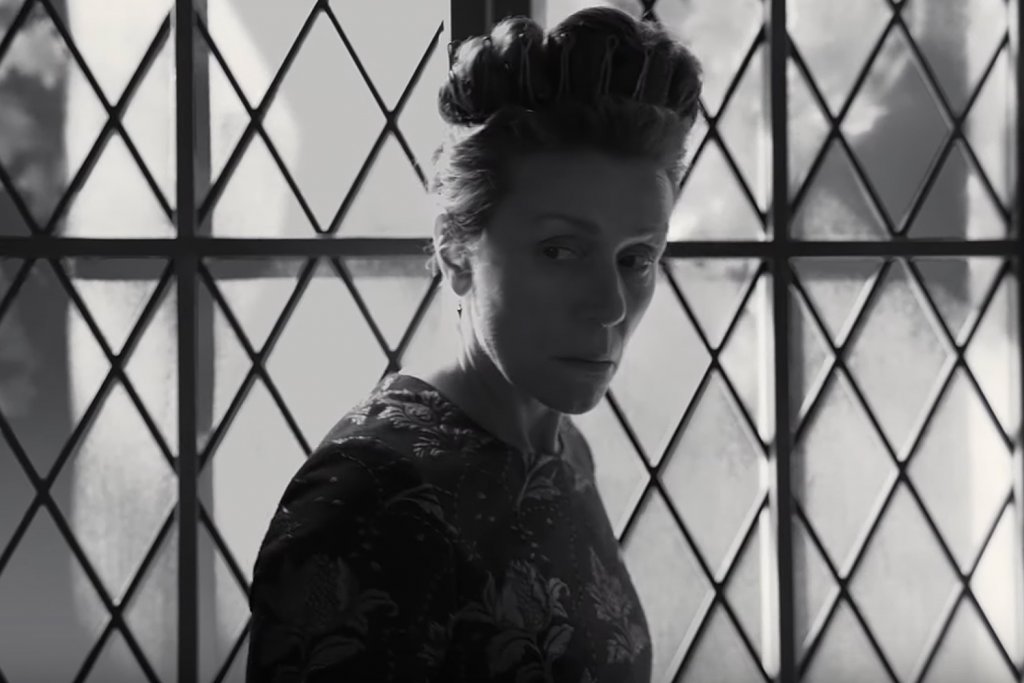
Denzel Washington as Macbeth in The Tragedy of Macbeth 2021 teaser trailer

Joel Coen’s take on Macbeth is a starkly stripped-back adaptation that feels entirely too by the book. Less of a movie than a stage play put to film, The Tragedy of Macbeth might look and sound good, but it struggles to assert why audiences need yet another big-screen take on Shakespeare’s 400-year-old words.

The film’s strength undoubtedly lies in Bruno Delbonnel’s stunning cinematography: sets are uncomfortably empty and cold, the image’s inky black and white is suitably visceral, and the claustrophobic framing locks the viewer in with the actors. Macbeth is certainly stylish, but the same iciness that works so well with its staging unfortunately also creeps into the storytelling.

Frances McDormand as Lady Macbeth in Joel Coen's The Tragedy of Macbeth

Denzel Washington and Frances McDormand give regrettably restrained performances as the weary couple vying for power, depicting little of the hunger, guilt, or ruthlessness that make their characters so compelling. Many of the play’s key moments do not resonate the way they should because of how stiffly Coen moves scenes along – which is a foundational problem when so much of Macbeth’s enduring lies in its frenzied intensity.

Despite its striking aesthetics and the calibre of its cast (not to mention a scene-stealing performance from Kathryn Hunter as the witches), The Tragedy of Macbeth can’t help but feel too tame, too unambitious. Even with every odd stacked in his favour, Coen still decides against taking a big swing. Instead, the solo director helms a handsome but disappointingly passive adaptation that future English students will no doubt turn to in lieu of reading the text.

This review was originally published in STARBURST Issue 476, which you can purchase here. The Tragedy of Macbeth is out now. Check out the trailer.

TITANE

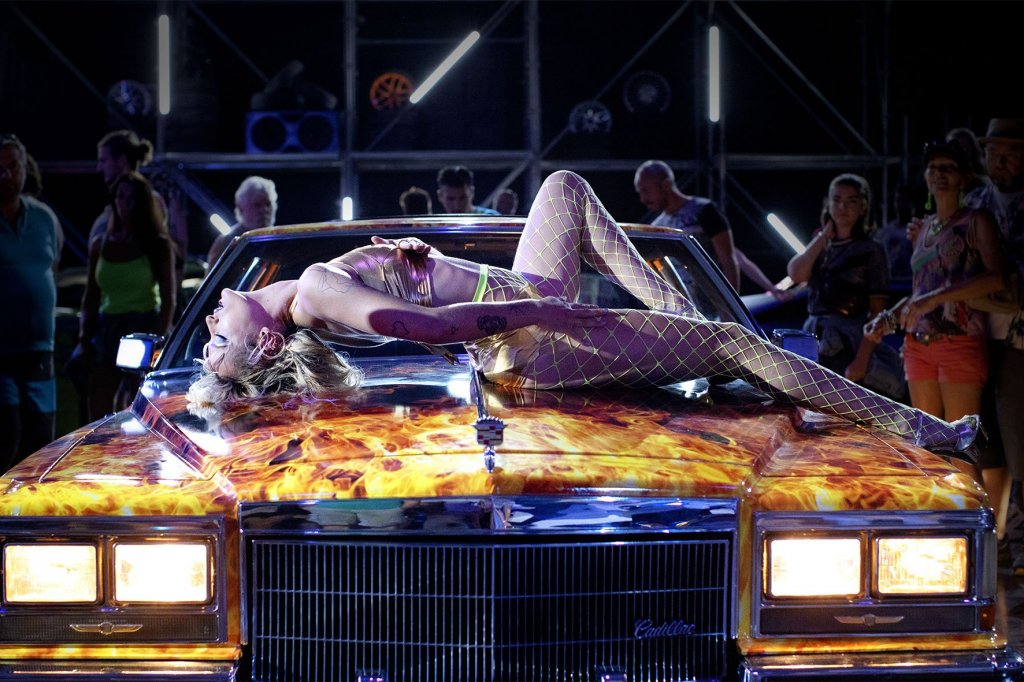
Alexia in Julia Ducournau body horror Titane

You know you’re in for a wild ride when a sociopathic killer having sex with a flame-painted Cadillac and becoming pregnant with a cyborg baby is little more than subplot. Following up her coming-of-age cannibal tale Raw with the Palme D’Or-winning Titane, French writer-director Julia Ducournau this time helms a thoughtful rumination on found family, gender, and sexuality that’s rich in disturbing body horror and violent extremes.

Agatha Rousselle as Alexia in Titane, directed by Julia Ducournau

In childhood, a brutal car accident left Alexia with a titanium plate in her head and a sexual attraction to automobiles. As an adult (now played by a spellbinding Agathe Rousselle, in her feature debut), Alexia is a car show dancer with a deadly penchant for stabbing her hair pin through people’s brains. When authorities take notice after a particularly frenzied spree however, she flees and finds refuge by assuming the identity of firefighter captain Vincent’s (an excellent Vincent Lindon) long-lost son, Adrien. From then on, day after day, Alexia painfully – and increasingly gruesomely – binds her breasts and swelling stomach to become Adrien, the threat of being discovered looming heavily over proceedings.

Titane is a visceral, nauseating, darkly funny and fundamentally touching story that’s deliberately perplexing. Unpacking themes of heteronormativity, homoeroticism, gender constructions, loss of autonomy and our relationships to our own bodies with surprising fluidity, Titane painfully lays everything out in the open and leaves you to contemplate what you’ve seen long after its runtime is up.

This review was originally published in STARBURST Issue 476, which you can purchase here. Titane is out in cinemas now.

THE KINDRED

THE KINDRED

Helen (April Pearson) has awoken from a coma caused by an accident outside her father’s flat. Heavily pregnant, she was knocked down after seeing her dad plummet to his death in front of her. She was lucky enough to have the baby while unconscious, her husband Greg (Blake Harrison) bringing the little girl up until she recovers. Unfortunately, while she was in the hospital, Greg had to sell their house since they fell behind with the mortgage. So he moved them into the flat she grew up in, which is far from ideal. While trying to regain her strength, Helen tries to remember what happened before her dad’s suicide and begins to see the ghosts of children in the flat. Could her father have been a murderer?

With a heavyweight supporting cast such as James Cosmo, Patrick Bergin, and Samantha Bond, you’d think this would be powerful stuff, and for the most part, it is. The subject is traumatic and harrowing, but unfortunately, the handling is a little lacking. Following a strong first act, things resort to cheap jump scares and unlikely plot developments. However, it almost redeems itself with the shocking climax.

Director Jamie Patterson doesn’t seem to want to commit to making a horror movie, and as such, when the shocks come, they are contrived and obvious. The main character’s recovery speed is unbelievable, as is her jump to bringing a psychic investigator into the flat. He’s depicted by Steve Oram, who only adds unwanted and unintentional comedy and is completely out of place with anything else seen before and after.

There’s a good story in The Kindred, but unfortunately, it misses the mark more than it hits.

The Kindred is available in limited theatres and on VOD in the US.

DON’T LOOK UP

don't look up

Adam Mackay’s Don’t Look Up is a disaster movie for the pandemic era, skewering pretty much every extraordinary twist and turn of human nature and human behaviour we’ve witnessed, often in disbelief, across the last couple of years. Two unexceptional astronomers (Leonardo DiCaprio and Jennifer Lawrence) discover a previously uncharted comet just outside the orbit of Jupiter. It’s the size of the Himalayas and it’s on a collision course with Earth. It’s a ‘planet killer’ and it will cause an Extinction Level Event. Under normal cinematic circumstances, we’d call for Bruce Willis and send him up in a  big rocket full of nuclear bombs and then sit back and wait for the slow-motion moment of triumph when humanity is saved following a nail-biting close shave or two. But we’re living in different times and, as we’ve seen lately, people are a little bit more sceptical, a lot more self-obsessed and, sadly, considerably stupider they were back in the simpler days of Armageddon and Deep Impact.

Kate Dibiasky (Lawrence) and Dr Randall Mindy (DiCaprio)  secure an audience at the White House and dutifully trot along with NASA’s Planetary Defence Co-Ordination Office head honcho Dr Teddy Oglethorpe (Rob Morgan) for an audience with President Janie Orlean (Meryl Streep) and her Chief of Staff son Jason (Jonah Hill). Unfortunately, the President and her son are idiots and treat the news with barely-concealed disbelief and disinterest. Dibiasky and Mindy leak the news on a morning talk show but they and their news are treated as a joke and the pair become the butt of increasing online mockery and hostility. No one is interested and no one believes them. Only when the President is involved in a sex scandal does she decide to take action by confirming that the threat is real and launching a project designed to divert the comet with nuclear weapons. But the mission is aborted shortly after launch when oily multi-billionaire tech giant Peter Isherwell (Mark Rylance) reveals that the comet actually contains trillions of dollars worth of rare-earth elements that the US Government can exploit commercially if they follow Isherwood’s scheme to launch weaponised drones into the comet which will break into fragments that can be recovered from the ocean. Needless to say, things don’t quite go according to plan…

Don’t Look Up is a sizzling, coruscating, and biting satire on the modern world and our collective priorities. No one in the motley cast of characters really comes out of this with much credit. DiCaprio’s Dr Mindy has the world’s safety as his priority until he is flattered and seduced by talk show host Brie Evantee (Cate Blanchett) and takes his eye firmly off the apocalyptic ball. A disillusioned Dibiasky, tormented by the fact that White House staff have been charging her and Mindy for refreshments which are actually free, returns home and hooks up with shop-lifting slacker Yule (Timothee Chalamet). The human race itself is divided on the issue of the comet; many believe it will create mass world employment opportunities, others demand that the comet be destroyed, some don’t even believe it exists.  Mindy’s ‘Just Look Up’ campaign to awaken the population to the threat is countered by the President’s ‘Don’t Look Up’ campaign encouraging people to quite literally look the other way.

If this all sounds uncomfortably familiar then congratulations, you have so far survived the Covid pandemic and witnessed the idiocy and stupidity of both those who purport to lead us and those who look to be led. The world, Don’t Look Up warns us, is a conflicted wall of sound and fury, angry people who stand by their own opinions no matter how irrational and dangerous, and people who aren’t fit for purpose or office who are, inevitably, just looking out for themselves and their rich and powerful friends. Don’t Look Up’s humour is simultaneously sharp and blunt; it takes no prisoners and no one on Earth gets a pass. It’s not a film without its flaws, though; it’s perhaps slightly too long and some of the crasser humour misses the mark like… well, a close call from a comet. But strong performances from a superb cast paper over the cracks – Mark Rylance is especially stunning as an obsequious, softly-spoken Elon Musk type, and the finale, which sails right over the top and goes literally into orbit, is as terrifying as the rest of the film has been depressingly on-the-nail. Mid and post-credit scenes are laugh-out-loud funny too. Don’t look up, don’t look down, look straight ahead; don’t miss Don’t Look Up.

Don’t Look Up is available to stream on Netflix.

THE MATRIX RESURRECTIONS

matrix resurrections

No one asked for this. No one wanted this. No one was interested in this. Who’d have thought, then, it would nosedive so spectacularly at the box office? Scott Adams argued that you can never underestimate the stupidity of the general public but on this occasion, it seems that the general public has been one step ahead and dodged a very unwelcome bullet (time). The Matrix Resurrections is a dull, uninvolving, and utterly irrelevant film, derivative of its own history and dozens of films that trailed in its wake and it’s another reason to never even revisit the original, iconic 1999 The Matrix, a film that didn’t even need its two existing lacklustre sequels, let alone this woefully belated and misbegotten fourth effort.

The original Matrix is (was?) a bona fide genre classic. It redefined sci-fi cinema much as Star Wars did over two decades earlier (but in rather different ways). And much as the shine has been buffed away from Star Wars thanks to countless exhausting prequels,  sequels, and spin-offs (it’s now little more than a colourful cash generator) The Matrix has been castrated and neutered by pointless sequels that have merely served to dilute the impact and cultural relevance of the original. Director Lana Wachowski’s hopes of a career resurgence after a string of poorly-received projects appear pretty forlorn in the wake of this saggy, tired, seen-all-this-before twaddle that’s so much a project of another time that it’s actually almost laughable.

There are, however, one or two fleeting flashes of inspiration here. The method by which Thomas Anderson/Neo (Keanu Reeves) is resurrected is fairly clever if a little tortuous (he’s been ‘reborn’ as a computer programmer who has previously created three successful Matrix video games, tasked now by Warner Brothers to create a potentially money-spinning fourth – how meta) and the fight scenes are still kinetic, pacey and well-choreographed. But that’s really pretty much it. The Matrix Revisited would surely have been a better title because this is just a Greatest Hits selection, all those things we liked and admired about The Matrix wheeled out again in a “remember how much you loved this?” style without an ounce of original thinking or any apparent attempt to move the idea forward into the 21st century. Bullet time, check, “I (still) know kung fu”, check, Mr Smith (now played by Jonathan Groff), check. The film also stuffs itself with footage from the earlier films just to remind us – because the public is stupid, right? –  that this is the same series but only serving to remind us that this is just the same old, same old but nothing like as good. Even the decent action scenes are slightly compromised by a lazy innovation whereby Neo can now use the power of his mind (or something) to fling his opponents away by waving his hands in the air at them. The final frenetic motorbike chase sequence is rendered preposterous when Matrix avatars are instructed to throw themselves off roofs where they plunge like sacks of potatoes into the road as hundreds of others pour into the street in pursuit like extras in a cheap zombie movie.

The plot is absurd and largely impenetrable, the visuals just a rehash of a visual style we’ve seen before and any superficial pleasure we might get from seeing Reeves as Neo and Carrie-Anne Moss return as Trinity (and a slightly larger-than-life turn from Neil Patrick Harris as The Analyst, creator of the new iteration of the Matrix) are quickly snuffed out as the film smothers us in a tidal wave of its own smug self-satisfaction and the mistaken belief that we’ll welcome this stuff back into our lives like some long-lost old friend. The Matrix Resurrections doesn’t even try to be metaphysical or pseudo-intellectual, it’s just content to regurgitate a concept quite happily and adequately explored 22 years ago but with absolutely nothing new to offer either narratively or visually. Frustrating, futile, and foolish, The Matrix Resurrections is largely utter guff.

The Matrix Resurrections is in cinemas now.