Warhammer 40,000 : Terrain Area Set

Terrain is a key element in the latest edition of the Warhammer 40,000 game, so much so that the wise folk at Games Workshop have produced all sorts of exciting terrain options for folk to have fun with.

Terrain is a tricky thing to manage; ruins, burnt out vehicles, statues, forests and the like for your toy soldiers to fight over are an essential part of most war games. But that also makes them pretty chunky sort of things; if you’ve got limited storage space or have a house so full of stuff that you have to play games elsewhere, moving these things about can be a challenge.

The wargaming industry has come up with all sorts of solutions in the past, from pop up books to just using any old stuff you have lying around. GW loves to give you options, and they do have plenty of old-fashioned plastic terrain pieces, as well as various guides on how to make the stuff. Their latest solution it the Terrain Area Set, a cardboard envelope with sixteen full colour, double sided cardboard tiles.

They lie flat and essentially have ruins printed on them. Because the new game has very specific terrain rules, these work fine. And they also function as beer coasters of sorts for actual terrain that you may want to use without scuffing up your nice table.

It’s a nice, if odd idea, and our main take away is that the folder they come in opens from the bottom and doesn’t really re-seal, meaning that you’ll end up finding a new place to store them. Or using they as fancy mats for your drinks. Odd, but useful, and we do wonder why they weren’t in the excellent Armageddon box.

stars

LEGO ICONS STAR TREK: USS ENTERPRISE NCC-1701-D

For decades now, hard-up Trekkies fans have had to resort to off-brand LEGO copycats and Temu knock-off merchants to get their fix of what Star Wars fans have taken for granted. Star Trek fans rejoice! Starfleet is finally invading a space that was hitherto reserved only for the Millennium Falcon, Death Star and every other imaginable Star Wars vehicle one might care to translate into brick. Well, why should they get all the fun?

And what a debut this is! When it came to picking their Star Trek launch, LEGO didn’t have an easy choice of it. While the spaceships of Star Wars are utilitarian, industrial vehicles which lend themselves well to brick construction, those of Trek tend to be curvier, top (or front) heavy, and altogether more sleek.

In this case, LEGO have gone with the natural candidate – the U.S.S. Enterprise NCC-1701-D.
The design

This set faithfully recreates the look of the Big D in all of its bulky, bloated glory. That’s a lot of grey, but it’s broken up with smaller gold sections and flashes of orange, red and blue – particularly in the dynamic and vibrant deflector dish, and colourful warp nacelles. The many (many) windows haven’t been entirely forgotten about either, featuring in a curved section which protrudes around the dish (all unlit, in this case).

Said saucer section is more angular than one might have perhaps hoped for, rather than being the purely rounded dish of the television series. Still, such is the nature of LEGO, so it’s hard to begrudge the Enterprise a few extra angles or an overly studded texture, especially when it comes to how impressive the finished product looks.

With its chunky body and stubbier neck, the D tends to lend itself better to LEGO than say, Kirk’s original Enterprise would have, boasting a thick neck, muscular pair of nacelle pylons and a broad, load-bearing underbelly.

It’s the most logical choice, balancing an iconic design with a build that’s not going to fall apart due to a fragile support system. Well, it was either that or a Borg Cube.

Sure, the whole thing looks as though it might fall apart in one’s hands, but it’s unexpectedly sturdy – provided you hold it in all the right places. Thankfully, the instruction manual also comes with advice on where and how to hold it when you’re swinging it about the house, just like the opening credits of the show. Is there anything they haven’t thought of?

This, in turn, comes accompanied with a display stand from which the vessel can be admired from all angles. And what a lot of angles there are.

The build

Make no mistake (no, really, don’t, lest you want to start all over again when you realise the dish isn’t connecting to the lower body), the Enterprise is one of LEGO’s most intimidating builds to date.

There’s 31 bags of it, spread across two boxes and just as many hefty manuals, which translates to 8-12 hours of building… provided there are no structural errors made early on.

There are no shortcuts here. It’s a gruelling build, especially during the later stages of the saucer section, in which everything starts clicking into place, piece by piece. Trek ships tend toward the symmetrical, so there’s little variety when it comes to constructing the hefty saucer plate. This has been segmented into eight smaller sections, each taking roughly 20 minutes apiece.

It’s finicky, often frustrating work (the deflector dish provoked a couple of temper tantrums), but rewarding when it does come together.

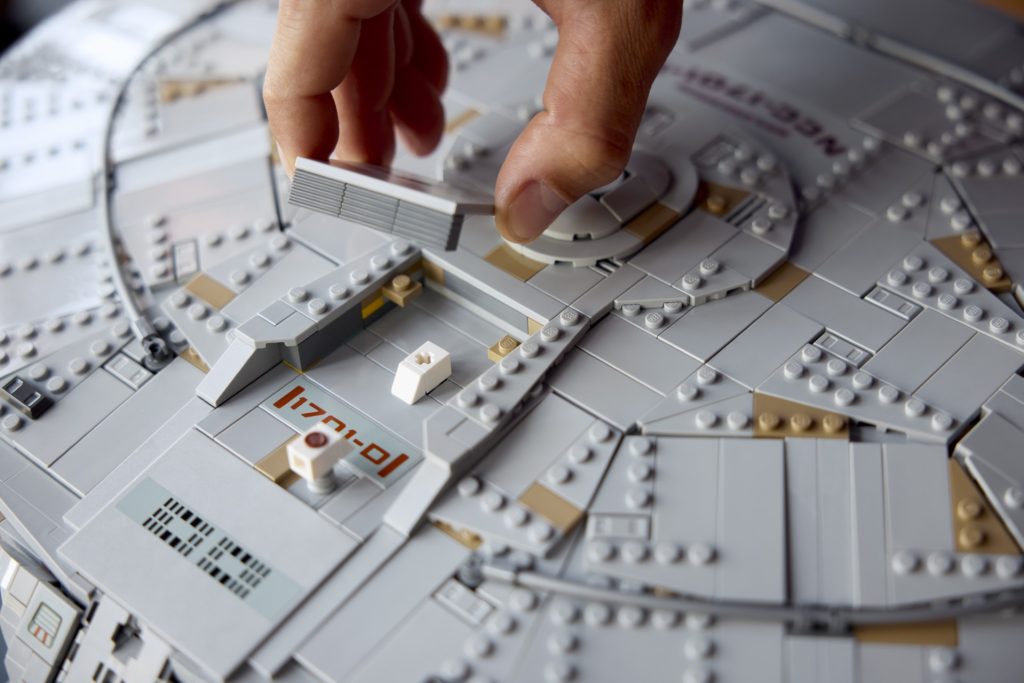
A selection of stickers gives the Enterprise its decorative elements.  Like everything else, the stickers are small and finnicky, and often difficult to line up right on the smaller pieces. Thank heavens for the pre-printed piece on the top of the dish, then, ensuring that the Enterprise’s designation will stand out regardless of how chubby or shaky the fingers applying the rest of the stickers.
Extras

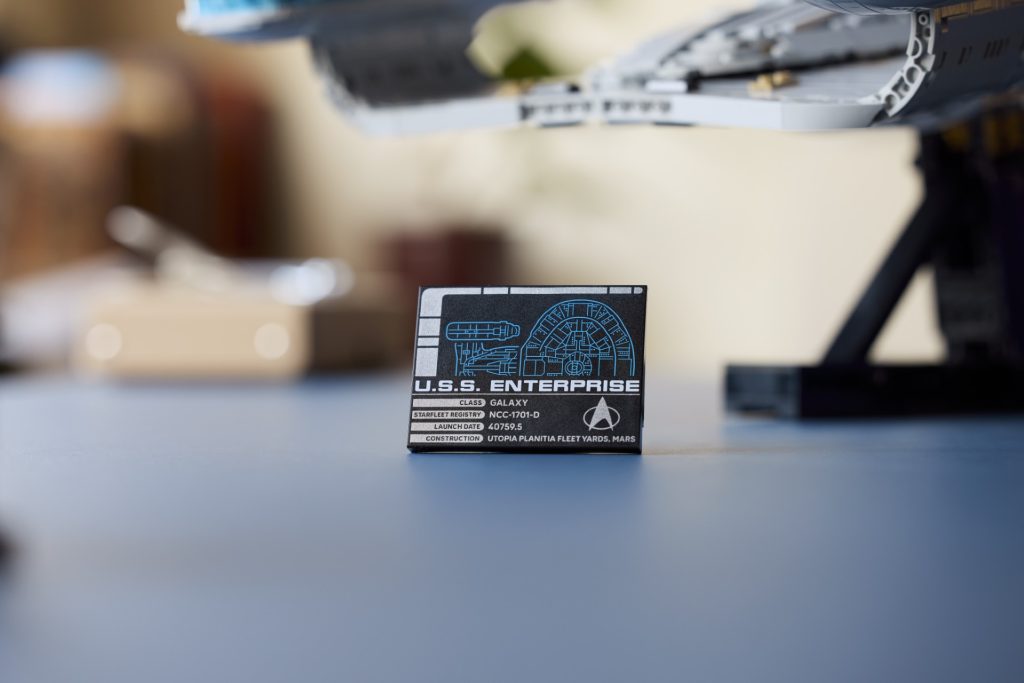
The Enterprise D comes loaded with little features and Easter Eggs to help justify the hefty price tag. Not least a fully detachable saucer section, thereby ensuring that all the hard work completed on its underside doesn’t go to waste. Hidden inside the build is even a gold dedication plaque and even a scale-accurate (and one load-bearing) shuttlepod.

While the box (both of them) doesn’t take advantage of The Next Generation’s iconic graphics, the books inside (both of them) do, making up for the lack of it elsewhere on the packaging.

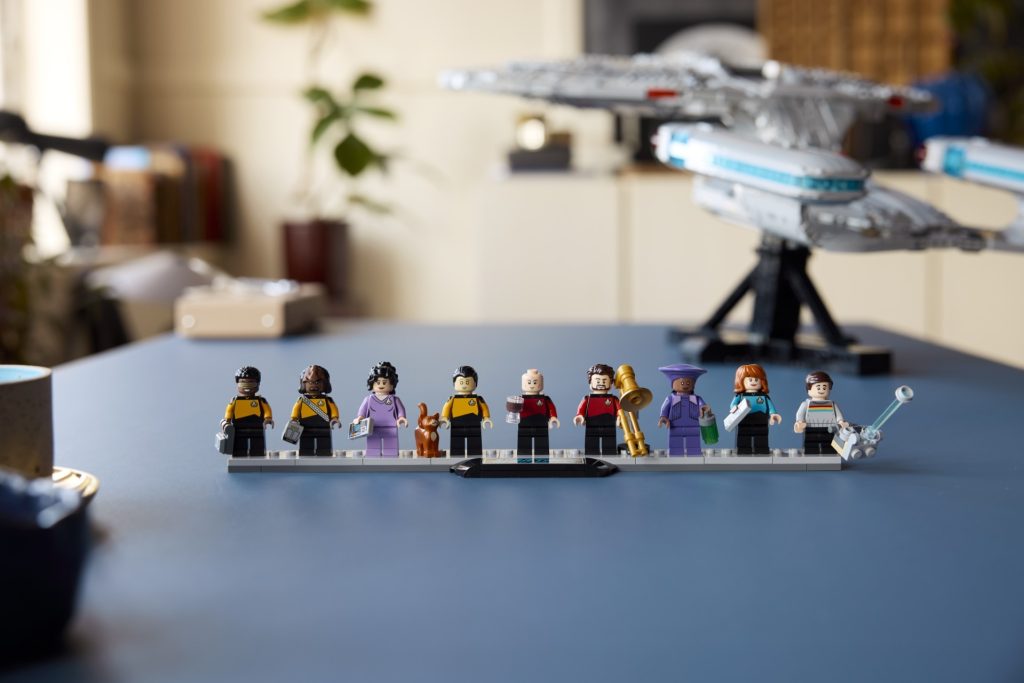
Almost single-handedly justifying the purchase is the selection of minifigures which accompanies the set. Consisting of Captain Picard, Riker and the core bridge crew, this nine-figure strong collection encompasses almost every main cast member from the television series – including even Wesley Crusher and Guinan. Featuring reversible facial expressions, each is a good likeness, and instantly recognisable as the Star Trek icon they are.

These, in turn, are accompanied with charming nods to Next Generation lore; Riker’s trombone, Spot the cat, and a cup of tea (earl grey, black) for Captain Picard. Sure, a Q minifigure wouldn’t have gone amiss, but it’s hard to fault the nine core cast members who have been chosen (your opinion on Wesley Crusher may vary).
Verdict

The Enterprise D is one of the most gorgeous LEGO sets ever created, both in its fidelity to the source material and in its structural integrity. That said, it’s not for the faint of heart, nor the clumsy of finger. There are perhaps easier ways of spending the best part of £350 that won’t have you screaming in frustration like Captain Picard in Chain of Command: Part II. But for the unintimidated, it’s a worthwhile and rewarding investment.

In bringing Star Trek to the world of LEGO, the NCC-1701-D successfully goes where no set has ever gone before… although you might not ever want to go there again after spending all day putting together that saucer section.

A glorious addition to any self-respecting fleet of model ships. Make it, so.

The Starship Enterprise NCC-1701-D is on sale from LEGO now.

BY THE THROAT [FrightFest Glasgow 2025]

Still traumatised after a vicious attack upon her person, Lizzy (Sex Education star Patricia Allison) takes on a job at a remote country house, acting as housekeeper and carer for a grieving married couple. As Alex (Rupert Young) heads off on a business trip, Lizzy is left all alone with his wife, the shell-shocked Amy (Jeany Spark). Caught up in the machinations of a family who clearly have something awful planned (get out, Lizzy!) she soon comes to realise that there’s more going on here than a mere wine mom gone wild.

Directed by David Luke Rees from a screenplay co-written by Madelaine Isaac, By The Throat is a tense work of psychological horror, drawing on elements of folk horror in its genre flourishes. Between the obvious portents of terror to come (pagan totems under the bed? Seriously – just get out!) and Lizzie’s harrowing flashbacks to her assault, it turns the charming Cummings household into a claustrophobic nightmare. Intimate, up-close-and-personal cinematography by Aaron Adrian Rogers heightens the unsettling atmosphere while disguising the budgetary limitations – even if it can be a bit too dark sometimes.

Supporting performances are a little stiff, but leading woman Allison gives a compelling portrait of polite awkwardness and anxiety in the face of white middle-class creepiness. If its story lacks originality, Rees and Isaac are mostly successful in keeping their audience guessing as to what the Cummings are hiding – if they’re hiding anything at all. Is Lizzy really about to fall victim to some kind of monstrous ritual, or is might she be tormented by demons from her own past made real? That’s all spoiled by an underwhelming, too busy finale, but the film’s ominous vibes were nice while they lasted.

Neither mystery nor style are quite strong enough for a complete stranglehold on the senses, but By The Throat is a quietly unnerving work of weird white people horror.

BY THE THROAT premiered at FrightFest Glasgow on March 7th, 2025.

stars

DUNGEONS & DRAGONS – PUNCHEONS AND FLAGONS

Dungeons & Dragons is a game played by folk of all ages from all walks of life, with all sorts of different tastes, but one of the things we all have in common is that we have to eat and drink. We’ve raved in the past about the excellent Heroes Feast and its companion, Flavors of the Multiverse, which are both excellent in-universe cookbooks.

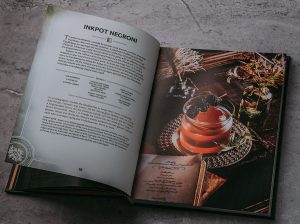
Puncheons and Flagons is the obvious sequel to those books; another cookbook, but this time focusing solely on drinks (both alcoholic and non-alcoholic).  The idea here is that you can make these for fun or also as part of a game. A well-served drink mid-game can lock a person’s senses into the game, creating a more memorable experience. 

Like the previous works, it’s robust and well put together and intended to cope with the odd spill or two (though it is by no means waterproof). It’s crammed with gorgeous food photographs, which are mostly there to serve as inspiration for your own creations.  It also has some reasonably sensible guidance for mixing drinks, with the basics of what you need covered in a home bar. (It does not go into anything advanced; this is a list of fun, fantasy cocktail recipes, not a bartending manual.) 

Each chapter ties into a specific tavern and location from The Forgotten Realms. We were delighted to discover that Candlekeep, famous for its scholars, has its own special bar. That said, it apparently stocks a lot of gin, which makes sense, given the haunted nature of some of the books in Candlekeep. The recipes are divided mostly by spirit, so the Pink Flumph Theater in Waterdeep is full of vodka-based drinks that have a ‘pink’ vibe to them, The Yawning Portal drinks are ale-based and so on. (These are all fantasy bars from The Forgotten Realms; if you want a real-world geek bar, try the Fab Cafe in Manchester.)

We particularly enjoyed the thematically clever ‘Eye of The Beholder’ drink, even though it’s a little heavy on lychee to provide to the eyeballs, and of course, there is a drink called Hellish Rebuke. It’s got quite a kick.

Puncheons & Flagons: The Official Dungeons & Dragons Cocktail Book is stuffed full of fun ideas and variations on familiar themes. And yes, there is a mocktail section (though most of the recipes could be made into mocktails with a little effort).  It is absolutely not for kids; it’s instead a fun cocktail with some crazy ideas, both for entertaining guests and to squeeze into your games of D&D. Fun.

HEROES’ FEAST: THE DECK OF MANY MORSELS

The Dungeons & Dragons cookbook, Heroes Feast, was so successful that it spawned two sequels (Flavors of the Multiverse and Puncheons and Flagons). It also spawned a very popular TV show that no one saw because it was on Plex, which is a shame because it looks like a lot of fun.

The reason this worked, of course, is that everyone needs to eat, even fantasy creatures. Gathering around the table to eat is a thing that folk do all the time. D&D fans will also gather around the table to play D&D. And then eat. Sometimes, at the same time as playing D&D, the genius behind the D&D cookbooks is that they add enough fantasy flair to each recipe while also providing solid recipes that aren’t difficult to make and are very nice to eat.

And yes, that means you can play D&D whilst eating food that’s also part of the game, which is 100% a fun thing to do. Heroes’ Feast: The Deck of Many Morsels makes the idea of cooking these recipes a little less daunting by slamming 50 of the recipes onto cards. These are reasonably wider than Tarot card-sized affairs, with a beautifully photographed example of the food on the front and a decent summary of the recipe on the back.

The cards are sturdy and will survive a mild spill as any other card would. The recipes mainly focus on snacks, sweets, drinks, and the like, as well as light tavern food, which will look nice on the gaming table and get hoovered up by the players. It doesn’t simply take a cheese board and rename it as an Underdark Forage Board; it literally adds fresh ideas so such a thing actually works as both as an in-game prop and a recognisable snack. Though yes, you will be able to recognise what a  Halfling Tea Sandwich is.

The cards also have a dual purpose; Dungeon Masters can have this deck on hand to illustrate to players what their characters are eating. It’s the sort of trick you’d expect to find in a Beadle And Grimm’s goodie box, a quick and clever way to help you imagine events in a game.

Overall, a brilliant addition to a Dungeon Master’s arsenal, and a wonderful way to (literally) add spice to the gaming table.

DUNGEONS & DRAGONS Mimic Treasure Chest Notebook Set

Custom stationery is always a bit of a statement. Businesses have died or thrived on the quality of their business cards after all, and more than one battle has been fought over a red stapler.  Fans of tabletop roleplaying games, especially old-school gamers, know all too well how important it is to have all your pencils at the ready and your notebooks, pencils and dice organised.

The Dungeons & Dragons Mimic Treasure Chest Notebook Set is the sort of quirky stationary choice for the sort of person who absolutely needs the right tools for the job but also wants to look cool doing so. This is a small box with five 4 x 6-inch blank notebooks inside, plus a little ‘tuck box’ space to store dice or some small pencils. It’s essentially a novelty gift for fans of TTRPGs, specifically D&D.

Of course, this makes it compatible with every edition out there because it’s just stationary, and there’s not a single version of D&D that doesn’t require something to take notes, and the various Dungeon Masters who lurk within STARBURST’S Secret Gaming Thunder Dome all agree that you should take notes and draw maps, even if the entire adventure just takes place in a tavern.

The box itself is quite nice and very sturdy. It’s obviously intended to be a mimic, those treasure chest-shaped monsters that exist to lure in the unwary.  You’ll need to peel off the ‘lock’ label to open it, and this does not re-attach. In a nice touch, when you peel off the ‘barcode and sales’ sticker in the back, we find a fun depiction of what happened to the mimic’s last victim.

Inside, we get a little ‘tuck box’, which is illustrated to look like a mimic’s tongue.  It’s specifically here to be open and used to protect your dice, etc.

The main event is the five notepads; the first two, labelled Owlbear and Lich, are lined notepads. The third, Displacer Beast, has dotted grids, and the last two, Black Dragon and Beholder, have lined grids. Each notepad is illustrated with the relevant monster, the images taken from other D&D books.

These are enough supplies for several campaigns, and the box looks sturdy enough to survive bouncing around in your bag of holding for a few years of play.

A fun, useful novelty item.

stars

WARHAMMER 40,000: DARKTIDE – THE MINIATURES GAME

At this point, the Warhammer 40,000 franchise is about as well known for its video games as it is for its board games and miniatures. So much so, in fact, that board games based on their video games are now a thing, rather than the other wall around. Darktide: The Miniature Game is based on the 2022 co-op first-person action PC & Xbox game of the same name, and it’s a rather good deal, both in terms of models in the box and the game itself.

The game focuses on a team of Imperial Operatives who are tasked with dealing with a supernatural cult infesting a hive world (a sort of planet-wide megalopolis). Or, to put it another way, cool-looking grim-dark heroes vs zombie-like monsters and mad cultists.

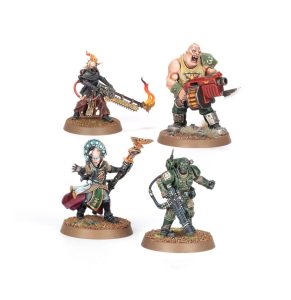
In the box, we get four character models: a Pysker (basically a sci-fi wizard), an Ogryn (a big lad with a big gun), a Zealot (a robed character with a flame thrower) and a Veteran ( a heavily equipped soldier).  We also get six pox-walkers (who look like super-gross walking dead) and ten traitor guardsmen who look more like well-equipped wasteland warriors than ex-soldiers. None of these models are unique to this set; fans of the excellent Warhammer Quest games will recognise most of them. These are good models; fun to put together and paint.


The rules are a lot of fun; it’s essentially a scaled-down, introductory version of the excellent Kill Team skirmish game.  There are some very interesting changes; rather than it being a two-player game where one side is the Imperial operatives and the other is chaos, you instead pick an operative, and the game itself automates the enemy. This keeps it more like the video game, but still keeps the fun to play, tactical side still relevant.

The majority of the mechanics take place via various decks of cards. For example, if you’re playing the Ogryn, you have a card with his rules on it and separate cards for his weapons and abilities. Another deck of cards tells you when the monsters move, what they can do, and so on.  Once set up (which takes a few minutes), the game runs pretty smoothly.

One gripe is the lack of actual terrain; we just get a nicely detailed board and some counters. This makes the game a bit more portable, but for all the plastic in the box, it would have been nice to have some barrels or rubble.

Darktide: The Miniature Game is easily the best tie-in game to turn up for review at Starburst Towers this year. It stood out amongst the crowd, not only for its  They could have taken the easy route and gone for a similar design as Space Marine: The Board Game,  turning it into a simple intro to their flagship Warhammer 40,000 miniatures war game. Instead, they’ve taken the time to create something unique (though still based on an existing rules set that they know works.) The models can also be used in Kill Team games, or for other Warhammer 40K games, if your so inclined.

This is one to add to the Christmas list, even if it’s a treat for yourself, and is currently only availble via the Games Workshop Website.  

WARHAMMER AGE OF SIGMAR: SPEARHEAD – FIRE AND JADE

Fire and Jade is the first supplement for the fourth edition of Warhammer: Age of Sigmar, and it introduces a new way to play Warhammer called Spearhead.  The book comes as part of the excellent Skaventide box, and that set contains everything you’d need to play this mode (including sample armies).

The core idea behind this mode of play is that you pick a pre-determined army, make some light tactical choices at the start of play, and then begin. The scenery and the board itself are also proscribed by the game, so the result is a ‘potted’ version of a fantasy skirmish wargame.

This might rankle older players, but it’s actually quite a nice idea because it tightens gameplay to about an hour, and that includes the usual faff, such as setting up the board and repeatedly moving the cat off the gaming table.

The Skaventide box has enough models for two of these forces, the Vigilant Brotherhood for the Stormcast Eternals and the Gnawfeast Clawpack for the Skaven, and the book contains rules for both of these. It also has rules for pretty much every faction in the game so far, and if you don’t have the units you need, Spearheaded-branded boxed sets are available from your friendly local game store.

The game itself is pretty tight. The game is points scoring; you gain points by achieving set goals, and the tactical advantages you select at the start of the game effectively cost you points. So when you use your secret weapon, you’d better hope it’s worth it. This provides depth you wouldn’t normally expect.

STARBURST received both physical and digital versions of the book from Games Workshop for review, and we found the physical book well made and thought through, clearly designed by someone who’s dropped a heavy book off a gaming table more than once. The digital version we looked at was also fine and worked on a normal tablet device with no issue.

This new game makes us wonder what the future has in store for Warcry, a very similar skirmish game set in the Age of Sigmar. Sure Warcry is more unit-focused, lengthy and intense, but over in STARBURST’s Secret Gaming Thunderdome we were looking at out big box of Warcry stuff wondering if we could adapt it for Spearhead play instead.

Spearhead isn’t a new idea, and it isn’t radical, but it does open up the game for more people; new players have an easier access point, and older players will find it easier to get a game in. Overall, it is a worthwhile move for Age of Sigmar.

WARHAMMER AGE OF SIGMAR: SKAVENTIDE

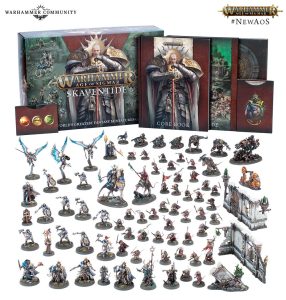
We got pretty excited when Games Workshop’s latest ‘big box of models and rules’ arrived at STARBURST Towers. Skaventide is the ‘launch box’ for the new edition of Warhammer: Age of Sigmar, Games Workshop’s gritty high fantasy setting. It’s a very heavy box packed with all the stuff fantasy wargamers need.

Much like their previous big launch, Leviathan, this is not a starter set – you won’t find dice here, though there are some fancy range rulers. It does have a big rule book and a big scenario guide (more on those later).  It is a big box of models and rules that will get you started on the new edition.

We get a lot of very well-designed plastic models (and some plastic scenery) in two factions: Stormcast Eternals and Skaven. There are over seventy models (mostly Skaven) and some terrain bits. We also get a double-sided board that will fit on most tables.

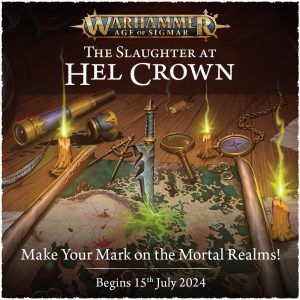
Oh, and there’s also a little bit of paper in the box with a QR code; the idea is that you play your first battle and let Games Workshop know who won; this is part of a campaign called The Slaughter at Hel Crown, which doubles as a giveaway to get more models from GW. We predict the Skaven will win. Based on no evidence, just vibes.

The Stormcast Eternals are near-super human elites. These sorts of factions are always very popular;  in game, they pack a lot of punch for a low model count and tend to be very intricate, interesting sculpts. Setting-wise, they’re appropriately dark (it is Warhammer). They’re meant to be these shining eternal warriors, constantly rising, phoenix-like, to defend the weak. In reality, every time they come back, they become a bit less human, making them questionable heroes.

Starburst had a couple of ‘hang out and hobby’ sessions whilst putting the Stormcast models together, and the low model count means you really spent a lot of time making them look pretty. The front-line troops (called Liberators) are the right mix of detailed and straightforward, fun to look at and paint. Next up are the winged Prosecutors.  Aerial units can be fiddly, but they’ve thought of that.  We also get a unit of Reclusians, near robotic, heavily armoured knights who came with a couple of fun pieces called Memorians; these are basically monks who serve to remind the knights that they are still, technically, human.

It wouldn’t be a Stormcast team without some stunning character models. The Knight-Questor looks like they’ve stepped straight out of some Fangorn artwork, teeth gritted, torch in hand. The Lord Veritant (and pets) is a blindfolded knight wielding a flaming sword and brazier, striking a pose. Similarly, the ‘person with a huge axe’ is Lord Terminos, who also has a very Gothic look. Finally, this faction ‘tank’ is the Lord Vigilant, a big knight on a huge, Gryphon-like beast.  It’s a gorgeous model that’s honestly a little intimidating to paint.  

The bulk of the models in the box are Skaven, an inhuman horde of Rat-like humanoids that are one of Games Workshop’s most iconic villains. The idea behind these horrors is unchanged from previous iterations of Warhammer’s fantasy offering. They are horde-like, plague-ridden, self-serving monsters that lurk underground and then pop up in full force to loot and destroy anything that isn’t Skaven.

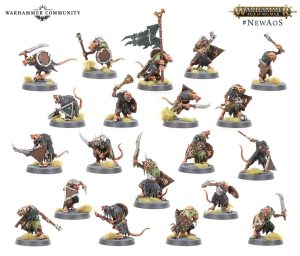
These models are a little trickier; they’re organic, furry monsters rather than shiny knights, but they’re so much fun. The bulk of the models are Clanrats. Dressed in rags and wielding the most wicked-looking weapon they can scavenge, these horrible little monsters are evocative of a high fantasy setting and are just a joy to clip together.

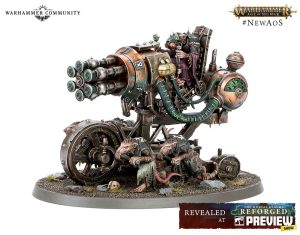
We also get three sets of Warplock Jezzails; these are rat-men with fantasy rifles. There are two creature teams, and they look great, though you do feel a little sorry for the Skaven who isn’t holding the gun; that must be a high-risk job. Speaking of guns, we also get a Ratling Warpblaster, a big steampunk-style cannon piece inspired by cannons, Gatling guns and someone’s worst nightmares. Gorgeous piece with simplified lines for both storage and modelling reasons.

There are three Rat Ogors, ogre-like rat men, who again have a crude arcano-tech vibe to them. Of all the models in the set, these have the biggest scope for conversions. We, of course, get some generals: a rat-wizard Grey Seer, which is one of the best versions of this particular character we’ve ever seen, and a Warlock Engineer, who looks like he’s about to charge someone a lot of money to repair something expensive. Finally, we get Clawlord on Gnaw-beast, a mounted commander who’s the ’counter’ to the Lord Vigilant.

The Skaven are, bluntly, worth the cost of the box. They’re fabulous.

The models slot together fairly easily, but it’s worth putting in the extra effort when assembling. You’re not expected to own basic modelling tools, but they’re easy to pick up if you don’t have a modelling knife, file, and clippers. (Don’t make the mistake of using a manicure set, as one of the STARBURST team did in their youth; you’ll ruin the nail file.)  The instructions are detailed, and the options are broad, but Games Workshop has spent the time to make sure that most people can put these together without having to worry about precision glueing tiny objects onto tiny people.

Rules-wise, we’ll take a proper look at them (and the campaign supplement, Fire & Jade) in another review, but the short version is that they’re very good, and this version of the game makes it easier than ever before to get into Warhammer. This is the sort of box that, if you gave it to a geeky teenager, they’d probably be playing Warhammer for the rest of their life.

This is the best Age of Sigmar box we’ve seen, and if you haven’t gotten into this gloriously dark fantasy setting, maybe it’s time you did. We strongly advise you to pre-order, which you can do here. 

stars

WARHAMMER 40K DEATHWING ASSAULT BOX

Dark Angel Deathwing Knight Warhammer

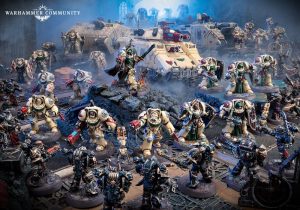
Warhammer 40,000’s signature faction are the various types of Space Marine, a rich blend of medieval knight, male power fantasy, super-soldier and colonial dread that comes in many flavours. Arguably, the crunchiest of these are the Dark Angels, the secretive and heavily storied chapter that draws upon Dark Ages fantasy stories such as the Arthurian cycle. The Deathwing are their greatest heroes, super heavily armoured warriors in incredibly thick Terminator armour, carrying weapons that only a super-human could wield.

It’s very silly. It’s very Warhammer.

STARBURST was sent a copy of the Warhammer 40K Deathwing Assault set for review, and it’s a delightful, pretty thing. This is a thing of joy, from the lavishly illustrated box to the well-considered contents.

The set contains the new Dark Angels Codex (the rules and setting book for the faction), as well as cards, transfers and a whole load of miniatures for you to assemble and paint yourself. 16 Dark Angels, plus three ‘teleport homers’ and three ‘watchers’, little monk-like munchkin creatures that add to the ‘dark ages, but in space’ feel of the set.

The Codex is of the usual solid quality we expect from Games Workshop. Crammed full of lore, story ideas and painting guides, the idea here is that you open it up to be inspired to create and paint your ideal Dark Angels army. They are also ‘quest’ style campaigns for you to run that are very heavy on the lore.

Deathwing Warhammer

Certainly, with the models from the Deathwing set, you could generate a fun army list. Interesting rules include ‘Vowed Target’, basically a bonus to dice rolls for telegraphing your plans to your opponent, and plenty of options to play a super-tough, relentless style game. If going fast and hitting hard is your preferred option, there are some ‘deep strike’ teleportation options and rules covering the Ravenwing (that’s Knights on combat motorbikes. Fun. But silly.)

The models themselves are exceptionally well done. We get a mix of Knights and Terminator models, both of which are chunky space warriors. Not only are they highly detailed, but the set also comes with lots of options for hobbyists to play with. These models have a very specific theme, they’re still easy (and fun) to convert if that’s your thing. There are also plenty of good weapons options, which is nice.

The box pairs nicely with the Leviathan set. There is plenty of crossover with the Space Marine models and lots of modelling options. 

Overall, the set is very pleasing. Not only are the models nice, they’re not too challenging to assemble. The rule book is crammed with illustrations, ideas and, more importantly, fun ways to play Warhammer 40,000. You’ll find these interesting to paint and, when done, rewarding to play with. We have high hopes that future releases will follow in this vein.

stars