THE GIANT CLAW (1957) / THE WEREWOLF (1956)

giant claw

A pair of creaky classics from producer Sam Katzman and director Fred F. Sears (best known for Earth vs the Flying Saucers) have been put together on this release from Australia’s Umbrella Entertainment.

The Giant Claw is a legendary movie – not particularly for the right reasons. Audiences have been drawn to it ‘ironically’ to laugh at the ridiculous bird, which resembles a flying turkey with visible wires and accompanying high pitch screech. However, behind the giggles, there’s a decent sci-fi creature feature here. Sure, it follows all the clichéd beats but it’s a lot of fun.

The plot involves a series of ‘unidentified’ sightings of a fast-moving flying object from aircrews but nothing is registering on the radar. When the suits discover the cause is actually a massive bird it’s almost too late as the creature circles the air looking for its next meal.

The Werewolf is a much more proficient picture. The titular character here is an amnesiac man who has appeared in a small town unaware of how he got there. When he’s robbed outside a bar, though, he transforms into a hairy, snarling beast. What follows could be a generic manhunt story, but it’s spiced up here by having the lycanthrope be the result of a pair of experimenting doctors. As well as the local sheriff and his crew, these two docs also want to find the man-beast, but only to cover up their actions.

The Werewolf plays like an extended episode of The Twilight Zone and is just as enjoyable. Steven Ritch portrays the sorry soul brilliantly; his tortured new existence painted on his face along with a lot of yak hair. The creature itself owes more to Matt Willis’ Andreas in The Return of the Vampire (1943) than Lon Chaney Jr’s Wolf Man and the transformation is still show as dissolves. The film should be much better known than it is as it’s an effective shocker with a lot of heart.

Unfortunately, this two-film set doesn’t come with any supplementary material and both films are on one disc, but they are presented in perfect condition. The black and white photography likely looking better than it did on release. A great chance to reappraise a pair of maligned classics.


PTU (2003) [MASTERS OF CINEMA EDITION]

ptu

Eureka’s latest Blu-ray release is a fun little thriller, with Hong Kong itself acting as the protagonist. It does suffer from a frequent issue with Hong Kong cinema however, a confusing tone leaving the audience bewildered at times.

The heavy smoking Sergeant Lo Sa (wonderfully portrayed by the portly Lam Suet) loses his gun after a triad member is stabbed to death. Sgt Mike Ho (Simon Yam) who is patrolling with the PTU (Police Tactical Unit) of the title, convinces his deputy not to report it, deciding to help find the gun before sunrise. The setup is a fantastic one, and as mentioned, Hong Kong is displayed as an urban jungle, full of sweat, neon, and vice. What is jarring is the sudden mix between thriller (Simon Yam making a suspect rub his tattoo until it bleeds, while slapping him is particularly unsettling) and the tomfoolery of Lam Suet. Even more mismatched is the PTU discovering abused sex workers in an abandoned building to an upbeat soundtrack, more at home in a comedy farce.

The disc features interviews with director Johnnie To, Simon Yam, and actress Maggie Siu – To showing his appreciation for ambiguity. It is rounded off with a serviceable commentary by Asian film expert Frank Djeng. There is an English dub option, but you would be mad not to opt for the Cantonese original, which only exemplifies the film’s hectic nature. There is a lot to like in PTU – the plot, setting, and actors all point to an amazing ride. Even though it’s still a satisfying adventure, you just feel with a settled rhythm, it could have been fantastic

.

THE HOUSE ON SORORITY ROW (1982)

house sorority row

Continuing US label MVD’s Rewind Collection, which is resurrecting films from the golden age of the video store, the original 1982 version of The House of Sorority Row is a welcome release.

It’s the end of the school year for Theta Pi house, but unlike all the other fraternity houses, they must vacate the building on June 19th, missing out on a weekend of partying. The girls have other ideas, though, and plan to defy housemother Mrs Slater (Lois Kelso Hunt) and throw a wingding anyway. The perfect thing to put her in her place: a prank. Involving a gun. Near a festering swimming pool. What could possibly go wrong? You guessed it and the girls spend the party trying to hide the body and being killed.

The House on Sorority Row follows the standard high school girls in peril formula that has been the norm since Bob Clark’s Black Christmas (1974) and features many of the clichés that are standard horror fare now. While the gore is minimal compared to its contemporaries (the head in the toilet gag is the most impressive), writer/director Mark Rosman (who would later go on to helm A Cinderella Story) ramps up the tension and makes even the most predictable scare work.

The MVD Rewind release features a great selection of special features, most ported over from previous releases, but fascinating nonetheless. We find out the film had a less-than-shoestring budget, which makes the finished product all the more impressive. It might not be a stone-cold classic, but it’s certainly a fun slasher that reeks of the ‘80s.

THE BABADOOK – LIMITED EDITION 4K SET

babadook

Released in 2014, Jennifer Kent’s Australian psychological horror film The Babadook became an instant genre classic, the thinking person’s horror film. Kent’s unnerving story is as much a coruscating exploration of grief and denial as it is a story about nameless, creeping dread and something nasty lurking in the shadows. Yet for all the plaudits heaped upon it and all the awards it has quite rightly won, The Babadook never really broke out and became a Box Office phenomenon, and whilst it easily recovered its tiny budget and delivered a healthy profit, it remains in many ways the cultiest of cult horror movies, a  film appreciated more by aficionados than the traditional ‘date night’ horror audience looking for simpler, slashier fare.

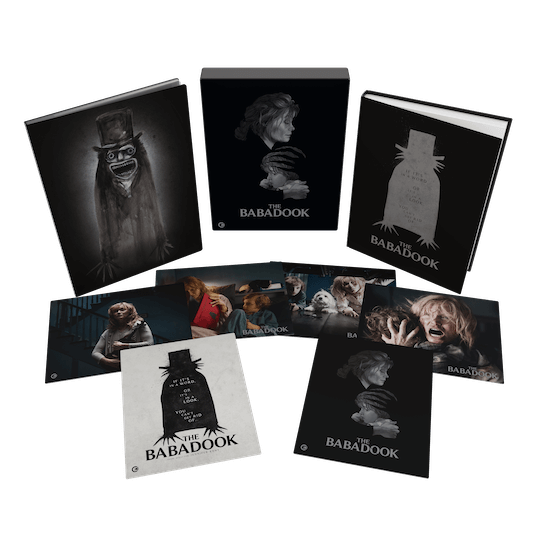
The Babadook has already been released on physical media but this gorgeous and impressive new 4K special edition from Second Sight finally gives this extraordinary film the attention to detail it and its admirers have always deserved, if not demanded. This is a package that is nothing is not utterly comprehensive. Housed in a sturdy, rigid slipcase this breath-taking new edition features both a new 4K master of the film produced by the original post-production facility and presented in HDR10 alongside a standard Blu-ray disc. A 150-page hardback book contains essays from horror scholars, archive interview material, production stills, and original artwork concepts, and also included in the set is a selection of collectors’ art cards. The film looks absolutely stunning in 4K, of course, the format really accentuating its muted colour palette and its use of deep, dark shadows, but the real meat of this new release includes not only all the features ported over from the original Blu-ray but a wealth of new interview material. British film-maker Phillip Escott has spoken to all the film’s major players both in front of and behind the camera including actors Essie Davis (Amelia) and Hayley McElhinney (Amelia’s sister Claire), producers Kristina Ceyton, and Kristian Moliere, production designer Alex Holmes, film editor Simon Njoo, music arranger Jed Kurzel and Alex Juhasz, designer and creator of the diabolical Babadook book itself. These substantial interviews confirm not only what a Hellish experience it can be mounting a film at all but also how difficult it was to get The Babadook off the ground in an Australian cultural climate largely indifferent to horror movies.  Many of the contributors are commendably candid not only about the problems inherent in making such an ambitious film on a low budget (some crowd-funding was involved to even get the piece finished), but also about how the film received terrible responses from test audiences and only started to find its audience when it was accepted for inclusion at the Sundance Festival and began to be appreciated by critics and genre fans in both the USA and the UK.

Few would argue that The Babadook is a modern-day masterpiece, a film that lives on and haunts the mind and the memory like its titular boogie man. It’s a film that is never destined to cross into the mainstream because it was clearly not intended for that audience but this superb and exhaustive new set finally gives it the in-depth attention it deserves and its admirers will find that literally no stone has been left unturned in its appreciation of this important and powerful movie.

THE BABADOOK – LIMITED EDITION 4K SET is released on July 26th and is available for pre-order through Second Sight


THE BIRD WITH THE CRYSTAL PLUMAGE (1970) [4K UHD]

bird crystal plumage

Let’s get one thing straight right out of the gate: yes, Dario Argento’s The Bird with the Crystal Plumage has already been given the excellent Arrow Video treatment. The cult director’s debut film hit Blu-ray and DVD back in 2018, packed with the wealth of special features we’ve come to expect from Arrow. Now, however, they’ve upped their game: as this is the latest movie to be given the 4K treatment by Arrow, and boy, is it worth the upgrade.

The film itself is an undisputed classic. Though Argento would later go on to outdo himself with the likes of Suspiria and Inferno, everything we know and love about the director’s signature style is here and plain to see: the protagonist (here an excellent Tony Musante) in an unknown and hostile environment; the stylish kills; the gorgeous score; the wide array of weapons; the black gloves of the killer and gorgeous pastel settings; and twists and turns galore. Every single thing that makes Argento so beloved is at work in his first film – debuts rarely come stronger than this.

The biggest selling point of this new set is that it’s in 4K – and not the 1080p-level 4K that Arrow usually produce on their regular Blu-rays. No, this is full-blown 2160p: true 4K scan restored from the original film negative, remastered on a UHD disc with Dolby Vision. It is stunning. An Argento flick has never looked better: the pastel environments pop perfectly, the blacks of the killer’s globes and cloak are as dark as a Zack Snyder movie, and the whole picture shines with a crispness that feels fresh and invigorating, while also staying true to the fact that this movie is 50 years old.

A highlight of any Arrow release is the special features, and The Bird with the Crystal Plumage is no different. Although none of the extras are new (most are carried over from the previous Blu-ray release), they’re brilliantly fascinating. Film critic Kat Ellinger provides endless insights in her piece Black Gloves and Screaming Mimis, which examines the film’s explorations about gender, violence, impotence, and the intersections of all of these, as well as how the film fits into the giallo canon. Interviews with Argento himself and actor Gildo Di Marco are also excellent: Argento comes across as incredibly literate and humble, with great love and respect for the film form in a way that never feels obnoxious or overbearing, while Di Marco sheds some light on Argento as both a filmmaker and a person. Critic Alexandra Heller-Nicholas provides a fantastic visual essay on Argento’s love of gender exploration throughout his career, but the standout feature is an archival interview with Eva Renzi, who plays Monica Ranieri in the film. Renzi is full of passion and fire, animated in her movements and words, and a joy to listen to. Her sense of self-worth is obvious and extremely admirable, and though her career never quite took off in the way she wanted it to, she was clearly a true talent who was taken too soon (Renzi passed away in 2005, just months after this interview was conducted).

The new 4K release also includes a booklet with essays by Howard Hughes, Jack Seabrook, and Rachael Nisbet, as well as some lovely artwork. As a whole set, it’s a stunner, more than worth the price for any new or existing Argento fans, and seriously worth considering if you already own it.


The Bird with the Crystal Plumage is out now on 4K UHD from Arrow Video.


MORTUARY (1983)

mortuary

A favourite from the video store days, Mortuary has been given an HD release from US label MVD as part of their Rewind series and is ripe for rediscovery.

Teens Josh (Denis Mandel) and Greg (David Wallace) have broken into the local mortuary to steal some tires in lieu of payment since Josh was sacked from helping out when he caught the mortician Mr Andrews (genre favourite Christopher George in his final role) conducting a séance. Before they can roll the tires out of the place, they spot Andrews and some robed women doing it again. Transfixed by the sinister display, Greg doesn’t notice Josh has gone missing – attacked by a robed figure.

Greg and his girlfriend Christie (former Walton Mary McDonough) try to find out why Josh disappeared and even try to quiz Andrews’ Mozart-loving son Paul (a young Bill Paxton), who works at the mortuary cleaning and embalming bodies. Meanwhile, Christie is having nightmares and is convinced a roped assailant is after her.

Mortuary manages to throw so much at the wall that some of it does indeed stick. Opening as what appears to be a supernatural-tinged thriller, it soon reveals itself to be a full-on, bat-shit crazy stalk-and-slash horror flick. The fresh-faced Paxton makes his presence known in all the wrong ways with a brilliantly Pee-wee Herman-esque portrayal of the nerdy lad who is infatuated with McDonough’s Christie. It’s likely not a performance he’ll want reminding of too often. McDonough spends much of the time sleepwalking (literally) in her nightie, unsure whether the danger she’s facing is real or imagined. Wallace is an unlikely lead but manages to shine through the fun if somewhat predictable second half.

As well as the on-screen talent, Mortuary has plenty of pedigree behind the camera. Director/co-writer Howard Avedis helmed grindhouse classics The Teacher (1974) and The Stepmother (1972), while cinematographer Gary Graver had an illustrious career working with Orson Welles and lensing some of 42nd Street’s err… best such as Invasion of the Bee Girls (1973) and The Toolbox Murders (1978). Composer Gary Graver (who is the subject of the disc’s only real extra) provides an effective score that elevates the suspense greatly.

Mortuary might not be one of the first films you think of when it comes to the ‘good old’ video store days, but it stands up remarkably well. It just needed to have made more (or at least something) of the spiritualist side, which is all but abandoned midway. It’s a shame the release doesn’t have more in the way of extra features, too.

ANTEBELLUM

antebellum

There’s certainly a statement of intent for the feature directorial debut of Gerard Bush and Christopher Renz. Antebellum is a powerful and disturbing story set within the historical slave trade in Southern plantations. Don’t read on if you want to go into the film without any spoilers.

Headstrong slave Eden (Janelle Monáe) is among the plantation workers in a Louisiana ranch. After aiding an attempted escape, she is branded and savagely beaten. The escapees get worse treatment, as the wife of one is killed and incinerated in a makeshift crematorium. The workers are ruled over harshly by Confederate soldiers, with beatings given out if they speak without being allowed to. This oppressive regime reveals some unbearable acts until Eden is awoken by a mobile phone ringing while she’s being horrifically raped by the army general.

As alluded to in that brief synopsis, there’s more going on in the narrative than is fair to disclose. From the opening shot – a stunning, single tracking shot – to the twisted reveals that arrive later on, the film has style. The appalling nature of the situation is never presented lightly and it’s clear Bush and Renz have the current political climate on their minds when they preface the movie with a quote from celebrated Southern author William Faulkner: “The past is never dead. It’s not even past”. They don’t shy away from showing the brutality of the soldiers against the slaves, and it often descends worryingly into exploitation territory, which threatens to undermine the important message.

For all the cinematic splendour and neat twists, Antebellum is a difficult movie to actually enjoy. However, the points the filmmakers make and the emotions the scenario provokes are vital, particularly nowadays.

Antebellum is released on Blu-ray and DVD on August 2nd.

SLITHER (2006)

Slither

There are two types of alien invaders. Those that arrive in huge spacecraft and blow the crap out of historical landmarks. Then there are the ones that streak across the sky and crash into a field in some backwater town unnoticed. Except for a copulating couple who investigate with dire consequences. Slither’s alien falls into the latter category. Only when a mother disappears, and mutilated pets and livestock are discovered does Sheriff Bill Pardy (Nathan Fillion) realise that something’s strange in the neighbourhood.

James Gunn’s feature directorial debut withered and died like a salt-smothered slug at the box office. It didn’t fare much better on DVD. It’s a shame as it’s a fun, and wonderfully gruesome film, filled with the blackest of humour and grossest of body horror scenes this side of Society. Fortunately, the comedy-horror has been revived by Australian label Umbrella Entertainment as part of their Beyond Genres series. Hopefully, Slither can now obtain the cult status it so richly deserves. Make no mistake, Slither is not original in concept, but it’s not supposed to be. Slither is Gunn’s love letter to B-movies. His references are deliberate. Invaders from Mars, Invasion of the Bodysnatchers, Night of the Living Dead, and The Thing amongst countless others are all paid homage. Characters, shops, and streets are all named after genre authors and directors. Slither could be watched numerous times and you’d still be picking up references.

This Blu-ray release is packed with bonus features although they are all from the original DVD release. The audio commentary with director James Gunn and star Nathan Fillion provides an entertaining listen. Fillion reveals a few amusing on-set anecdotes, and Gunn takes a deep dive into the obvious, and not so obvious films referenced. There are on-set talking heads interviews, which were standard extra fare during the early noughties, visual effects and makeup revelations (hardly any CGI, but plenty of latex) deleted scenes and a gag reel naturally. If you’ve ever wondered how fake blood is made then Gorehound Grill is for you and The King of Cult: Lloyd Kaufman’s Video Diary is also worth mentioning (his cameo met an unfortunate end). Slithery Set Tour with Nathan Fillion and Who is Bill Pardy? has Fillion running amuck with a camera.

Slither is a B-movie homage oozing with affection and a slimy underappreciated gem that deserves a lot more love.

Slither is available on Blu-ray from Umbrella Entertainment

RAN (1985) – 4K

Ran

Ran is cinematic legend Akira Kurosawa’s reimaging of Shakespeare’s King Lear. Set in feudal Japan it tells the sprawling epic of Hidetora Ichimonji, a powerful, but elderly warlord, who has built his vast kingdom upon warfare and conquest. He decides to divide his kingdom among his three sons: Taro, Jiro, and Saburo. Taro, the eldest, is pronounced as leader of the Ichimonji clan, while Jiro and Saburo are instructed to support him. Jealousy and rivalry ensue as the country is once more torn apart by civil war.

While Ran is a very impressive piece of work visually, the film itself is ponderously slow and unnecessarily long. Scenes unfold at a languid pace with characters simply staring at each other. Another problem is that the characters are underdeveloped. The brother’s motivations seem precipitated solely by greed and jealousy. Coupled with heightened acting the film feels like an extravagantly produced pantomime, which is unfortunate for such an acclaimed director whose work has influenced just about any director you’d care to name.

Although Ran itself is disappointing, the extras on this Studiocanal release are exceptional. The featurette about the 4K restoration is fascinating. It’s astonishing that a film that is only thirty-six years old would need so much restoration. The negative was literally held together by tape.

There are several documentaries about Kurosawa’s life and career. The most comprehensive is the feature-length A.K. by Chris Marker. With the international successes of Throne of Blood, Rashomon and Yojimbo, Kurosawa was celebrated in his native Japan. His most well-known film Seven Samurai was remade as The Magnificent Seven, and George Lucas cites The Hidden Fortress as an inspiration for Star Wars. Kurosawa was the Japanese Spielberg of the 1950s and ’60s. His fortune changed after the much publicised debacle that was Tora! Tora! Tora! Many in the Japanese film industry thought that Kurosawa’s career was finished. Throughout the remainder of his career, he struggled to raise financing for his films.

Included in the bonus features are two excellent documentaries about the history of the samurai and their code of honour. There is also an interview with Ms Mieko Harada who plays Lady Kaede, a character similar to Lady Macbeth but handy with a knife. Finally, the spotlight is shone on Ran’s director of photography Shoji Ueda, whose work is exquisite. If nothing else, Ran is gorgeous to look at, but if you are new to Kurosawa, start with any of his early samurai films. Ultimately, Ran is a film for the Kurosawa completest.

Ran is available now as a 4K release.

ENCOUNTER OF THE SPOOKY KIND (1980)

spooky kind

Predating the breakthrough success of Ricky Lau’s Mr. Vampire (1985), Sammo Hung’s Encounter of the Spooky Kindcombined jiangshi “Chinese hopping vampire” folklore with kung fu to humorous effect, resulting in one of the earliest examples of horror-comedy in Hong Kong cinema.

Set during the early 20th century, Courageous Cheung (Sammo Hung) is known for his fearlessness, and in a foolish effort to uphold his reputation, accepts a challenge to spend the night at an abandoned “haunted” house. If he can peel an apple in front of a mirror without breaking the skin, he will survive the night! If not, local superstition suggests that something dreadful may happen… Unbeknownst to Cheung, his no-good friends have seized this opportunity to play a mischievous practical joke, creating a terrifying ghostly illusion!

At first, our now not-so-courageous Cheung is duped, later scolding his friends for tricking him, but all is quickly forgiven when the real ghost appears! After a narrow escape – resulting in bodily dismemberment – Cheung returns home, unaware that his promiscuous wife (Leung Suet-Mei) is having an affair with his employer, Master Tam (Huang Ha). Concerned that Cheung will discover the truth of his wife’s infidelity, Tam hires Chin Hoi (Chan Lung), a Mao Shan necromancer and Taoist priest, to get rid of him permanently through supernatural means, removing all risk to his own reputation, without raising any future suspicion.

Using Cheung’s self-proclaimed courage against him, Chin tricks him into spending the night at a spooky temple where, as a result of Chin’s necromancy, a jiangshi dwells! Fortunately for the oblivious Cheung, fellow Taoist priest Tsui (Chung Fat) wants nothing to do with his brother’s pursuit of coin, and instead offers Cheung wisdom on how to survive… through supernatural kung fu!

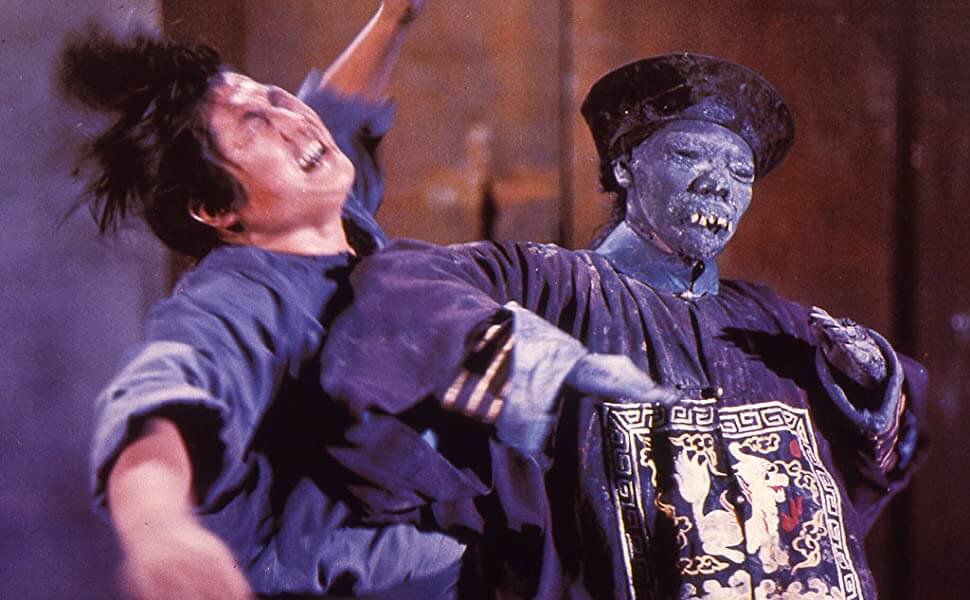
As the progenitor of the “jiangshi” kung fu subgenre, Encounter of the Spooky Kind (aka Gui da gui, which literally means Ghost Fights Ghost) helped to shape the cinematic visual style of the Chinese vampire boom that followed, including Lam Ching-Ying’s Vampire vs. Vampire (1989) and Ricky Lau’s Mr. Vampire II (1986). In many Chinese legends, the jiangshi is depicted as a hopping reanimated corpse, arms outstretched, and dressed in traditional changshan garments from the Qing dynasty. This is also true of Sammo Hung’s Encounter of the Spooky Kind; the costume and set design encapsulating the Great Qing period.

Never skipping a comedy beat, Sammo’s personality is endearing throughout. From the first “jiangshi” encounter to the “chopsocky” finale, Sammo showcases his athleticism and discipline in the martial arts against the equally accomplished Yuen Biao, Lam Ching-Ying, and Huang Ha; choreographed to the tone of schlock horror, reminiscent of the Hammer and Shaw Brothers co-production, The Legend of the 7 Golden Vampires (1974).

Eureka Entertainment’s 2K restoration of Encounter of the Spooky Kind comes to Blu-ray with a collector’s booklet written by James Oliver, an audio commentary by Asian film expert Frank Djeng, an archival interview with Sammo Hung, alternate English opening and closing credits, the original Cantonese and English dubbed audio tracks, and reversible artwork featuring the original HK artwork and newly commissioned artwork by Darren Wheeling. It is a stunning package with one minor omission… Bey Logan’s audio commentary from the original Hong Kong Legends DVD (with its reference to STARBURST Magazine!).

Through expert direction, beautiful cinematography (courtesy of Yu-Tang Li and Cho-Hua Wu), and imaginatively choreographed fight sequences, Sammo Hung set the template for the future of Hong Kong horror with Encounter of the Spooky Kind. Moments of genuine suspense, contrasted against martial arts mastery and elements of physical comedy, conjure an essential supernatural Hong Kong classic.