Witchsign takes place in the land of Vinterkveld where dragons once ruled and magic was the order of the day. But now the dragons have gone and the Solmindre Empire has risen out of their ashes and made it its mission to wipe every semblance of magic out of existence. It seems as if they almost succeeded but some children are still being born with the taint of the witchsign, the indicator that the dragon’s magic is growing inside them. It is the Vigilants of the Synod’s task to find these children and take them somewhere they will never be seen again, and when a young brother and sister called Steiner and Kjellrunn are brought to the Vigilants’ attention it seems as if Kjellrunn’s fate might be sealed. However, it is Steiner who is mistakenly captured and taken to the mysterious Academy where those who bear the arcane taint are taught to master their magical powers at an often-deadly cost. This is what is in store for Kjellrunn if the Vigilants realise their error, but how can Steiner escape and return to protect his sister? In this, the first novel in The Ashen Empire trilogy, the siblings are going to begin a journey which will take them into the witchsign’s darkest heart…
We don’t know about you, but we always worry when we open a book and find a map waiting for us. In the case of Witchsign, it wasn’t so bad because the pages in the uncorrected reviewer’s proof actually read ‘map to come’ but the knowledge that a map is potentially even on the horizon still made our heart sink a little. For this writer, a map often means that this story is going to be so unnecessarily complicated/overwritten that the author thinks we need a visual aid before it even begins. Thankfully, that’s not really the problem with Witchsign. In fact, with its relatively short, sharp chapters, which constantly switch between the individual viewpoints of Steiner and Kjellrunn, the novel is a surprisingly quick and easy read.
But here’s the problem: despite a compelling opening, two well-drawn if generic protagonists and a ‘big bad’ that is suitably sinister, Den Patrick’s writing doesn’t have the lyricism a story like this needs to work (although we’re aware that’s a very personal opinion). More than that, Witchsign doesn’t seem to know what it wants to be – with its inquisitorial background and the fascist motif of the Solmindre Empire and their child-stealing agents, it had the possibility of really resonating with the reader because it has so much contextual relevance to the witch trials of history and the persecutions that are still happening today. It could have been a political and social commentary as well as a fantasy and it could have had genuine emotional power but, instead, it simply veers between childish Gothic and a kind of half-hearted Brothers Grimm, with more than a nod towards Harry Potter. Witchsign lacks heart, it lacks awareness, and you’d be hard-pressed to find any genuine magic within its pages. Sadly, a wasted opportunity.
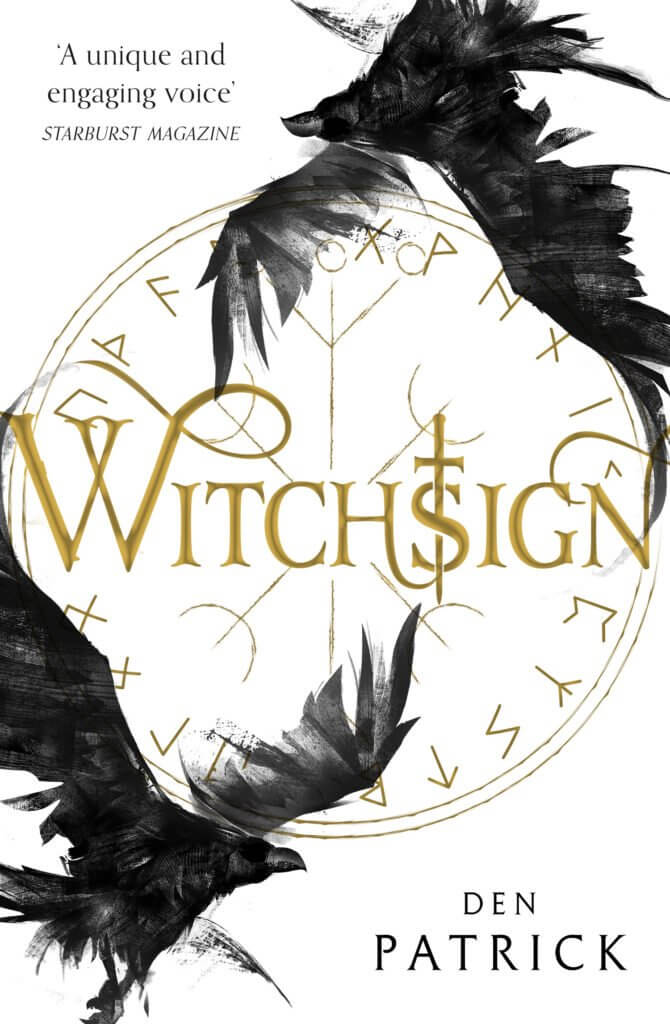
WITCHSIGN / AUTHOR: DEN PATRICK / PUBLISHER: HARPERVOYAGER / RELEASE DATE: MAY 22ND