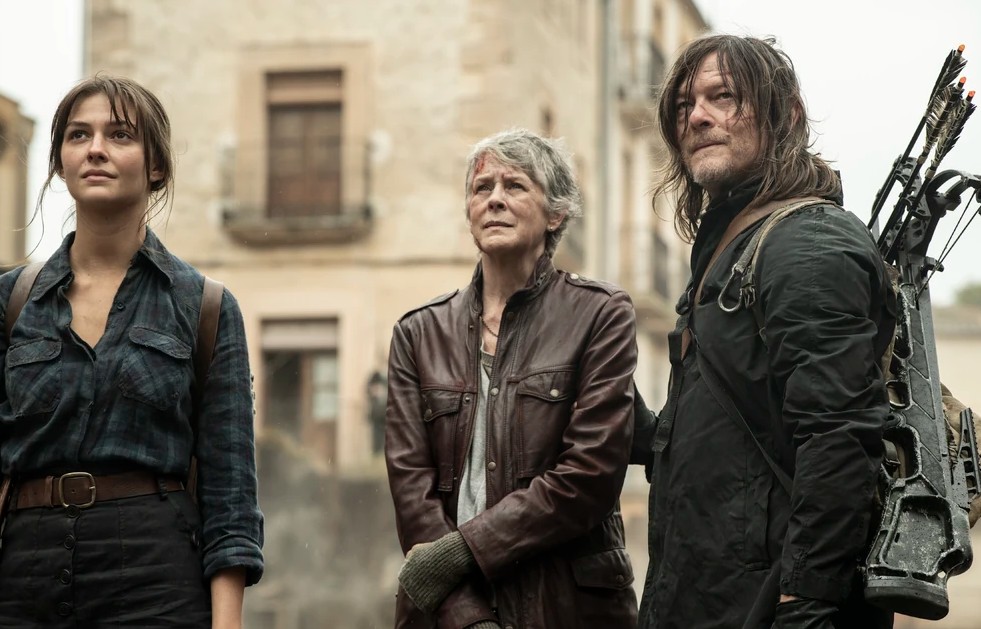
Although the opening episode’s surprise cliffhanger soon fizzles out, events in Episode Two immediately pick up as Daryl and Carol are reunited. In fact, the storyline of La Ofrenda (Spanish for “The Offering”) quickly immerses the pair in the unusual environment of the Spanish coastal region where they were shipwrecked. Their impulsive actions also quickly position them on one side of a conflict that neither of them yet fully understands the fracture lines of. Within hours of arriving in Spain, Carol and Daryl are no longer just unwitting refugees; they’re already combatants.
After Daryl finds a still-recuperating Carol watching a seemingly carefree couple relaxing by a fresh mountain stream, they pause for a moment to observe them unseen. This wistful vista of young love, free of fear and responsibility, is shattered when an armed patrol arrives and attacks them. Daryl takes out the assailants and saves the youngsters’ lives. Roberto and Justina are grateful, but reveal they are runaways who have eloped from their settlement, Solaz del Mar. After Daryl insists they repay their debt to him by returning, so that Carol can receive medical treatment, they reluctantly agree.
One of the signature successes of Daryl Dixon is the show’s ability to get great visual impact from its real-world locations, and in a way that generates an evocative and distinctive sense of place. The first two series were bursting with bucolic Gallic vistas, and impressive urban French desolation. With the showrunners aware of just how important the idea of ‘place’ is to the series’ identity, series three is already pulling together a sense of how the art, architecture and complex social history of Spain might have morphed through the experience of a zombie apocalypse.
This means that the setting of Solaz del Mar is a particularly interesting prospect, especially as it’s quickly made clear that this is not an everyday dystopian enclave. The new arrivals are greeted with warm hospitality, as Carol’s infection is treated by Justina’s grandmother, while Roberto’s father provides Daryl with accommodation and the offer of tools and materials to fix their beached and damaged boat. There’s also some life and a bit of joy in evidence at Solaz del Mar. The Mediterranean climate seems to support not just a bountiful harvest, but resources enough for parties, colourful ritualistic celebrations and more than a glimpse of the good life. Given that it’s far from being a work-camp offering a life of drudgery and hard labour, it’s not immediately obvious why Roberto and Justina were so keen to flee.
It’s only later when it becomes apparent that the young lovers hope to escape an obligation that could see the pair separated for ever. Each year, the settlement’s leader Fede must handover a young woman to the clutches of El Alcázar as the price for their ‘protection’ of Solaz del Mar. El Alcázar’s leader Guillermo Torres styles himself as the last surviving member of the Spanish monarchy, with all of the entitlements he believes are invested in that status.
It’s perhaps not the most original, nor the most exciting, jeopardy that the showrunners could have injected into the plot. The idea of one essentially decent community being preyed upon by their more powerful neighbours, who extort an appalling ‘tax’ with menaces, is as old as storytelling. But with resistance to the ritual being brutally punished by El Alcázar’s enforcers, it does at least set in motion the potential for a showdown between the blackmailers and the blackmailed. There’s also a weak point in Torres’ inner-circle that he’s unaware of, which could have unforseen repercussions.
What makes it trickier to predict how this will play out is the differing approaches of the two American émigrés observing proceedings. Daryl is single-minded about finding a way back across the Atlantic, and is determined that they not get ensnared in local matters. He won’t countenance the idea of taking the two youngsters with them. Carol is more empathic and willing to voice concerns to her hosts. What complicates matters for Daryl is the arrival of the sole surviving member of the group he tackled earlier, who could expose him as a killer.
This is an episode light on walkers, which focuses instead on introducing the new and alien European culture into which Carol and Daryl are thrust. There are hints of a latent tension between the pair (Daryl the grumpy isolationist, Carol the diplomatic lobbyist) which could introduce a sparky new dynamic to their relationship. Their new environs look great on screen and give off a very different ambience to their earlier French counterparts. This sojourn in the Spanish sun is already revealing its undead rustic charms.

The third season of THE WALKING DEAD: DARYL DIXON premiers on Sundays on AMC and AMC+ in the US and will be available in the UK on Sky Max and NOW TV from October 24th
Read our previous reviews of the third season of THE WALKING DEAD: DARYL DIXON below: