Venice is one of the most beautiful cities in the world, but between movies like Death in Venice, Vampire in Venice,and especially Nicolas Roeg’s extraordinary Don’t Look Now, the big screen hasn’t done the Venetian Tourist Board any favours. Neither did 1990’s The Comfort of Strangers, an intriguing psychodrama that serves as a vivid warning to anybody who may find the kindness of strangers too difficult to refuse. Sometimes, your survival might depend on being impolite and walking away very fast.
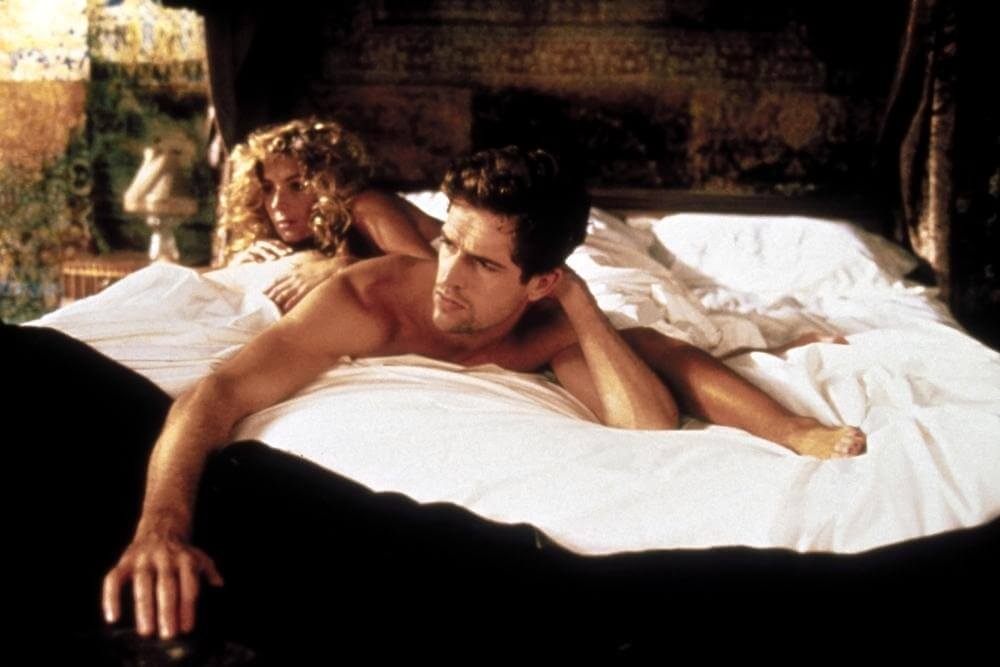
Mary and Colin (Natasha Richardson and Rupert Everett) are an English couple holidaying in Venice. After losing their way while in search of a restaurant, they are befriended by a swaggering Venetian bar owner called Robert (Christopher Walken) who quickly reveals an unhealthy obsession with his late father. Despite the couple’s best efforts to extricate themselves, Robert and his disabled wife Caroline (Helen Mirren) gradually draw Colin and Mary into their twisted world of baroque grandeur, violence and sadism – and Mary discovers that their original ‘chance’ encounter with Robert wasn’t so ‘chance’ after all. But it’s too late now. The trap has closed.
Why The Comfort of Strangers is one of Paul Schrader’s least known films is a mystery to us, because it’s easily as good as anything else he’s made as a director. His lens delights in the decaying opulence of the Venetian architecture, prowling the alleyways, celebrating the sunlit expanse of the Grand Canal and fetishising the gorgeous décor of Robert and Caroline’s apartment. Schrader isn’t let down by his cast, either. Richardson, Mirren and Everett give three complex, understated performances while Walken seems to enjoy himself tremendously playing the larger-than-life but still realistically intense psychopath. If Harold Pinter’s screenplay seems a little cold and theatrical, that’s because most of the dialogue (and all of the structure) has been lifted wholesale from Ian McEwan’s excellent source novel, but the stiltedness works well within the context of the story. Some viewers may wonder why Mary and Colin don’t make their excuses as soon as Robert first materialises out of the shadows because it’s obvious from his bearing that nothing good is going to happen, but The Comfort of Strangers plays so perfectly on a particular ‘remain gracious at any cost’ old-fashioned English politesse that we can almost understand why the couple let themselves be swept up into Robert and Caroline’s darkness, never believing that events will turn as nasty as they do. To that degree, the film is a vividly black dissection of the middle-class English psyche, a humourless comedy of manners with a grand guignol punchline.
Although it’s taken The Comfort of Strangers far too long to make it to blu-ray, the BFI’s new presentation is worth the wait. It’s also complimented by a small but perfectly formed Schrader-centric collection of extras.
Do yourself a favour. Watch The Comfort of Strangers, watch Don’t Look Now, and then compare and contrast and try to decide which of the two masterpieces leaves you feeling the most ill-at-ease. Roeg’s supernatural thriller has the biggest reputation but The Comfort of Strangers’ power may surprise you, not least because it’s so utterly, nightmarishly, believable.
THE COMFORT OF STRANGERS / CERT: 15 / DIRECTOR: PAUL SCHRADER / SCREENPLAY: HAROLD PINTER / STARRING: CHRISTOPHER WALKEN, HELEN MIRREN, RUPERT EVERETT, NATASHA RICHARDSON / RELEASE DATE: OUT NOW