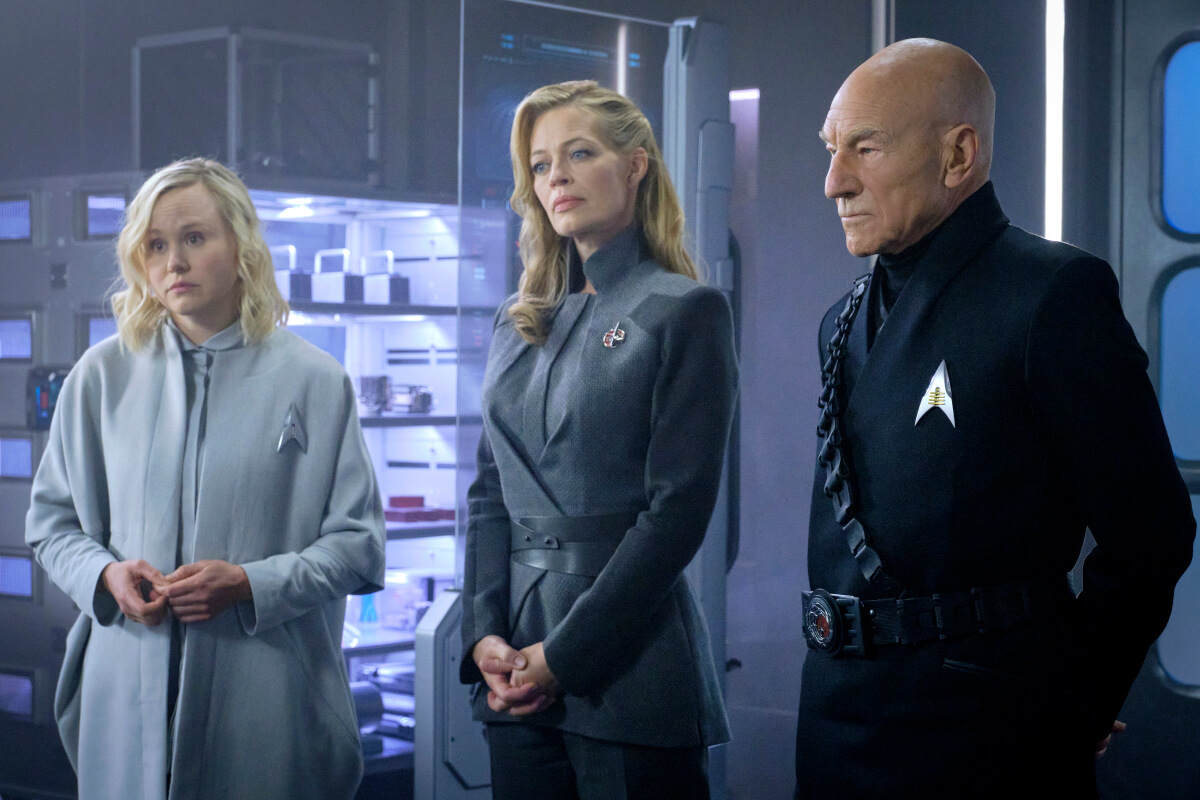
Star Trek: The Next Generation never did a Mirror Universe episode. A staple of everything from The Original Series to Deep Space Nine and Discovery, the evil counterpart of Trek’s utopian future evaded TNG. And while Penance isn’t set in the Mirror Universe we know (or for that matter, isn’t an episode of TNG), it’s the closest we’ll ever get to seeing Picard’s mirror counterpart.
But first things first. If you saw the season premiere (and if you didn’t, why are you reading this?), you’ll know that it ended with Picard’s old frenemy (see, we’re down with the kids) Q crashing back into his life for the first time since The Next Generation ended and introducing him to this changed reality.
It’s great fun seeing Patrick Stewart and John de Lancie reunited onscreen. The two have always had great chemistry, with de Lancie imbibing Q with an impish glee in poking away at Picard’s pomposity. But, in keeping with Picard’s more adult tone, this is a more serious version of Q than we’ve previously encountered. He’s darker, more dangerous than before, at one point he even slaps Picard. The Mariachi band summoning, Robin Hood cosplaying Q of old would never have done that.
If you’re expecting this to be the Picard and Q show though, you may be in for a disappointment (at least in this instalment). Q’s purpose here is to introduce Picard to a changed future – crucially this is not a mirror universe, but a corruption of the timeline our characters originate from – where he’s the most decorated, ruthless general in a fascistic Earth. Q even reels off a list of Trek characters Picard has personally executed, while their skulls are proudly displayed in his home.
Elsewhere, his crewmates are finding out their new roles. Seven’s done particularly well for herself, while Jurati seems to have turned into a 24th-Century version of a mad cat lady. Gradually, the crew reunite and concoct a plan to repair the timeline with the help of an untrustworthy new ally. We’re not going to give it away, but if you’ve seen the trailer, you’ll have a pretty good idea who that is.
Some reviewers have pointed out that Picard’s sophomore season feels somewhat like a Trek greatest hits album, and Penance is the episode of the first part of the season that feels most derivative of Trek’s past. The hellish reality we see here is virtually identical to the Mirror Universe. And while that’s always fun, it’s been done to death across various series. Would it have killed them to have come up with a different twist on the dystopian future?
That’s not to say Penance is bad. Far from it, it’s great fun to see the crew thrown into this situation, especially the likes of Seven and Jurati, whose improvisational skills both leave a lot to be desired and are a work of comic genius. We’ve just been here many times before.
Q implied at the end of Episode One that the creation of this new timeline has a personal connection to Picard, and while we get no answers here, let’s hope that’s the case. Picard is meant to be an exploration of his character. And while the first season dealt primarily with him reconnecting with Starfleet and coming to terms with the loss of Data, it’s currently unclear where this season is going.
We know from Episode One that his relationship with his mother is key (and she’d better not – contrary to Internet theories – turn out to be that Borg Queen who boarded the Stargazer), and Picard’s childhood is a largely unexplored area. Although we know some of where this season is going (by the end of this instalment, literally in the case of Episode Three), we’re starting to tap into a greater mystery surrounding the past of one of Star Trek’s greatest characters. And although there’s a slight sense that they may spectacularly screw it up (after all, this is the show that gave Picard a robot body), so far, we’re intrigued.
Star Trek: Picard is available to stream on Prime Video with new episodes every Friday.
Read our previous reviews: