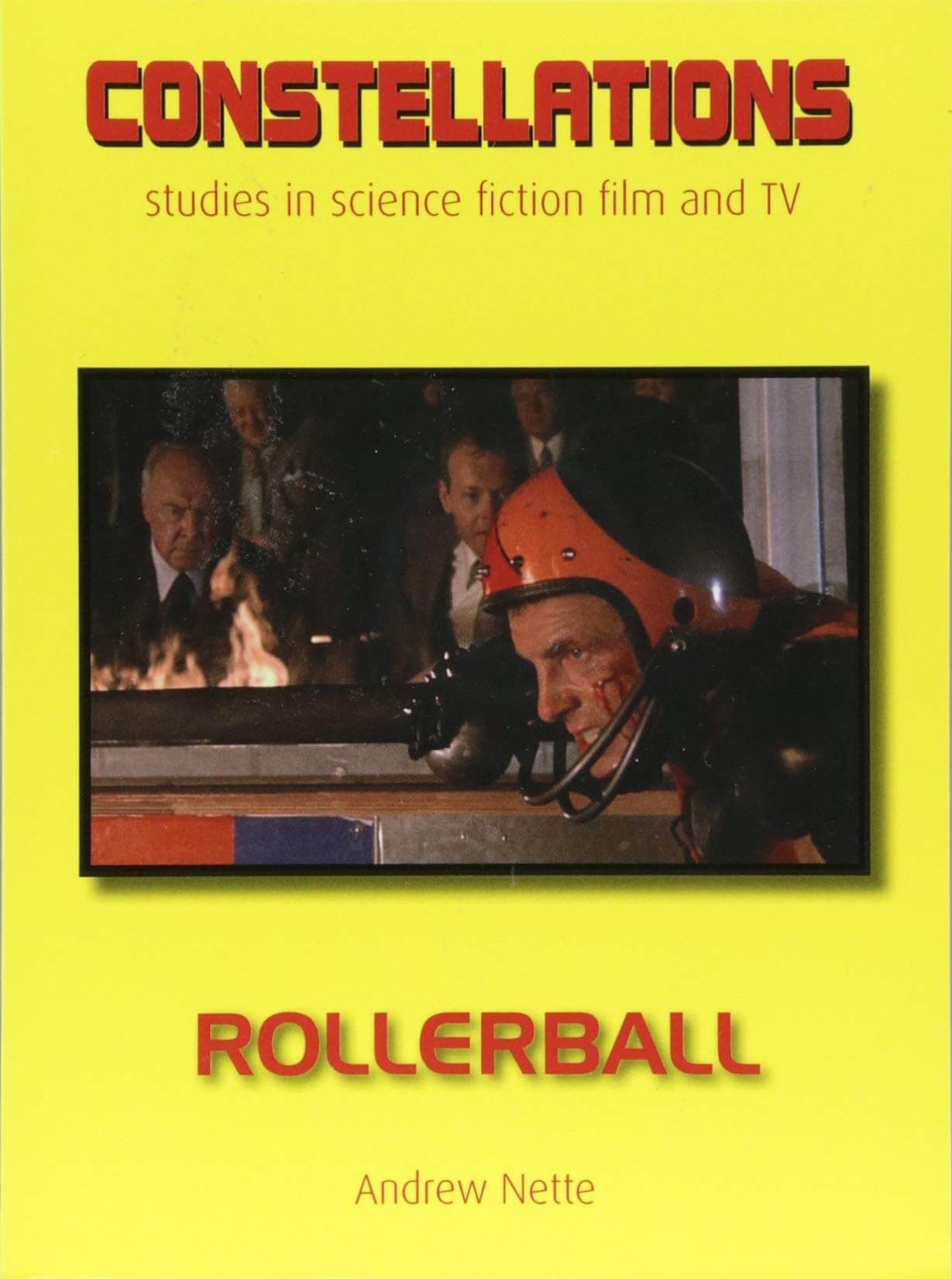
Released in 1975, Norman Jewison’s Rollerball became infamous for its ultraviolent depiction of a future dominated by corporations in which “there are no more wars” and the aggression of the masses is instead played out in a game that combines roller derby, ice hockey and motorbikes in a wall of death: the titular Rollerball. The movie’s notoriety eclipsed critical appreciation of the deeper themes of the story (by Jewison and screenwriter William Harrison); themes of corporate power and technological change which arguably failed to cohere in the finished film. But Rollerball remains fascinating despite its flaws, and Andrew Nette’s excellent new book explores the film from a number of intriguing angles to unearth both its meanings and its considerable influence on subsequent science fiction film and television.
nette begins by contextualising Rollerball within early 1970s sci-fi, a period which he defines as less interested in space travel, extraterrestrials and the cosmos and more in environmental destruction, authoritarian government and technological fears. Jewison, hot off the successes of Fiddler on the Roof and Jesus Christ Superstar, recognised that science fiction after 2001: A Space Odyssey was, in Nette’s words, “enjoying a rare moment of cinematic and literary respectability”. Nette offers a detailed account of Rollerball’s making, taking us behind the scenes in the casting (especially of James Caan as the film’s nominal hero Jonathan E), crewing (which included vital contributors like director of photography Douglas Slocombe and costume designer Julie Harris), production design (by John Box) and, crucially, the staging of the film’s violent game sequences by a team of top stunt performers. The author’s close examination of the creative process serves to illustrate just how carefully Jewison built his dystopian world, and goes some way towards defending the film against those critics who dismissed Rollerball as an ultraviolent B-movie.
Nette’s scene by scene analysis is largely descriptive and reads like an extended plot synopsis highlighting a weak screenplay that fails to dramatise the film’s themes successfully. But this does not detract from the author’s considerable strengths as a writer and researcher. One of the bedrocks of Nette’s book is his sourcing of Harrison’s own writing on Rollerball, which include previously unpublished papers housed at the University of Arkansas. Nette uses these throughout to provide new insight, not only into the development of Rollerball, but also the working relationship between Harrison and Jewison, their disagreements and their private thoughts on the film’s reception and release. Another highlight is the interview with Jewison with which Nette concludes the book. Here Nette gives the director right to reply to a number of issues raised in the study, including reasons why Rollerball was a critical failure in 1975 despite big box office takings.
Nette’s scrupulous research and careful writing makes for an enjoyable, informative read. In fact, Nette’s book is so good, that you will inevitably want to revisit Jewison’s film afterwards. It’s unlikely, though, that you will find the film as satisfying as Nette’s study of it, which is to say that this monograph comes very highly recommended.
ROLLERBALL (CONSTELLATIONS) / AUTHOR: ANDREW NETTE / PUBLISHER: AUTEUR / RELEASE DATE: OUT NOW