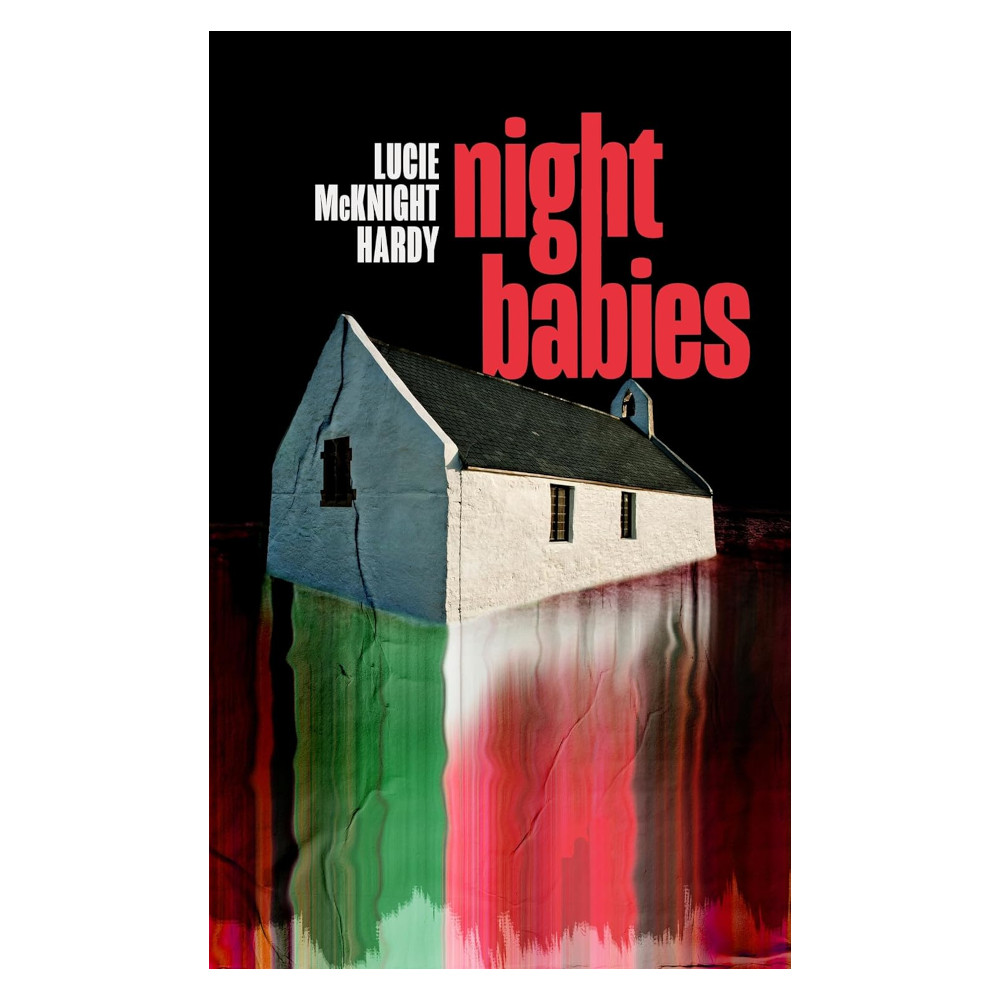
Lucie McKnight Hardy returns to the world of ‘weird girl’ fiction with her latest novel Night Babies, releasing late April 2026 with John Murray Press. McKnight Hardy, known for her earlier atmospheric horror novels such as 2019’s well-received Water Shall Refuse Them, weaves a new landscape in Night Babies as struggling painter Astrid and her long-suffering boyfriend Kit take refuge from a home emergency in the chapel on her friends’ land.
Fighting against deadlines, relationship tension, the creeping consequences of a long-ago trip to Florence, and a deteriorating mental state, Astrid becomes increasingly obsessed with the reservoir the chapel overlooks, as well as the secrets that may be hiding in its depths. Strange visitors, violent dreams, old guilt; a tight and claustrophobic storm begins to swirl in the rugged landscape of the Brecon Beacons, demanding a closer look at the nature of what is truly wild, and that which imprisons us.
McKnight Hardy’s new novel is steeped in quintessentially Welsh horrors. The reservoir looming blackly beyond the chapel windows with secrets buried at its bottom is reminiscent of the intentional flooding of Capel Celyn in the 1960s which left the entire village underwater, while the remote farmhouses, crumbling psychological states, and strange horrors mounting in the hallways brings to mind the infamous haunting of Heol Fanog – one of Wales’ best-known paranormal cases. Without specifically naming these things, McKnight Hardy draws quietly on a swell of national eeriness, an inherent uncanniness in the untamed landscapes of Wales, and those fears that run forever through a national psyche. It is a natural kind of horror, a swirling and untouchable one – wet and dark and full of blood – and one that it is gripping to watch McKnight Hardy’s characters grapple with. Straight away we are confronted with the inherent human weakness – we cannot fight the natural world, and we cannot fight that which we don’t understand.
A richly described, artistic view of the landscapes and settings of the novel means that the narrative passes in the same oil-paint compositions that Astrid is feverishly trying to complete for her first gallery exhibition in her young career. The bones of the novel colour the way McKnight Hardy creates not only her setting but her characters – Astrid, deliciously three-dimensional, always just slightly beyond our forgiveness, always just a little too close to hate. Astrid paints and so does McKnight Hardy – the water up against its banks in the night, the tension between her friend Flora’s husband and the secret from years ago, the strange wounds her boyfriend Kit keeps waking up with in the morning.
The novel is brooding and photographic, the mounting wrongness gathering like a fog. The characters are strikingly real, flawed, and relatable in a darkly guarded kind of way, splaying out qualities that we may be trying not to acknowledge in ourselves. Astrid is haunted by her past – specifically a college trip to Florence with her handsome art teacher – and as the white and gold of Italy, the marble cherubs and modelled sensuality begin to blur with the brambly darkness of the Welsh winter, the voodoo dolls under the bed, the strange handprints on the windows, we see the way a personal history will colour everything we do; the way the past is not a forgotten thing, but something always just in reach. Astrid’s inability (or unwillingness) to see herself for what she really is, what she’s really done, is a tantalising slow-burn down into the core of what makes someone truly bad, or truly forgiven.
Night Babies is delightfully tense on every conceivable level – something is constantly lurking just out of sight. Astrid dreams of demonic cherubs and undead children, fighting against gallery deadlines as her paintings grow ever stranger, while her host Flora is heavily pregnant and enjoying the slower lifestyle of a homemaker. She is forced into close proximity to Flora’s snooty husband Simeon, who Astrid reviles for the upper-class snobbery he represents, and yet is strangely captivated by. The contrasts between the sweeping location and the tightening claustrophobia of people thrown together and cracks beginning to show is a masterful balance by McKnight Hardy, leaving a reader wondering which danger is going to swoop first – the social, psychological, or environmental?
Richly layered and cleverly plotted, Night Babies feels like a race to a nugget of truth that will make sense of everything. The parallels between the beautiful and the grotesque (a word attached to Astrid throughout as she becomes more unmoored from herself) give a refreshing evocation of femininity, a woman unafraid to be disgusting, frightening, preoccupied with the body and the things we leave behind. (Night Babies is sure to be popular on ‘weird girl’ BookTok, a space which celebrates female protagonists connecting to their base selves.) Potentially a comment on the demands made of women – bearing children, motherhood, the balance of everything together and getting on with it – Night Babies is not afraid to take its characters to the dark animal depths of the nature from which we all originally came. The novel becomes subtly witchy, and yet relatably domestic – Astrid as a figure of what we should be, and simultaneously who we actually are.
McKnight Hardy’s constant balancing of the supernatural and the psychological leaves a delicious ambiguity to Night Babies. There is a constant question of what is truly real- what power the supernatural has, or how fractious Astrid’s narration can become. It is never made clear what the true driving force actually is – haunting, tension, mental illness, guilt, ghosts – and the novel is all the richer as a result, weaving a complex tapestry from which there are endless threads to unpick and examine. Night Babies is simultaneously a tight, terse retelling of a struggling friendship and forced proximity, and a sweeping, panoptic look at what might lurk just outside the bounds of our accepted reality. It is a slow descent, a sinking, a cold creep as we watch something being pulled slowly beneath the water.
NIGHT BABIES will be released in book shops from April 23rd 2026.