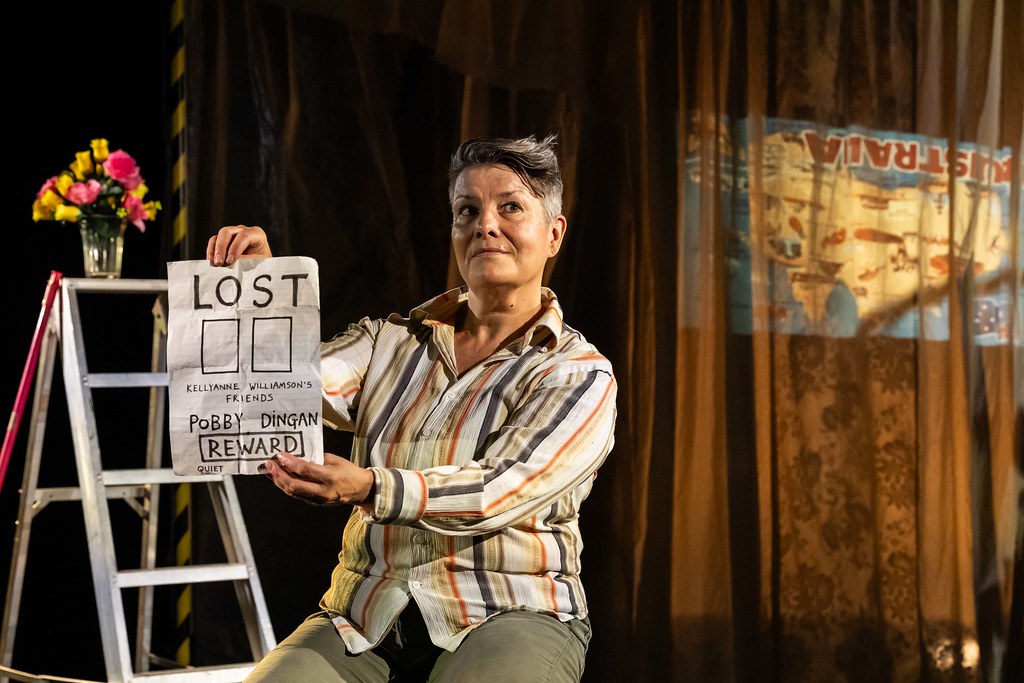
Lightning Ridge is a theatre show designed for a young audience that is currently touring Scottish venues.
The story concerns the residents of a heightened version of the real Australian town of Lightning Ridge, known for being the centre of Australian opal mining. Our focus is on the Williamson family: dad Rex, mum Susan, son Ashmol, and daughter Kellyanne. But overwhelmingly, our focus is on Kellyanne’s two imaginary friends, Pobby and Dingan.
Rex has moved the family to this dusty outback town from the big city. His aim is to explore his ‘claim’ – a small area of land on which he can mine for opals. Such is the worth of this precious gem, that finding just one reasonably sized stone will set the family up for life. Susan is less impressed, having already left behind a pastoral English lifestyle, complete with Pony Club membership and all that suggests, to move to Australia. The continuous dust of the outback wears her down on a daily basis.
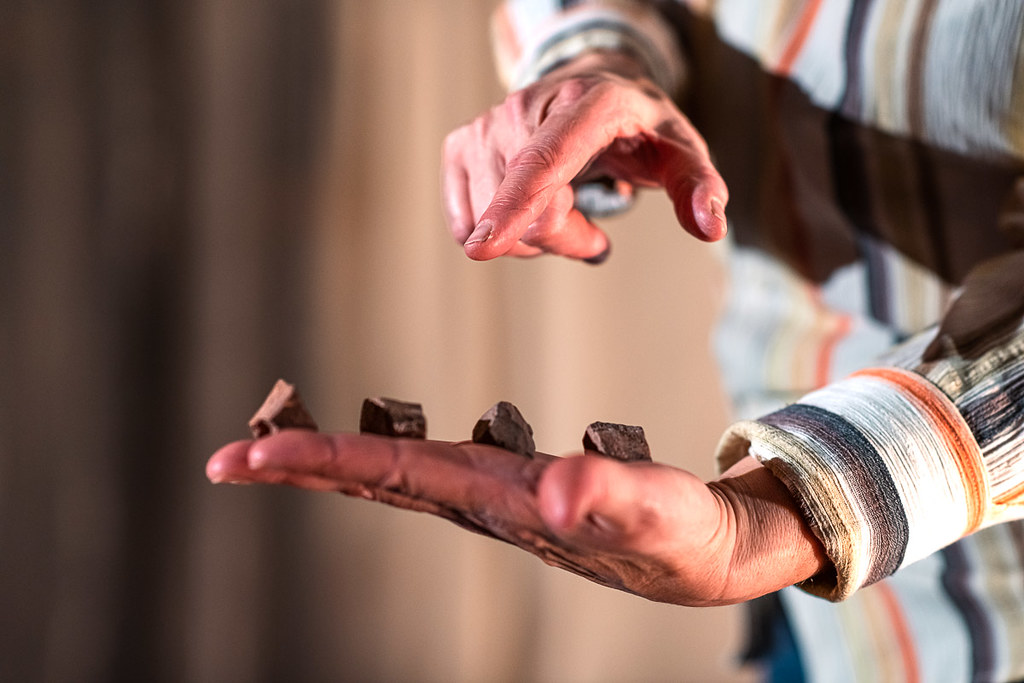
Of the two children, eight-year-old Kellyanne begins as our focus, as Poppy and Dingan are her imaginary friends. So vividly outlined are the descriptions of these two characters who can’t be seen, that the audience is immediately able to imagine their physicalities. Indeed, all of the characters, however fleetingly mentioned, are so fully realised, that even one line allows the audience to either relate to the tropes inferred, or to be able to visualise that character’s mannerisms.
Kellyanne is deeply emotionally reliant on the support of her imaginary friends, to the equally deep annoyance of the twelve-year-old Ashmol. Ashmol can’t see Pobby and Dignan, but it is established early on in the story that some people other than Kellyanne can. This will prove to be vital later on. Indeed, there are various moments throughout the story that turn out to be foreshadowing for what is to come later on. So subtly woven are these, that it only becomes apparent in the final scenes how effective this has been as a storytelling device.
In a bid to repair the slightly broken relationship between father and daughter, dad Rex starts to try to engage with the two imaginary friends, who, it is plain, he cannot see. He engages with them at the family home, and even takes them with him to work, in his claim mine. One day, Pobby and Dingan don’t come home with dad. A distraught Kellyanne falls ill, and implores her brother to help her find her missing friends.
Ashmole calls on the community to help, and is genuinely surprised when they do. But alas, there is not to be a happy ending here. The final scenes are however, deeply emotional, and make a fitting climax to the story being told.
The story has been adapted from Ben Rice’s 2000 novella Pobby and Dingan, by Catherine Wheels’ Theatre Company – and this adaptation dates from 2023. At this point in the production’s development, all the various aspects are well embedded within the production, and are brought to life delightfully. The familiarity with the source material shines through, and it is clear that everyone involved in conceiving this story has a deep affection for, and familiarity with, the original tale.
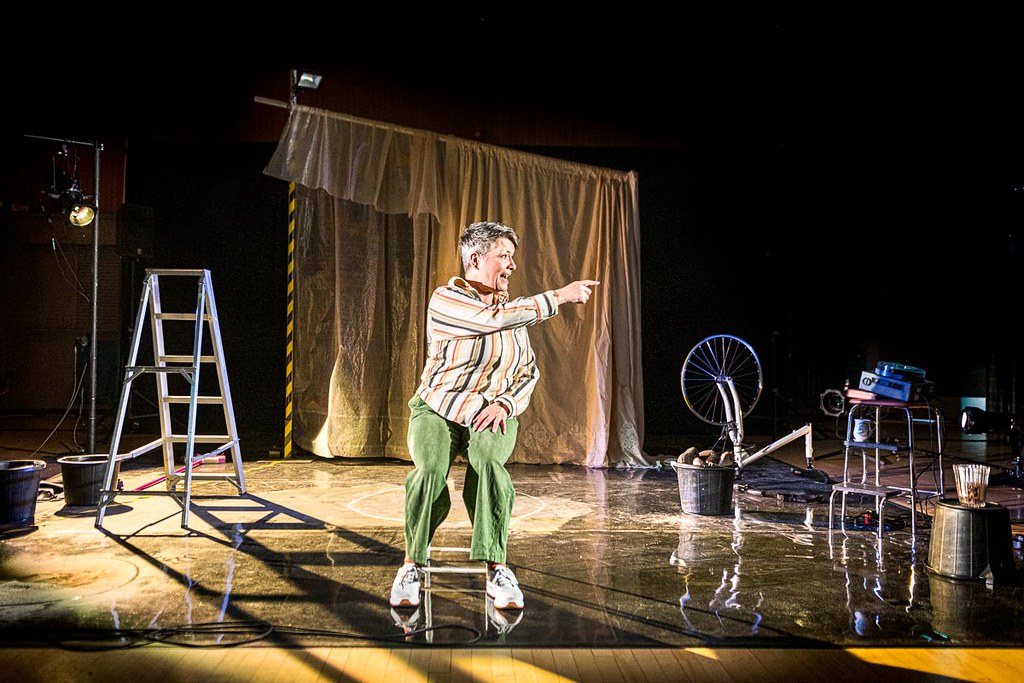
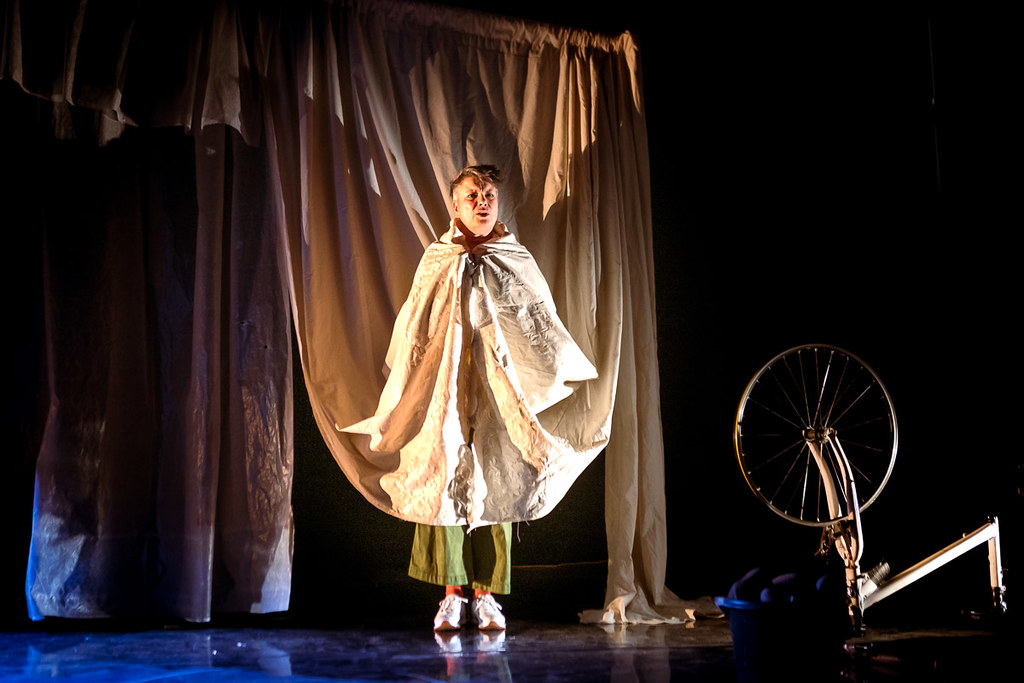
This show has obviously been made on a restricted budget, and the team is doing a lot with relatively little. There’s a gorgeous soundscape, which evokes the drainingly hot outback landscape. There’s a careful use of lighting, and further sound techniques to heighten certain moments.
The magic in this performance lies with the talents of the performer, on this occasion Catherine Wheels’ artistic director Gill Robertson. Robertson is a gifted performer, weaving images with their words, and bringing the younger members of the audience into the story world with skill and humour.
The story here is engaging, and its novella roots mean that it feels as if nothing vital has had to be edited out to fit into the fifty minute running time.
The show is stated to be suitable for ages 8 and up, and we think that feels about right. Much younger, and the slightly surprising end moments might be too overwhelming. Much older, and the charm may be deemed to be ‘too uncool’. Even though it is twelve year old Ashmol who ends up becoming our quasi-narrator, actual twelve year olds may be too old for the message being delivered here.
With themes of isolation, community, and how rituals shape our lives, the story evolves to give an ultimately uplifting message of how a shared experience can bring together people who otherwise seem very different from each other. The friends may be imaginary, but the support and love is very real.
This is a truly delightful, and, at the end, surprisingly heart-wrenching piece of theatre, ideal for younger audiences, but with enough to engage their accompanying adults. A beautiful story, thoughtfully told.

Lightning Ridge will continue to tour venues across Scotland throughout February and March 2026, and will also be performed as part of the Theatre in Schools Scotland programme.
Images by Murdo MacLeod and Sally Jubb, supplied by Catherine Wheels’ Theatre Company