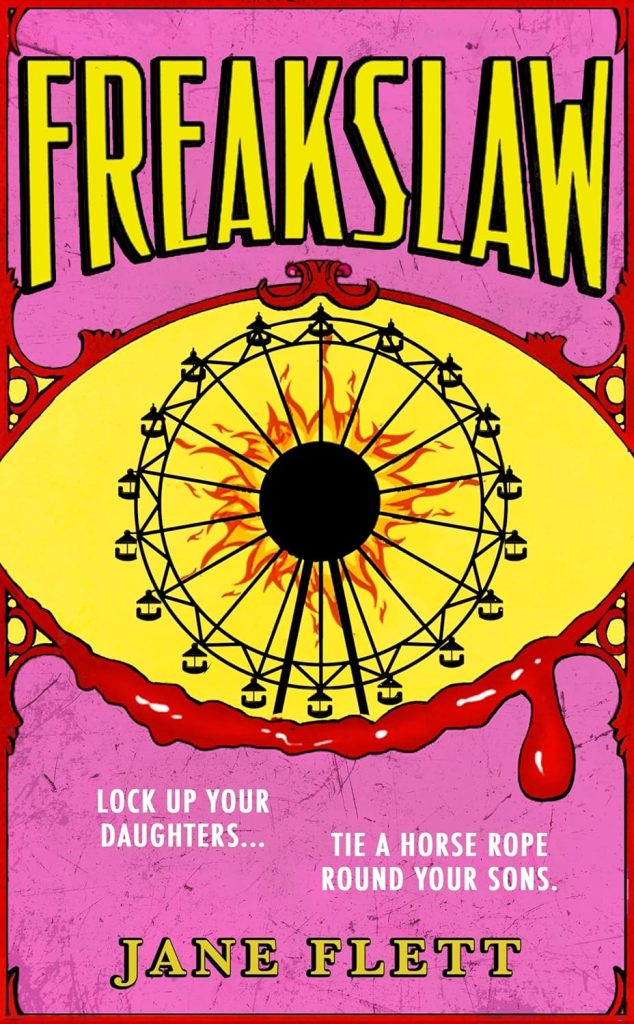
The dark and impenetrable forces of the occult dig their tendrils deep into the foundations of the small working-class Scottish town of Pitlaw in Jane Flett’s debut novel. Freakslaw is a psychedelic, hedonistic trip into the movements and machinations of the Freakslaw Circus, who pitch their tents in the struggling town with the intention of brewing chaos and change for the repressed locals. Suggestions of the governmental non-involvement that have plagued industrial Northern towns post-Thatcher, struggling factories as a result of waning capitalist projects and dubious political ideals run rampant here; poisoning its locals with the casual racism, misogyny and insularism that ensures they will never find it within themselves to challenge.
Flett’s bleary magical realist style has teenage witches luring in the town’s prime womanisers, conjoined twins stealing from the Co-Op, the heavily body-modified Pin Gal performing magic tricks in the pub, and the so-called ‘Werewolf Louie’ setting his sights on the local hairdresser. This blending of the two worlds – so enjoyably jarring for their differences – sets a highly entertaining and original backdrop for Flett’s mental and spiritual war to unfold in front of, as the Pitlaw locals find deep emotions and beliefs stirring in the depths of their souls they had never before even noticed. The novel questions the very nature of the occult by forcing it to live so closely alongside the painfully mundane – is it merely just a force that all humans possess within them? Does it take something with such intent for chaos and hedonism as the Freakslaw Circus to set it free and challenge the idea that towns like Pitlaw must live in the same bleakness forever?
The novel revels in its own filth – darkly occult, sexual, daubed with greasepaint, slick with oil, smelling of fried onions and popcorn and undulating with the gaslights. Flett’s creation of the Freakslaw Circus is masterfully three-dimensional, a ticking bomb slumbering on the outskirts of a town that is terrified of it and the differences to the status quo that it represents. The circus becomes almost a living being as it beats from within once the sun goes down, sending out searching fingers for locals to devour. Teenage witch Nancy – animalistic in desire and action, impossible to properly like or dislike so base are her impulses – draws in the repressed, the hypersexual; challenges these entrenched Pitlaw beliefs simply by existing. Circus hand Jed offers a reprieve for the questioning, the mistreated. The Twins – a conjoined brother and sister – spread alternative options for the grey lifestyles that have come to imprison the locals living them. Flett’s proud circus freaks offer a subtly altered way of living, an embracing of that which makes them different rather than the Pitlaw desire to stamp it out – and the almost chemical reaction of the locals once the freaks spread out into the town and begin to draw them in is as deliciously satisfying as if these traps had been personally set.
This idea of embracing freakery is, in the novel, the only way to challenge the damaging ideals that have ossified in Pitlaw across generations. Blood rituals take place as the locals start their breakfast, blurry psychedelic parties begin as they settle down to sleep. The circus is a funhouse mirror, aptly; twisting the town into a towering alternative version of itself. Bi-curious Derek sees in this circus a freedom from his abusive father, academic Nancy sees a reprieve from the stress of solidifying an exit out of Pitlaw to University, weary and unappreciated housewives see a glimpse of their former golden youths when they were powerful and free. Flett’s creation of Freakslaw as the answer to the deeply buried inner desires of the locals, and yet simultaneously a hostile, enemy entity seeking to destroy all that defines them is not only the keystone of the novel’s dynamism and strikingly believable human experience, but a subtle and intelligent commentary on the way that society is – and always has – continually beaten away chances to change for the better, stabs at freedom and acceptance, in favour of a stringent status quo and embracing of arbitrary social positions and powers. In a sense, then, the novel acknowledges why and how power is drawn from these social rules, these entrenched ideals and beliefs, and understands their generational and locational power as something that needs much more than simply temptation to begin to crumble. ‘Freakslaw’ questions where that social authority comes from, demands to know who has given anyone the right to decide what constitutes ‘freakery’.
The novel’s pacing almost feels like it mirrors the psychedelia that Flett has woven into the narrative – synesthesia, time dilation, uncanniness and strange knowledge seemingly from nowhere – as though the novel dips and weaves along with a real summertime. Warm, hazy, sensual and alive, Flett’s setting is made so rich by her darkly lyrical writing style – highly original and almost poetic, striking in the confidence and completion of its sound for a debut novel – that the novel almost physically feels as though it lasts the entire summer. Characters are richly fleshed, interactions and relationships build slowly and believably, the influence of Freakslaw spreads slowly, and the novel feels almost alive as a result; it is strikingly present from the moment the circus arrives to the towering climax that its war with the town reaches. The slow, almost lethargic build of violence, sex, and chaos can be felt as the language and actions become denser, realer – focusing on the base animalism of humanity with Flett’s repeated attention drawn to the body; blood, hair, sweat. These human bodies, freaks or not, become the conduits for a kind of cerebral cultural warfare that has been brewing for generations, building karmic power and questioning the strength of ancestral and geographical ties. Slowly, masterfully even, Flett’s depiction of the characters’ descent into the most base and primal versions of themselves; that which they had been simultaneously fighting against and yet pining for, means the novel itself simultaneously descends into the fundamental conflict it set out to illustrate – the war between that which we are, and that which society deems acceptable. The war between the versions of ourselves that fit into predestined social positions, and the versions that celebrate the knowledge that we are scarcely more than animals.
With Freakslaw, Flett touches freedom. Her circus freaks are the reminder that the only barriers to a true human experience – the distilled human essence of the pure enjoyment, danger, pleasure and fear of Freakslaw, the acceptance of the self in all its forms – are those that we have put in place ourselves. This cultural war that Pitlaw rages against the unknown, against the different and occult, is merely some violent, bladed jealousy that the circus freaks have seized these differences, seized this base animal freedom. Without dropping every rule and expectation they have hinged their lives upon, the locals of Pitlaw can never touch this same true freedom and experience the raw hedonism and beauty of living in the wild, in giving in to desires and ideas, in the radical acceptance of every facet of the human experience in every conceivable bodily and spiritual dimension.

FREAKSLAW is released in hardcover and digital editions on June 20th