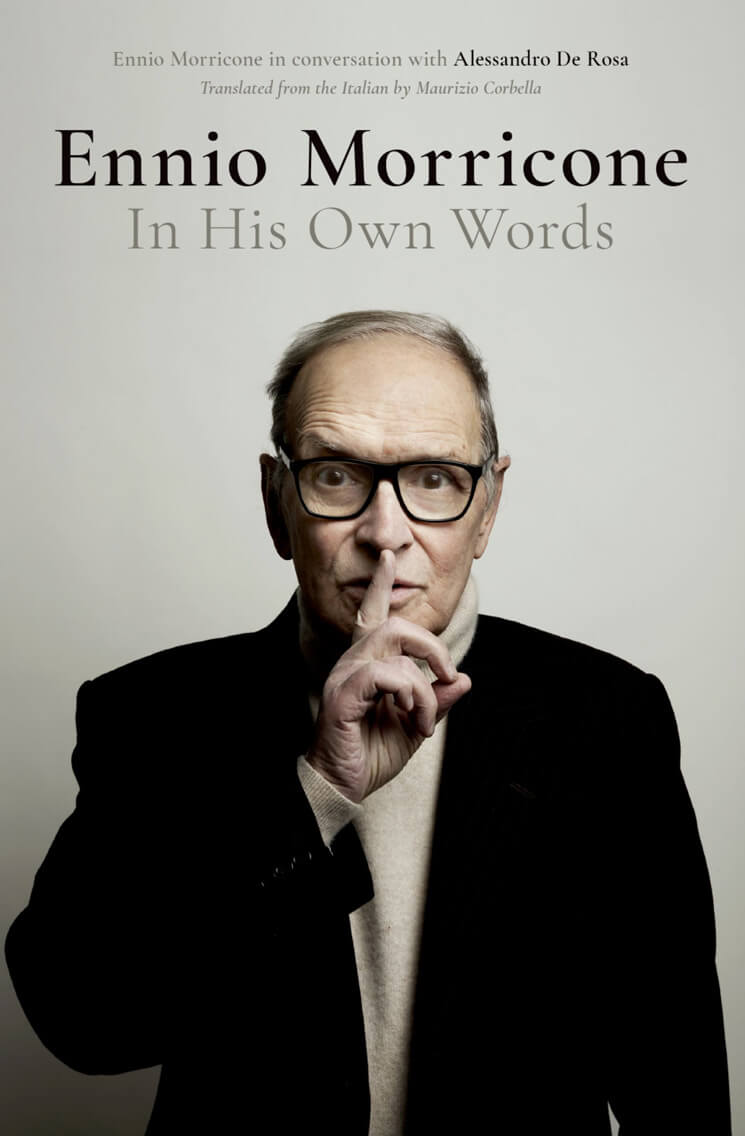
When it was first announced in 2016, the book Ennio Morricone: In His Own Words, seemed like it was going to be the definitive word on the maestro, as it consisted of a series of conversations between the composer and his friend and protege, Alessandro De Rosa. Sadly, when it was first released by Mondadori as Inseguendo quel suono: La mia musica, la mia vita, the whole thing was in Italian.
Thankfully, it took less than three years, and there’s now an English edition, translated by Maurizio Corbella, and released from Oxford University Press. It’s a densely-packed series of discussions between Morricone and De Rosa, covering the illustrious composer’s entire career. The question is: was the book worth the wait?
The answer: it depends. First of all, the flyleaf of In His Own Words states that “Opening for the first time the door of his creative laboratory, Morricone offers an exhaustive and rich account of his life, from his early years of study to genre-defining collaborations with the most important Italian and international directors, including Leone, Bertolucci, Pasolini, Argento, Tornatore, Malick, Carpenter, Stone, Nichols, De Palma, Beatty, Levinson, Almodóvar, Polanski and Tarantino.”
That’s stretching it. If a reader picks up this book hoping for a lot of discussion regarding Morricone’s work as a composer of film scores, that will happen, and there are some very interesting facts at the outset. The first 30 pages or so of In His Own Words contains some really interesting trivia regarding Morricone, such as just how far back he’s known his most well-known collaborator, Sergio Leone. The various jaw-dropping bits of trivia might not reveal much in the way of the composer’s process, but they certainly tell a lot about the man.
For the most part, however, the book is a look at Morricone’s creative process and his concepts regarding composition. About halfway through In His Own Words, the composer says, “Music springs out when I’m faced with the challenge to conjure up an idea, to give birth to it. Sometimes the idea may come up later, sometimes it may not materialize at all; other times it may show up randomly. When any of the above happens, I can either abort the idea, or elaborate it, or even transform it into something different.”
From that point on, the conversation becomes less about film scoring in particular, and more about how the maestro’s approach to music works as a whole, and where he sees music in the world. It’s fascinating, but it’s really quite a deep dive into the world of music theory and the modes in which one has to work to create pieces which endure for the listener and composer both.
Thanks to Alessandro De Rosa’s in-depth knowledge of Morricone’s life and work, Ennio Morricone: In His Own Words covers the composer’s work with a depth rarely seen in books about film scores. While the breadth of material covered doesn’t necessarily get as much into his relation to the pictures themselves as a casual fan might like, those looking for true insight will find themselves enraptured.
ENNIO MORRICONE: IN HIS OWN WORDS / AUTHOR: ALESSANDRO DE ROSA IN CONVERSATION WITH ENNIO MORRICONE / PUBLISHER: OXFORD UNIVERSITY PRESS / RELEASE DATE: OUT NOW