 This double DVD set, selected by the British Film Institute (BFI), chronicles the many changes going on in the drab post-war years. These changes were occurring in British society and in the way the BBC itself produced television documentaries.
After the war the BBC had wanted to broadcast newsreels that were being produced for the cinema, but when the newsreel companies refused to give them permission, a separate film unit was organised to provide a regular BBC Television Newsreel series. These were filmed in 35mm format and the unit soon became the basis for its documentary productions.
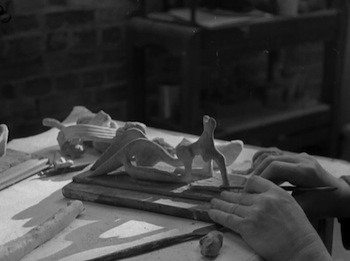
One outstanding early BBC documentary, included in this set is John Read’s 1951 look at the work of sculptor Henry Moore. It focuses on him working on his Reclining Figure for the Festival of Britain, and the processes he used to create this work of art. The commentary written by Read and spoken by actor Bernard Miles, is a rather schoolmasterly explanation of how Moore’s work takes an abstract look at the human figure and integrates these forms with the landscape and with the nature of the materials he uses. Music composed by William Alwyn elegantly accompanies the many views of Moore’s sculptures both in the studio and in the presence of nature where they belong. The sculptures are rotated and seen from different angles to show-off the play of light and shade on their smooth curvaceous surfaces, underlining their form and beauty. There is even a segment where Moore addresses the camera, and it’s great to see a brief glimpse of him at the end looking like he can’t get away from this fate-worse-than death!
Whereas, Henry Moore is a traditional form of documentary shot on 35mm film, the Test Flight programme broadcast in the Eye on Research series in 1959, uses new techniques that bring the immediacy of television images to the audience. Using outside-broadcast cameras over six series, from 1957 to 1961, they visited research establishments and laboratories to provide live coverage of the latest advances in science. Test Flight edited by Aubrey E Singer is a prime example of these programmes. Presented by Raymond Baxter, he interviews test pilot Squadron Leader S J Hubbard before he sets off to create a sonic boom. It provides the story of this test flight as it happens, using interviews with scientists and pre-filmed sequences to show the effects of a sonic boom when the aircraft passes the speed of sound. Looking at it now it looks like a supreme work of logistics and organisation.
In contrast to the sobriety of the science and factual programming, there was room for more experimental filmmaking using mobile and versatile 16mm cameras to catch glimpses of modern Britain. A good example of this is Ken Russell’s Pop Goes the Easel that imaginatively looks at the fantasies of four young artists, and is itself a work of pop art using a combination of hand-held cameras and rapid editing.
John Schlesinger, who like Russell, also went on to direct feature films, produced in 1957, Song of the Valley that is a 3 minute-long mix of fact and fiction in the streets of Halifax. Two years later, Morning in the Streets, takes an impressionistic look at life in the backstreets of a Northern City. Using a more autobiographical format Dennis Porter in 1960 viewed the changing lives of people in Between Two Rivers. He visits the Forest of Dean where he grew up, and shows how changes in traditional work and life is affecting individual lives and communities. In 1964, Philip Donnellan explored the lives of Caribbean people in Birmingham, which examines and explores the traditional view of Britain and Empire. The set is rounded off by Dispute: Round 1 and Dispute: Round 2 that uses the fly-on-the wall format to observe the two sides of an industrial battle between the workers and the management of a haulage company.
These wonderful, grainy, monochrome TV programmes from the 1950s and 1960s, are like transmissions from another planet and make you appreciate the versatility and imaginative output of the BBC in those eventful years.
VISIONS OF CHANGE: THE EVOLUTION OF THE BRITISH TV DOCUMENTARY VOLUME 1: BBC 1951-1967 / DIRECTORS: VARIOUS / RELEASE DATE: 14TH DECEMBER