Flux’s opening episode introduced around ten major plot threads in one go, and as the series has gone on, more and more characters and storylines have joined the fray. We’ve been saying all along that our judgement on this six-part epic will rest on how well the many strands are wrapped up by the end, and now The Vanquishers has aired, well…
Hmm.
It’s certainly true that this episode had a lot that it needed to do to provide a satisfying conclusion, and it’s also true that a lot of things happen in this episode, though they’re not necessarily the same things.
After all the build-up around new villains Swarm and Azure, and around the Doctor’s hidden past with the Division, Flux ultimately decides that it wants to spend most of its final hour being a Sontaran story – not only retreading invasion story tropes we’ve seen many times before, but retreading the Sontaran invasion we had four episodes ago.
Despite all the added stuff about infiltrating UNIT and breaching the Lupari shield, it’s another case of the world being covered in Sontaran ships; there’s an odd lack of escalation between the two invasions, as if Chris Chibnall forgot he’d done this bit already. (An easy solution could have been for episode 2’s Sontarans to be present in Liverpool and historical Crimea only, and for its mentioned-but-unseen global invasion to be held off until this finale.)
Let’s not be too grumpy, though – some of the Sontaran stuff has a lot going for it. The chocolate-addicted Sontaran is a fun comedy scene (yes, it is, don’t pretend it isn’t to look grown-up). The second half finally ramps stuff up, leading to a big space sequence with some impressive visual effects – as cinematic as Doctor Who’s ever looked. And there’s an edge of original satire in the idea of the Sontarans taking advantage of a major disaster.
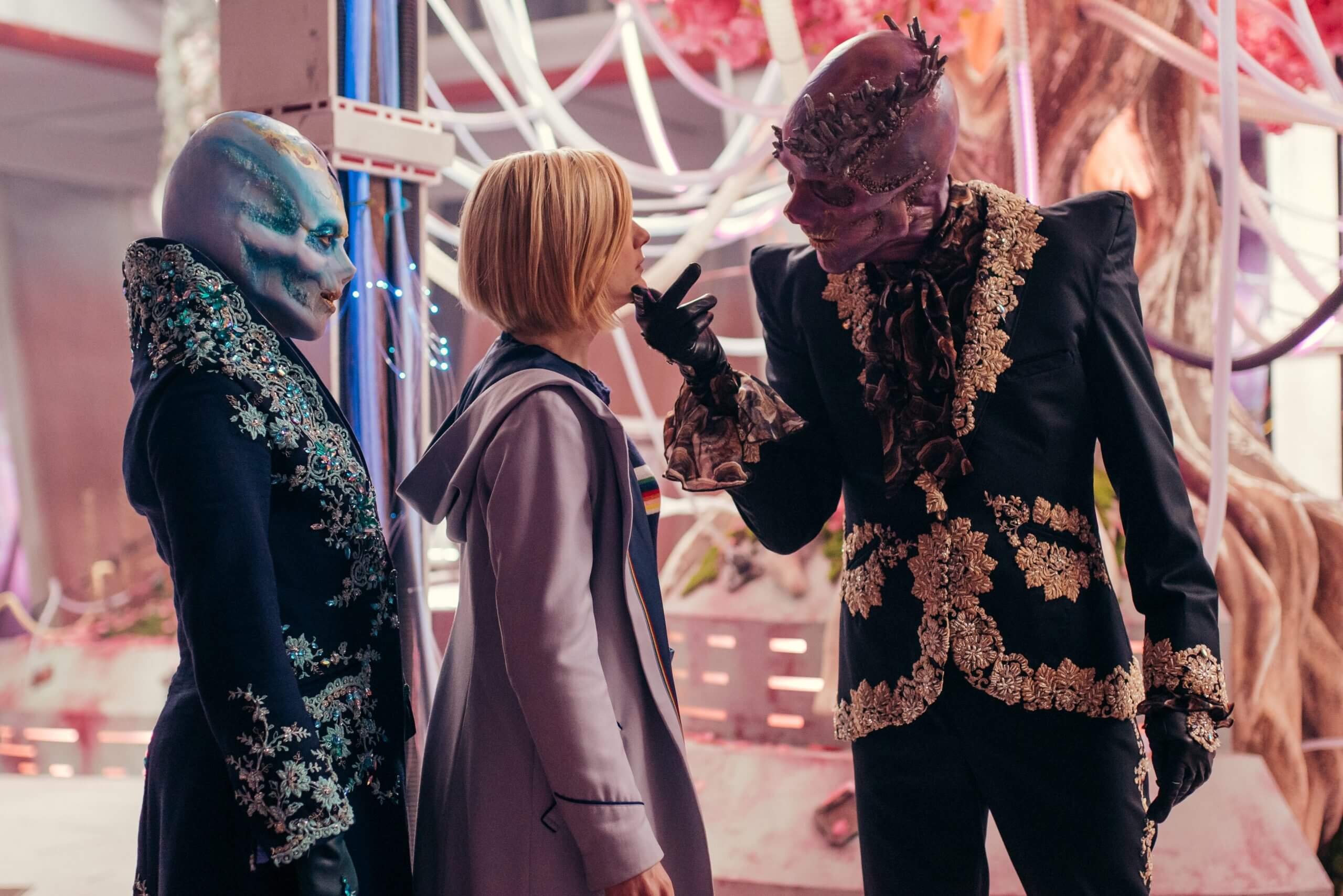
But, poor Swarm and Azure. Set up to be the big bad of the season, they’re relegated to second billing here, and we end the series still not sure who they actually are. Sure, there’s another elongated sequence of the villain expositing stuff at the Doctor (after the Master last finale and Tecteun last episode), but what did it actually explain?
So they want to do a big old Flux, which is also what their sworn enemies the Division were doing, making their killing and taking over the exposition role from Tecteun rather pointless (the Flux threat is no different despite the villains controlling it having been swapped – like with the Sontarans repeating their previous invasion, where’s the escalation?).
And they were doing all this because they like death, and they think it’s silly that the Doctor likes life, is that it? The Doctor has what’s meant to be a deep philosophical argument with Azure, full of mythic-sounding but meaningless drivel such as Azure declaring her desire for “the end of all spatial objects”, and the only meaningful conclusion that can be drawn from any of it is “death bad, being alive good”. Not exactly Sartre, is it?
They don’t even get a climactic confrontation with the Doctor. We remarked last week on the problem of Jodie Whittaker’s Doctor often being written as passive, not standing up to the baddies, and here we get the apotheosis of that – her standing by as the main villains of the series are randomly offed by a literal deus ex machina.
It’s such a confusing and arbitrary ending. This idea of a god-like being saving the day isn’t a first for Who – back in Series 1’s The Parting of the Ways, Rose’s transformation into the Bad Wolf entity allowed her to wipe out the Daleks, and in Series 3’s Last of the Time Lords, the Doctor rose from near-death in a Christ-like manner due to the power of hope, or some nonsense. But while both those plots hardly stand up to scientific scrutiny, Russell T Davies’ writing made them work as the culmination of character arcs, dependent on active effort by the heroes, and as big triumphant moments we could buy into. With ‘Time’, and their very clumsy foreshadowing (“Beware the forces that mass against you and their Master.” / “Their Master? I have no idea what you could possibly mean by that!”), Chibnall is imitating the aesthetic of a Russell T Davies finale but without understanding what makes those things work – it’s an image based on an image with no basis in character or reality; an empty simulacra of a story.
No, Time’s destruction of Swarm and Azure is just another thing that happens, in an episode full of things just happening and characters just standing around. It’s the same Wikipedia-style storytelling that blighted Survivors of the Flux. This person’s here and now this person’s here too and now this person’s gone – when they send Joseph Williamson home, they almost literally say “Your function in this plot has been completed.” There’s no respect for the old screenwriting adage of “show, don’t tell”; Kate Stewart, more than ever a piece of iconography rather than a character, tells us she’s leading a human resistance, but all we ever see her do is stand around in a tunnel; the Lupari are massacred off-screen. It’s difficult to care about any of it.
With everything so hectic, Chibnall’s script is focused on ruthlessly moving the plot forward and never stops to reflect – all action, no reaction. Jericho dies, and we get a two second shot of Yaz looking sad, then we move on. We barely take a moment to reflect on what the loss of the Lupari means for Karvanista, let alone the Doctor.
Scenes are cut away from in a rush to get to the next thing. Stopping the Flux should be the big triumphant moment of the episode – the series, even. A collection of characters are assembled in the TARDIS at this point, in a similar manner to another Russell T Davies finale, Journey’s End. In that one, as they save the universe and bring the Earth back home, Davies relishes in showing the characters celebrating together, giving each and every character a moment. It’s triumphant, a scene that gets you up and cheering at the screen. Here, within a couple of seconds of the Flux being destroyed, the episode cuts away to the next thing – not a moment to celebrate, to reflect. The same happens with the Grand Serpent being left on the asteroid – just a few more seconds of him reacting to his new exile would make the scene so much more impactful, but we’re not allowed that. All action, no reaction; all plot, no character.
The biggest thing that’s swept out of the way, however, is surely the state of the entire universe. In The Halloween Apocalypse, the Flux destroyed something like ninety percent of the universe, the repercussions of which were seen across the series. Here, it was hinted that the Division had the technology to reverse that damage. A clear set-up for the Doctor to fix everything, right? But, as far as we can tell, neither she nor anyone else ever did. So, in a show about exploring space and time, the status quo is now that the majority of the universe is gone forever? Can’t wait for the next lot of writers to completely ignore that, as well they should.
The exception to this lack of reflection comes towards the very end, when the Doctor apologises to Yaz for hiding her intentions; a slower moment that allows for a rare and satisfying moment of character development – appreciated by us and by Jodie Whittaker and Mandip Gill, who finally get to remind us they can act when given the material.
So. Looking back on the past six episodes, then…
On the plus side, Flux was an ambitious change of tack for Doctor Who, and we’ll take ambitious but messy Who over boring played-safe Who any day. It’s a show that’s lasted for almost 60 years because of its ability to change and try new things – to flux. This year’s series was bold enough to dive deep into big mythical ideas, it introduced some fun new characters, and from a visual perspective – effects, costumes, cinematography – it was the best Doctor Who’s ever been.
But, it failed to translate those ideas and aesthetics into a meaningful or even coherent story, and it let its new villains fall by the wayside to make way for stuff we’ve seen before, but without what made those things work. A big epic like this would always depend on how everything comes together at the end – which is a risk when we have a showrunner who’s disappointed with both his finales so far. For a third time, he disappointed here. The Vanquishers leaves us with the impression that none of this interconnected epic actually connects, nor does it have much to say.