PLATFORM: PC, PS5, XBOX SERIES (REVIEWED) | RELEASE DATE: OUT NOW
Oh boy, this is going to be a tricky one! Crimson Desert, from Korean developer Pearl Abyss, started life as a follow-up to the beloved MMO Black Desert Online, before plans changed and the game turned into a massive (like, really massive) single-player RPG. It borrows so many systems from such a wide range of games that we’d be here all day if we tried to list them all, but let’s have a brief attempt at giving you a few examples of what to expect:
Fishing, horse racing, gambling, mining, bounties, cooking, crafting, collecting materials, researching new abilities, tons of upgradeable gear with unique perks, interchangeable abilities, skill trees, additional characters to swap between, camp management, the list goes on. We’re really only just scratching the surface here – it seems like if an RPG mechanics is worth having, Crimson Desert has most likely got it, but despite the plethora of well-used mechanics leading to an overwhelming sense of comfort and familiarity, it manages to end up feeling like its own thing.
Stepping into the role of Kliff, a member of the Greymane faction on a quest to find his followers who have been scattered across the land after being attacked by Myurdin and his Black Bears, you’ll work your way through a main questline split across 14 chapters and almost 170 missions. Along the way, you’ll meet countless factions who require your assistance, leading to hundreds of additional side quests. While its story isn’t the greatest – it amounts to “find your mates and beat the evil man” – and the quality of the dialogue is questionable at best, there’s so much to do that the path that you take through the game is likely to be uniquely your own.
The first three or four chapters serve as an extended tutorial, sending you on endless fetch quests while introducing you to the game’s main mechanics and systems. It can honestly be a bit of a slog to get through, and things don’t really get going until you reach chapter 6 or 7 (potentially 50+ hours into the game…), by which time you will have got the hang of what the game expects of you and everything starts to feel like it’s all coming together. Even then though, there are likely to be plenty of things that don’t quite make sense, and there will be a lot of skills and abilities (and indeed entire questlines) that you’ve barely touched. Crimson Desert has a habit of introducing things too quickly, giving you new quests, activities and toys to play with way before you’re anywhere near being ready to handle them. For some, that might be part of the charm – you’re given a ridiculous amount of possibilities, and it’s totally up to you if you want to work your way towards being able to tackle them effectively – but others might be frustrated by the overall lack of direction.
While exploring Crimson Desert‘s five distinct areas, you’ll come across plenty of puzzles, which prove to be one of the game’s strongest points. Many of them are extremely obtuse and are often solved with either a very keen eye (clues can be found through determined exploration) or simply a lucky guess. Others, such as the sprawling puzzle-platforming Abyss – a series of floating islands that are almost big enough to count as a seperate game all of their own – are more skill-based, challenging you to use the abilities that you’ve gained to find the solutions to its many problems. Offering much-needed Abyss Artifacts (upgrade tokens) as a reward for completing each puzzle, having to solve at least a few of these puzzles is almost unavoidable, but those of a more cerebral nature are likely to find them very enjoyable indeed.
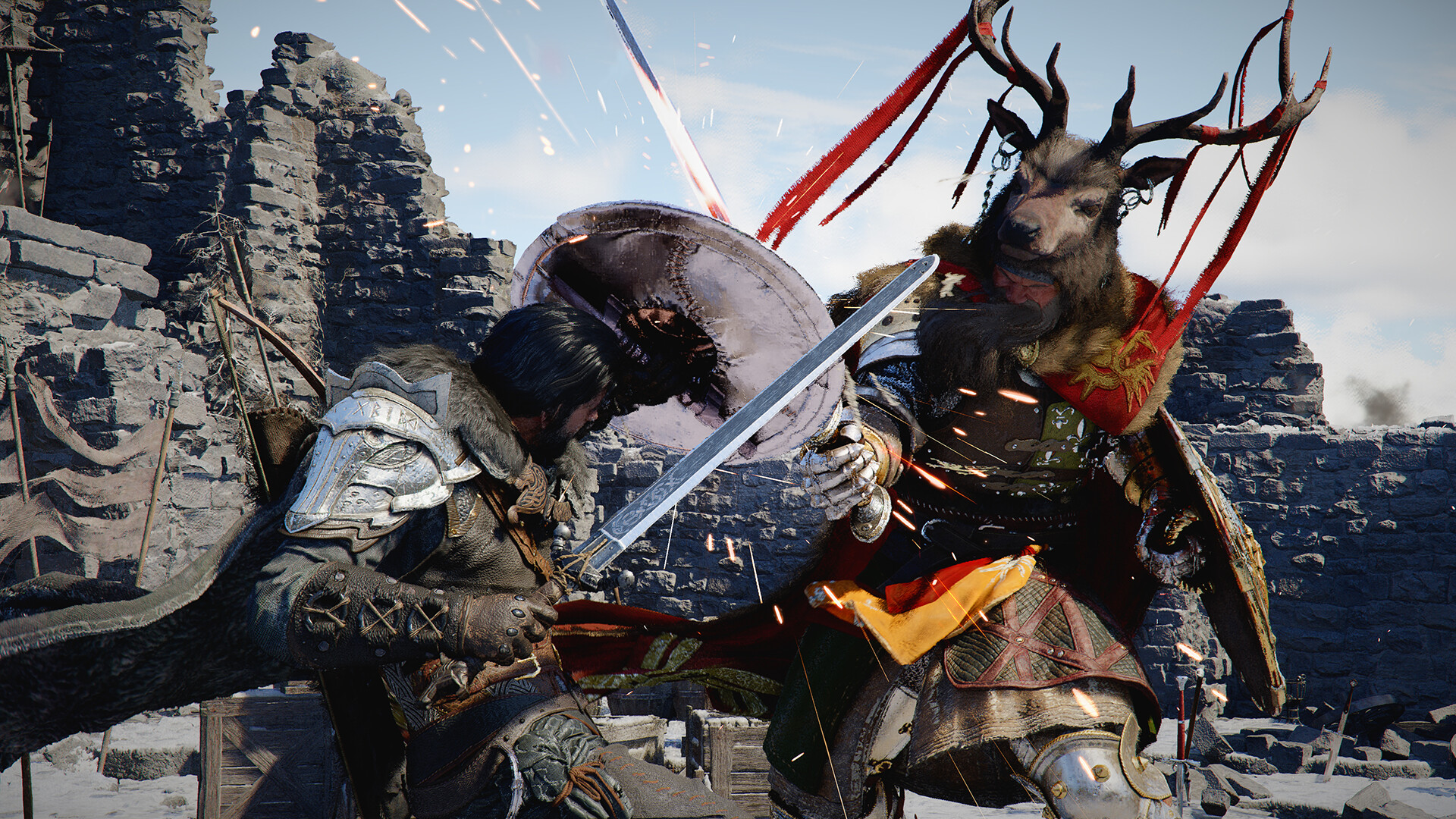
Crimson Desert‘s other highlight is its combat, which feels weighty and impactful no matter which type of weapon you choose to wield. There are plenty to choose from, including one-handed swords and maces, two-handed longswords and axes, and bows with a variety of arrows. As you progress, you’ll learn how to find and equip Abyss Cores to your weapons and armour, adding new moves and abilities to your loadout, as well as unlocking additional abilities within Kliff’s skill tree. It takes a while to get there, but when everything finally clicks into place, it’s some of the finest RPG combat of this console generation. It’s a slight shame, then, that boss fights – despite often being memorable in design – aren’t the most engaging, with repeated fights, bosses that flee before you can kill them, and victory depending more often than not on whether you remembered to bring enough healing items with you.
After reaching the end of the story, you’re likely to have a lot of side content to work through, whether that’s hunting legendary beasts, flying your dragon around just for a laugh, creating outlandish weapons and tools in the Kuku kiln, or mopping up faction quests. Spending more time in Crimson Desert‘s world is no bad thing, as the environment is an absolute treat in the visual department. On high-end PCs the scenery is almost jaw-droppingly beautiful, and although consoles fare slightly less well it’s still an incredibly handsome game whichever platform you play on.
With so much going on, Crimson Desert is an extremely ambitious and unique game. For everything that it does right, it seems to take slight mis-steps at the same time. Exploration is fantastic but the controls are peculiar to say the least, combat is excellent but the rewards for completing missions rarely feel satisfying, there’s an admirable variety of characters and enemies but the dialogue and voice acting leave something to be desired… There’s a truly exceptional game in there, but there’s also a lot of things that seem to stand in the way of letting you fully enjoy it. Whether that’s down to the game’s Korean origins and its sensibilities not quite translating well to a western audience, a hangover from its early days as an MMO that’s been repurposed as a single-player title, or if it’s just questionable game design, is something that could be debated for years to come. Several patches have already been deployed in the couple of weeks since release to address the most egregious shortcomings, so there’s hope that over time it might become a slightly more friendly game to play.
So how does one give Crimson Desert a score? There are plenty of undeniably great elements to it, its ambition should absolutely be applauded, and the fact that they even got such an insane piece of work to function (almost) properly in the first place is almost miraculous. At the same time though, the structure of the game and its pacing make it difficult to really get fully invested, for every positive aspect of its gameplay there’s also a negative to counteract it, and the lack of an engaging narrative means that there’s nothing to really push you through those opening few dozen hours other than a heck of a lot of busywork with very little reward. When it hits its stride though, it turns into the sort of game that’s difficult to put down, but frustrations can build up over time and lead to an overwhelming sense of apathy. The need for changes and updates is pretty clear, but the potential is definitely there for Crimson Desert to become something very special in the future. For now, a solid 6 out of 10. Just make sure you’ve got plenty of time to spare…