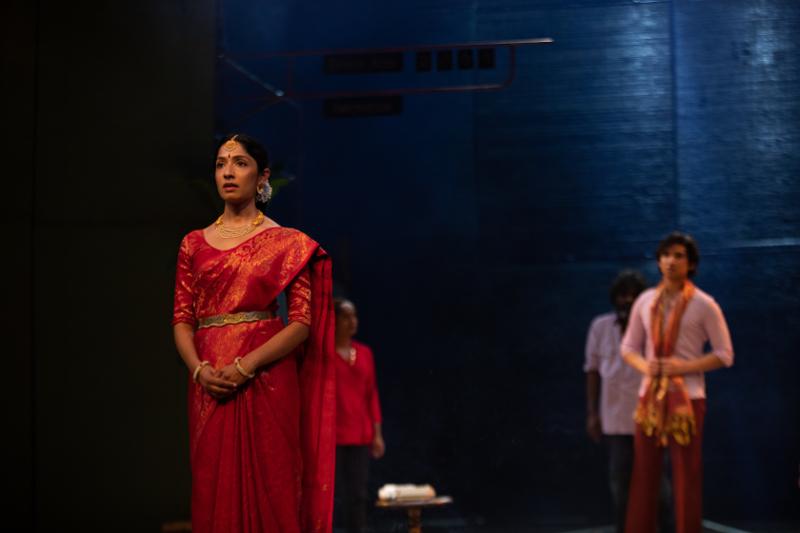
This is an epic piece of Sri Lankan / Australian theatre, from Sydney-based company Belvoir, currently playing as part of the Edinburgh International Festival.
The story focuses on Radha, and her son, Siddhartha, known as ‘Sid’. Radha (Nadie Kammallaweera) and Sid (Shiv Palekar), live in Sydney, although Sid has moved out of his mum’s flat so that he can have the full student experience. Whilst Sid is Australian, having been born in Sydney, Radha is a naturalised Australian citizen, having been born and raised in Sri Lanka. As is often the case in theatre, Radha’s personal history is intertwined with that of the fledgling republic, and Radha has a front row seat to the political intrigue and debate, due to her family’s position in Sri Lankan society.
The narrative leads us on a journey through modern, post-colonial Sri Lankan history, as Radha’s family, a part of the Tamil minority, tries to reason and negotiate with representatives of the Sinhalese majority. Much of the discussion revolves around the use of language – an imposed English is known to everyone, although government jobs are only available to those who have the “correct” qualifications in the language of the coloniser. The proposed changes will mean that those fluent in only Tamil will be excluded from participation in almost every area of civic life, as Sinhal will become the language of government and the civil service. The differences between the two are implied to be not merely linguistic – imposing the use of Sinhal will materially shift the culture of the nation as a whole. The stance of the characters summarises the problem: “If you change the language, you change the country”, and “Two languages equals one country”, “One Language, two countries”. In the background, this change of language emboldens the emerging call of the Tamil people, and their militant wing, the Tamil Tigers, to begin taking direct action against the government it felt was seeking to suppress the Tamil population.
Whilst Act 1 takes place mostly in 2004, it is in Acts Two and Three when the storytelling becomes more fluid, moving backwards and forwards across time and continents, from 1956, through 1983 and back to 2004, as we witness the broad sweep of politics making the national highly personal. We see Radha as a babe-in-arms, a young woman, and a widow in her late forties. We meet her family – her grandparents, her son, a younger version of her husband, presumed dead in the 1983 riots against the Tamil population of Sri Lanka. We see Radha’s friend, a journalist on an independent newspaper, and we see the Indian Tamil man, presented as somewhat opportunistic, who buys her house and eventually becomes, it is implied, a middle-man in the supply of arms to both sides of the Sri Lankan conflict.
This is a dense story, and the three and a half hour running time is justified as it allows the necessary space for the story to be told. The running time is also reflective of the nature of South Asian theatre, and so reflects the diaspora whose story is being portrayed. In a further acknowledgement of the origins of the story, an on-stage group of musicians accompanies the actors, carefully positioned stage left, out of most of the direct action, but very much a part of the world of the play. The cast of nineteen, and the three musicians are drawn from Australia, Sri Lanka India, France, New Zealand and Malaysia, reflecting the global nature of the story, even if the focus is on one family.
Away from the direct narrative of Sri Lankan political history, this play also asks us to consider who we are, and where we fit into the story of the country that, however temporarily or permanently, we call home. The notion of home is often fluid, and rarely fixed. Even if a person remains in one country, they can move home, and have different motives for their relocation. Australia in this play is represented by Abbie-Lee Lewis, a Kalkadoon woman, portraying Lily, an aboriginal woman who has come to Sydney to learn law, “the white man’s words”, to then use her knowledge to defend and fight for her people’s rights. It’s a reminder that Australia continues to privilege the white Anglo-Australian settlor colonial descendants, even in a country which is increasingly multi-cultural. Presented in English, Tamil, Sinhalese, Yolngu Matha and Turkish, it’s notable that almost all the characters, barring Sid, are bi-or multi-lingual. The translations to English are for the benefit of the audience, more than for the characters.
This is an impressive and detailed work of theatre, in which every word of dialogue, every prop and costume on the stage, every translation, every statement, has been carefully considered and executed. Everything becomes slightly messy in the third act, with a couple of moments that felt rushed, but that is reflective of the narrative as a whole – life is messy, and after waiting decades, sudden change can happen almost instantaneously.
This play makes you think, not just about the luck which allows us all to live in the comparative peace of the west, but also about what would push us to abandon all that we have known if circumstances around us change. It also forces us to realise that, even if we think we are in a privileged position, our situation can change, almost in an instant, and that we must resist the rise of those who would curtail our freedoms, in the name of amplifying their own power. This production will leave you considering your place in your society and your nation long after the curtain has dropped. Highly recommended.
Counting and Cracking, Edinburgh International Festival, 9-14 August, https://www.eif.co.uk/events/counting-and-cracking and Birmingham Rep, 19-27 August, https://www.birmingham-rep.co.uk/whats-on/counting-and-cracking/