THE COLOSSUS OF NEW YORK (1958) / CERT: PG / DIRECTOR: EUGENE LOURIE / SCREENPLAY: WILLIS GOLDBECK, THELMA SCHNEE / STARRING: ROSS MARTIN, OTTO KRUGER, JOHN BARAGREY, MALA POWERS, CHARLES HERBERT / RELEASE DATE: AUGUST 5TH
Top scientist Jeremy Spensser (Martin) is on his way to collect the prestigious ‘International Peace Prize’ with his family. His stupid son Billie has a tantrum when he drops his cheap toy plane. Dad dutifully rushes off to retrieve it and is knocked over and killed by a truck. Fortunately, his father, William (Kruger), is a top brain surgeon and he decides that, as the world really can’t do without his son’s genius, he’d better transplant his son’s brain into a big ugly, towering artificial body so that he can carry on his good work even after the expiration of his mortal form. But Jeremy is, not unnaturally, tormented by his plight and his loss of ‘soul’ and, in time, he starts to go mad as he loses sight of his humanity.
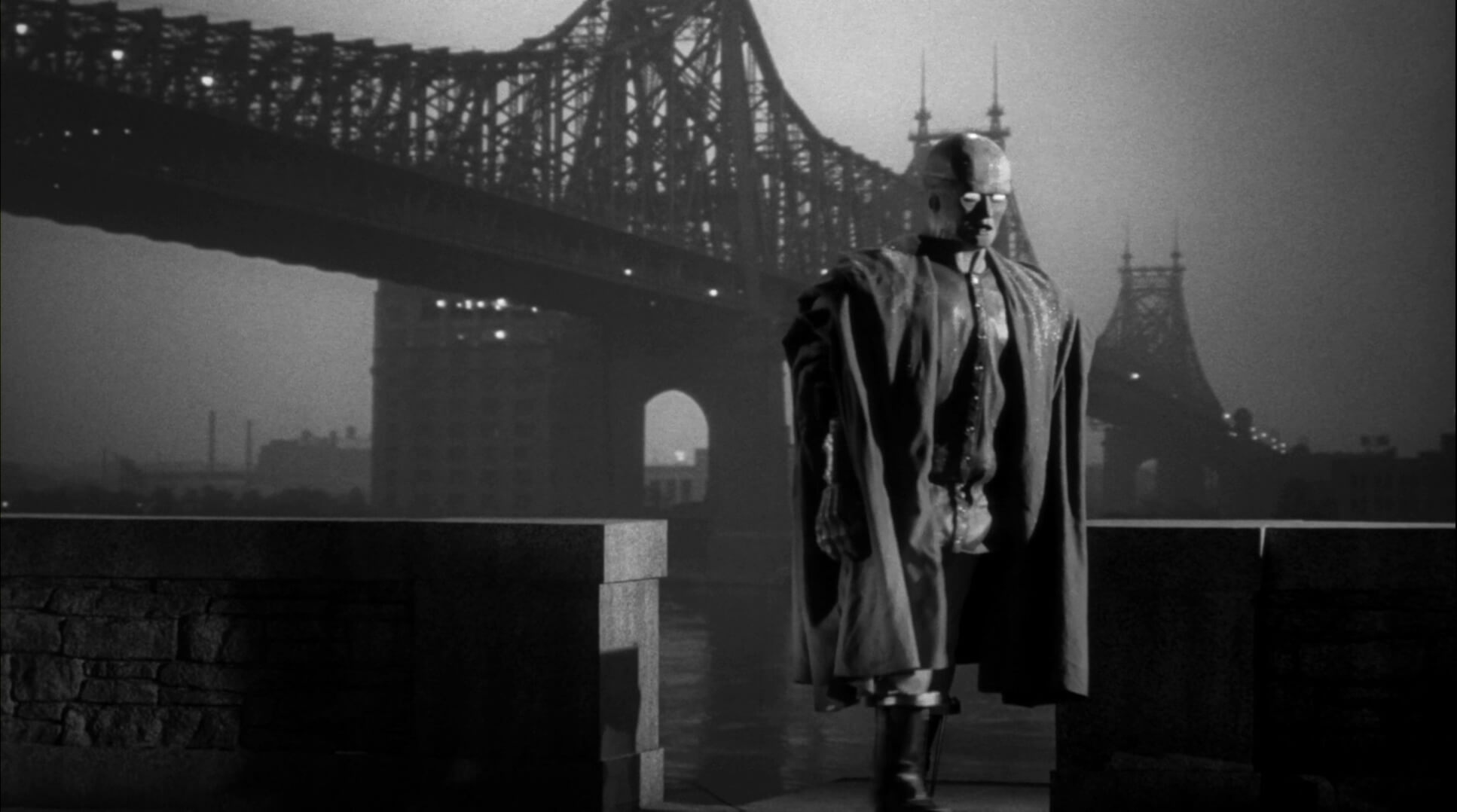
The Colossus of New York – a 1958 variation on the Frankenstein story, of course – hasn’t worn as well as many of its black and white science fiction contemporaries, mainly because it looks so cheap and runs for just seventy minutes. Quite why William decides to put his son’s brain in such an a massive, ugly robot body is never touched upon; the thing has a big wooden head, wears a massive carpet-like cape over its shoulders and speaks with a voice which crackles with electrical energy. He also somehow develops the ability to fire a death ray from his eyes, which he uses to devastating effect in a massacre at a (distinctly underpopulated) United Nations event at the film’s climax.
The Colossus of New York is saved from the annals of cheap and forgettable B-moviedom purely by virtue of the fact that its core idea – a disenfranchised brain placed in an unfamiliar and entirely unsuitable body – can’t help but be a little disturbing. Robert’s ‘voice’ when he awakens and realises his fate, is quite eerie and unnerving and we genuinely feel his increasing despair as time wears on and he becomes less and less human and more and more desperate. But the film is too simplistic and clumsy to properly explore the ramifications of Robert’s plight and consider just how horrifying his life after death really is. It’s content just to deliver us a big robot which goes mad and kills people before being brought down. The final sequence carries some poignancy, though, as a tear (or it is a splodge of oil?) leaks from the Colossus’ eye-slot after the creature has been toppled.
Hampered by poor production values and a histrionic script, The Colossus of New York is inevitably one of the second-tier 1950s SF movies and yet it’s not without its charms and there are a few effective moments and memorable images which have helped give it a certain reputation and notoriety across the years.