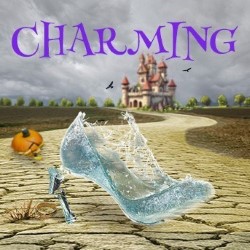
Charming is a play that asks the question: what happens if your ‘Happy Ever After’ is anything but? Cinderella wants a divorce, and the Fairy Godmother is here to deliver Cinders’ list of demands.
This three-handed piece has many of the hallmarks of a classic British one-act play, of the type that used to form the bulk of submissions to local drama festivals: a familiar situation, played with in some way, and a resolution reached that at least suggests that all loose ends have been tied up. The best examples of such plays were tightly written, smartly directed, and featured actors who had ground their skills, often over decades.
What we get here is something of a confused confection. The idea is strong – the perceived restrictions of fairy tales are increasingly being examined, and fresh interpretations given to what might have happened next. It’s great to see some older actors on stage, a demographic that’s all too often overlooked when plays are being written, or cast.
However, it’s in the delivery that this play needs some development. The script opens with an awkward scene of Prince Charming either talking to a silent someone off-stage who also can’t be seen, or to an unheard voice on the other end of a telephone call. It makes for a really stilted beginning.
From there, the Fairy Godmother arrives, and we suffer costume whiplash. Whilst the Prince is dressed in what would be recognised as a ‘classic fairy tale Prince outfit’, the Fairy Godmother looks like her outfit has been acquired from Primark and Shein. Leopard print leggings and a skirt meet a bright pink t-shirt with wings on it (presumably because Fairy Godmothers can fly?), and trainers. Towards the end of the show, Cinderella’s step-mother arrives, dressed in what could be (and quite possibly is) a costume eminently suited to Lady Bracknell from Oscar Wilde’s The Importance of Being Earnest.
The actual dialogue is often clunky. A further revision of the script, or another six weeks’ of development, and the assistance of a dramaturg, would have helped matters greatly. As it is, there are almost no sympathetic characters here – not even ones referred to in passing, but never seen.
An attempt has been made at discussing how the differing versions of fairytales intersect, but this doesn’t really go anywhere, other than to demonstrate that the writers have good underlying cultural knowledge.
There’s a good idea here. But at the moment, it is too far from charming.

Charming continues in the Forest Theatre at Greenside at George Street (usually the Royal Society of Edinburgh) at 17:20 daily, until August 23 (not 10, 17, 18).