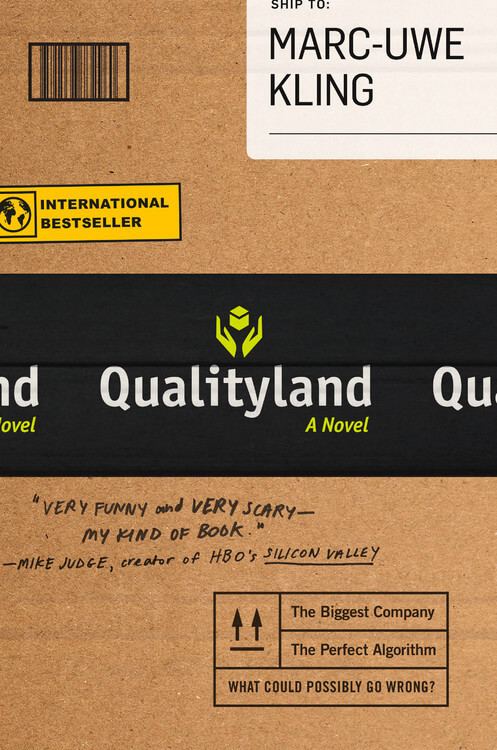
AUTHOR: MARC-UWE KLING | PUBLISHER: ORION | RELEASE DATE: JANUARY 9TH (KINDLE), FEBRUARY 18TH (PAPERBACK)
In QualityLand, everything runs perfectly. People are happy and content, if only because not being so would require some thought independent of what the algorithms state. Things might change if John of Us, the first android to run for president, achieves his goal, or perhaps if lowly machine scrapper Peter Jobless manages to get rid of the pink dolphin vibrator nobody will believe he doesn’t at least subconsciously desire.
Imagine the internet. The barrage of intrusive advertising, algorithmically-defined recommendations and the constant implication that if you disagree with a statement you are wrong. Now imagine everything negative about it applied to every facet of everyday life, and you’ll start to get an idea of the absurdity of QualityLand. A person’s worth is numerically quantified through ranking levels; everyone’s surname is taken from their parent’s occupation, defining from birth what opportunities they are afforded; advertising slogans are dropped into news reports; history is reduced to the plot points of movies and full-time employment can be found in online trolling.
Aside from the enjoyably ridiculous yet oddly plausible world-building of a country voluntarily surrendering itself to a system that by its very nature dehumanises them, humour comes from the interactions between people and sentient machines, neither of whom seems to have a better idea than the other about the best way to live or, before sleeping together, people negotiate a contract of mutually-agreed activities similar to the tediously reiterated plot point of Fifty Shades of Grey but acknowledging that the idea is completely stupid.
Although the book is a humorous one, driven by farcical satire reminiscent of Douglas Adams or Rob Grant, the comedy doesn’t entirely filter out echoes of George Orwell’s cynical nihilism, fully embracing how sinister it would be to live in a nation that functions on your every thought and whim being unassailably predictable, while the notion of a mistake regarding them being so unthinkable that no measures exist to deal with such an occurrence. The humour also goes to some darker places, such as babies being drugged with hormones to pacify them or dating apps being recommended to victims of domestic abuse.
It’s bizarrely compelling to watch people accept their lives being dictated to them because they have never known anything else and don’t question other possibilities existing. That it takes Peter receiving an item so incongruous to realise that something might be wrong with the system that he has until then remained blissfully unassuming a part of speaks volumes about how unthinkingly accepted it is.
QualityLand is first and foremost a humorous book of fiction, but it makes real points about the creeping omnipresence of people’s digital lives. If they aren’t careful, before they know it, they might find themselves living in a world not too far away from this one.