For centuries, the sight of the Moon has encouraged humanity to dream about how we can visit our nearest celestial neighbour and what we might find there.
Is the Moon an airless, stagnant world? Is it a landscape inhabited by strange flora and fauna? Does it nurture intelligent lifeforms?
As science fiction historian Mike Ashley points out in his introduction to this volume, these questions were posed by the earliest philosophers. For example, as early as the fifth century BC, the Greek philosopher and scientist Philolaus speculated that giant creatures lived on the Moon’s smooth surface. The Greek satirist, Lucian of Samosata in the second century AD was the first to write amazing tales of visiting the Moon. New discoveries made by telescope in the 17th century encouraged more factually accurate stories centred on the Moon.
With the 19th century’s advances in technology, the likes of Jules Verne and H. G. Wells applied more rigorous scientific principles to how we might travel to the Moon, and in turn, inspired new generations of writers who paved the way for genuine rocket research and space exploration.
Selecting twelve stories that predate the Apollo Moon landings, Ashley shows how the Moon has fuelled our imagination. Opening with Dead Centre written in 1959, by Judith Merril, she tells us about the first manned lunar landing through the eyes of rocket designer Ruth Kruger.
The story focuses on how Ruth copes with her son who wonders where ‘Daddy has gone.’ Merril deals with the human and emotional aspects of space travel, while in contrast, A Visit to the Moon by George Griffith – who in his day was a very popular writer of ‘scientific romances’ – is a more traditional adventure story. The Astronef an incredible anti-gravity-propelled ship, takes Lord Redgrave and his bride Zaidie to the Moon and beyond for their honeymoon. Echoing the values of the period, Zaidie is sent off to do her ‘household duties,’ whilst Lord Redgrave takes a look at the engines.
Other obscure gems include Sub-Satellite by Charles Cloukey, who first described a rocket journey to the Moon in 1928. A more familiar story is Arthur C. Clarke’s 1951 classic The Sentinel, which became the inspiration for Stanley Kubrick’s 2001: A Space Odyssey.
Ashley provides a great selection of adventures along with a handy introduction to the genesis and background of each story. He makes us appreciate the Golden Age of lunar inspired fiction and whets our appetite for real Moon missions in the very near future.
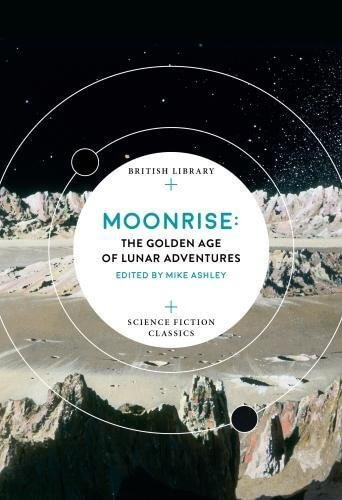
MOONRISE: THE GOLDEN AGE OF LUNAR ADVENTURES / EDITED BY MICK ASHLEY / PUBLISHER: THE BRITISH LIBRARY / RELEASE DATE: APRIL 5TH