With JULIA DUCOURNAU ’s third feature film ALPHA hitting cinemas, we talk with the writer-director to find out more about it…
When Alpha premiered at Cannes earlier this year, audiences left the Palais in stunned silence. Julia Ducournau’s new film, her first since the Palme d’Or-winning Titane, had been shrouded in secrecy – no trailer, no advance screenings, just whispers of something ‘viral’ and ‘intimate’. What emerged was entirely unexpected. With Alpha, Ducournau cements her reputation as one of contemporary cinema’s most daring and empathetic provocateurs. Much like her visceral coming-of-age nightmare Raw and the metallic, outré fury of Titane, Ducournau’s latest once again confronts the tangled thresholds between flesh, identity, and transformation. This time, however, her work is less overt body horror and more a haunting, dreamlike meditation on contamination, memory, and compassion.
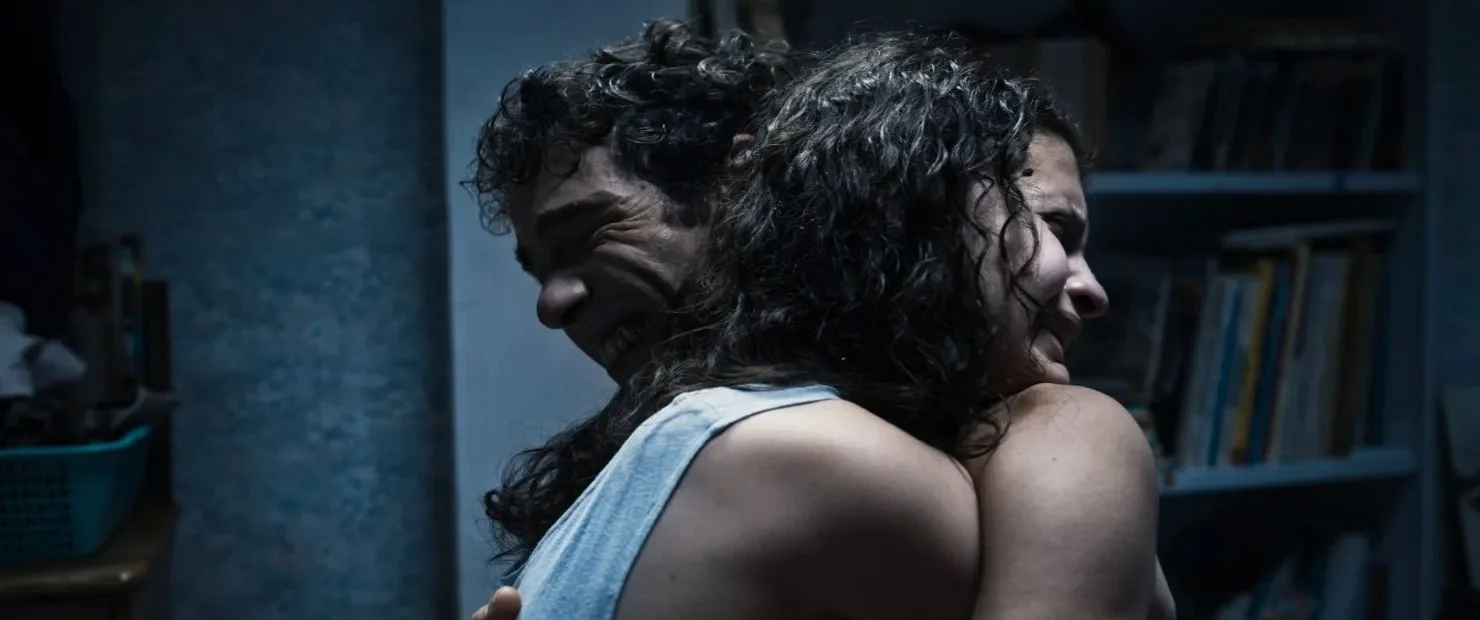
Set against the backdrop of an epidemic that, though imagined, carries unmistakable echoes of the AIDS crisis, the film follows three interlocking characters: a young girl named Alpha (played with eerie restraint by newcomer Mélissa Boros); her mother (Golshifteh Farahani), a doctor struggling to maintain control as the epidemic spreads; and her uncle (Tahar Rahim), an IV drug user and one of the first victims of the disease that turns human tissue to marble. The story unfolds in a twilight world – recognisably our own but suspended in mythic ambiguity – where the body of a thirteen-year-old girl becomes the site of collective fear and inherited grief. What arises is not a tale of horror but a mediation on love; the family’s unravelling becomes a metaphor for the way shame and trauma metastasise through communities and generations. It’s a film about how we inherit pain and how we might learn, through empathy, to transmute it.
Placed in the arc of Ducournau’s work, Alpha feels like an inward move rather than a retreat. Ducournau channels her recurrent obsessions – transformation, the body as a site of social meaning, and the redemptive power of unconditional love and found family – into a story about collective fear and the moral responsibility of care. The film refracts the director’s interest in corporeal states through a more elegiac, socially attuned lens: it asks how societies mark and ostracise the ‘Other’, how fear and trauma spread like contagions, and explores the intersection between freedom and the entanglement of relationships.
In conversation, Ducournau is as precise and disarmingly candid as her filmmaking. She speaks quickly, hands in motion, shifting from dark humour to near-philosophical intensity. The French filmmaker spoke with us about drawing a line between the individual body and larger societal systems, about sanctifying the diseased as martyrs rather than outcasts, and how growing up in a world where touch is equated with danger influenced her filmmaking.
STARBURST: You’ve said that Alpha was an exposing and scary experience to make. What risks were you taking, emotionally or professionally, that made it feel that way?
Julia Ducournau: I embrace the unknown. I embrace imbalance. I really don’t think anything good can be done creatively if you’re trying to reproduce a recipe or stay in your comfort zone. The film digs into how trauma is transferred – almost like a disease – from person to person, generation to generation, especially when grief is denied. When society refuses to acknowledge pain, it festers. It becomes inherited, whether that be in the body, in the family, or society. To me, they all function the same way. That’s something I wanted to confront directly. The film is about what’s left unsaid, so I knew my characters would have to face words. They’d have to speak openly, to be raw. And that meant I had to do the same as a writer and director. In my earlier work, I was very diffident with dialogue. I believed emotion had to come from image and sound first and foremost. In Titane, even the line “I love you” in the last scene terrified me. I wrote it, deleted it, wrote it again – during writing, during shooting, even in the edit! I was very afraid of the cliché that these words represented. But I left it in, because that phrase, so common, so universal, helped the characters move from being characters to being heroes. With Alpha, I told myself I had to go further. I told myself: now you must write a film that is I love you from beginning to end. A film entirely about love: its risks, its dangers, its responsibilities. Because love means respecting someone’s freedom. The more you love them, the more you have to let them be free. And that can drive people mad. You see that with the mother character in Alpha. Too much love can destroy.
It’s interesting that you equate love with freedom, because Alpha also treats love as entanglement. If you associate love with contagion, and present illness as a condition of empathy, how do you resolve those two seemingly opposing equations?
We see in the film how letting go is almost impossible. The mother’s collapse at the end is devastating. You mentioned entanglement, and I think that’s a key word. There’s an image early on of connecting dots like a constellation [Alpha, as a child, takes a pen to her uncle’s arm and connects the injection sites marring his skin]. To me, that encompasses the subject of the film. Memory, grief, trauma – they all work like constellations. You build meaning by connecting fragments: things that happened, things you were told, things you imagined. It becomes the memory, even if it is not an objective truth. The constellation also symbolises interconnection – our need for care – and the danger that comes with it. The mother, as a mum and a doctor, represents this duty to care for others, to remind us of our shared humanity. But she also embodies the risk of contamination. And yes, there’s a historical echo, too. In the 1980s, AIDS was called the ‘disease of love’. Suddenly, love equalled death.
The story follows multiple characters but like you said, it’s filtered through Alpha’s perception. You could have chosen to frame it through the mum’s eyes, who had a better understanding of the medical dimension of the disease, or through the uncle’s, who had the lived experience. Why tell it through Alpha? Did you view her as the beginning of a new era of empathy?
I’ve always thought of Alpha as coming before Raw in the timeline of my films. The name ‘Alpha’ has a prototypical quality. In astronomy, the first star discovered in a constellation is called the Alpha star. I also liked the idea of a girl who’s born into a world where everyone is dying or is doomed to die. Alpha and Omega. Life and end. She exists between those poles. But I also wanted to explore how society turns fear into cruelty. Alpha is ostracised and shamed for no reason other than suspicion and ignorance. People retreat into fear, and that fear translates into this cruel and generalised retaliation. If you find that hard to watch happening to a child, then you have to ask yourself: why weren’t we equally horrified when it happened to thousands of real people? Some of them were just as young. When I started writing, I wasn’t sure how old she should be. I considered making her older, then way younger. But I realized she had to be at the start of adolescence, because sexuality is central. Now, to be clear, the disease in Alpha isn’t AIDS. It’s fictional, called DIP-219. You only see it mentioned once in a poster in the background. But the emotional context – the fear, the stigma – echoes the AIDS crisis. I didn’t want to make a historically literal film, because it’s not about a specific illness. It’s about how fear infects a society. Still, the sexually transmitted aspect mattered, because I wanted to show how terrifying it is to discover your sexuality in a world where intimacy equals death. That’s how my generation grew up. The sexual liberation of the ’70s vanished. Suddenly, bodies were threats. Desire was dangerous. It shaped our relationship to love in a very traumatic way. That’s why Alpha is 13, just at the threshold of that awareness. But I will say, I refused to cast a minor. Even though there’s no nudity, there’s touching, kissing, and the expression of awakening. It had to be an adult actor. It’s a story about the birth of sexuality, not a sexual story.
Julia Ducournau’s ALPHA is in cinemas on November 14th.