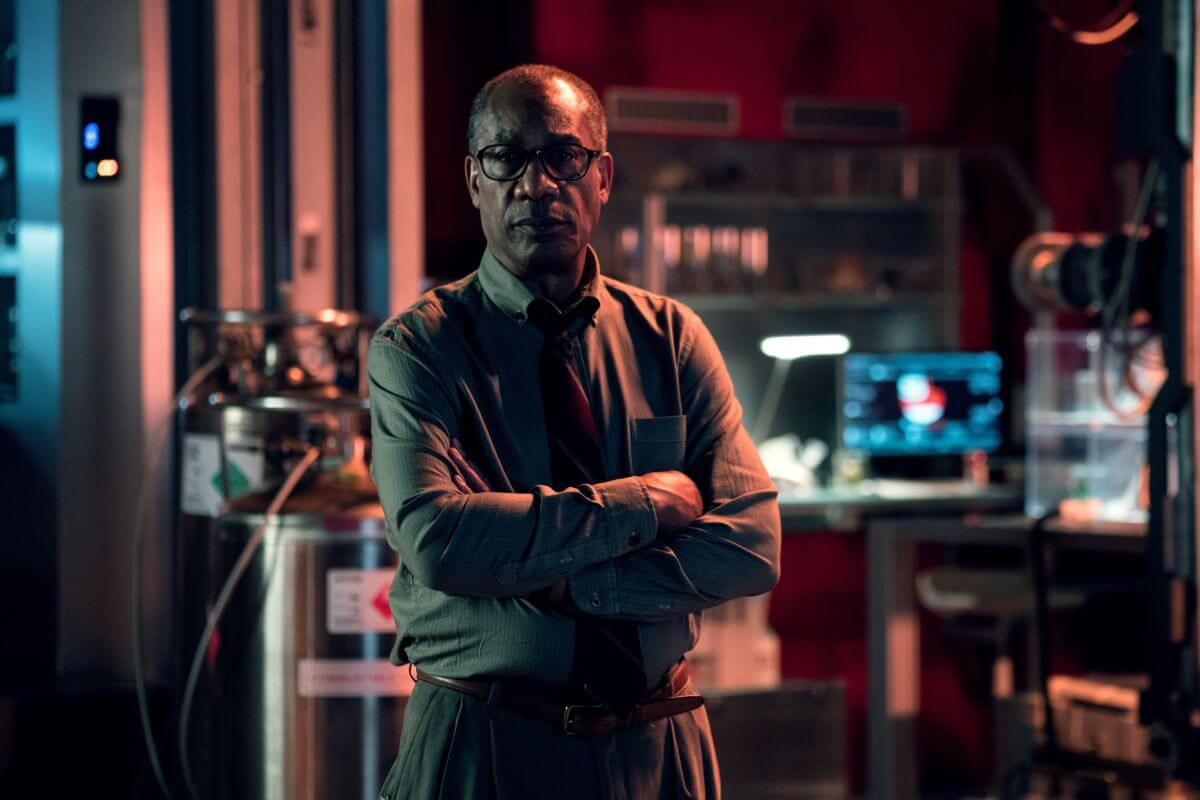
If you’ve seen Zack Snyder’s Justice League, then you’ll know that the character of Silas Stone is absolutely essential to the overall plot. His complicated relationship with his son Victor Stone – now more enhanced in this version – threads its way through the movie at key moments, not forgetting to mention that Silas is experimenting on, and using the power of a mother box, which the Justice League might need to save the planet. A year on from the release of Zack Snyder’s Justice League, STARBURST talks with actor Joe Morton (Terminator 2: Judgment Day/Eureka/Speed) to discuss the powerful story arc that Silas and Victor now have, what it was like to work alongside Ray Fisher, and much more!
STARBURST: How did you originally get involved with the character of Silas Stone?
Joe Morton: Well, the first time I got a call from Zack I was in an airport going from New York to LA, because I was doing Scandal at the time, to be told that I would get yet another phone call because he was interested in me doing Silas Stone for Batman vs Superman. That’s how he was going to introduce the characters. Then sometime later, I was home in New Jersey, and then my manager called to say that Zack was on the phone, and he wanted to talk to me about the part. At this point, I was finishing up on Scandal, so I was out in LA. I did a couple of scenes for Batman vs Superman. It was incredible, we did it all in a day and a half, and Zack is an amazing director. When we finally got to Justice League about a year or so later, it was amazing to watch him. It’s a huge cast, and it’s an enormous set. He just has the best personality, and the best disposition for all of that, just to make it feel very easy, and very fun.
Taking it right back to Batman vs Superman, what do you remember the most from working on that sequence?
We had to do a lot of green screen stuff, because the mother box wasn’t really there, so I had to just act as if it was. Ray wasn’t actually there, so all of that had to be acted without anybody else. It was also fun to be in that part of the scene where Silas is frustrated with things not working. You see boxes of pizza in the laboratory. It was just fun, and a real pleasure.
Fast-forwarding here a bit, when did you originally find out that they were going to release Zack Snyder’s version of the Justice League, and at that time, what did you yourself actually want to see from this cut?
I wasn’t quite sure what the cut was going to be. I got a call again from Zack, I guess this was sometime last year. He was saying that Warner Bros had come to him to release his cut of the movie, and apparently, he had that cut in his house, on his computer. Basically, the call was to sign waivers so that we wouldn’t get paid twice. Then when I saw the cut, my basic impression of it was, the original that came out was an action-adventure movie, and I felt like Zack’s cut was mythological. It felt like more of a myth of who these characters were. It had greater depth and complexity in terms of character. I think with Silas and Victor Stone, what’s lovely about Zack’s idea is that all of the other characters have an alternate ego. Batman is who is when he’s not Batman, etc. Victor can’t do that. He is who and what he is all of the time, just like black people in this world are who and what they are all of the time. On some level, I think that’s what Zack was talking about.
Talking of Zack Snyder, what has he been like to work with over the course of two movies, and why do you think his vision as a director has gone on to become so well known?
He really does occupy the work. When you look through his book, his storyboards, and what he wants to shoot that day, he is clear on what it is he wants to do, and how he wants to get where he wants to go. Also, his disposition on the set is just miraculous, to be working with that many actors, on sets that are that huge, with that kind of action, and just make it feel very easy, and straightforward. At the end of the day, you didn’t feel overly exhausted. I was doing a play in New York while we were shooting Justice League called Turn Me Loose, which is about Dick Gregory, who was a well-known comedian and activist here in America. It was basically a one-man show. So to go from that to the Justice League was like going from a confessional that was very deep and very complex to a very elaborate and well-functioning costume party. It was wonderful and a really nice balance. The way he runs his sets just made it very easy.
Okay, let’s dig into your character, now, as a parent yourself, what did you pull in from that when it came to playing and shaping Silas Stone?
So if we continue with the metaphor that I think Zack was after, you have a black father talking to his son about being able to accept who he is in the world. I have a son and two daughters, and that’s what I think I used in terms of talking to Victor. Especially the scene where you see him dealing with Victor after the accident. It is that moment that every parent is terrified of having to face. Where your child is on the hospital bed, and his or her life is on the line. Silas basically gets it in his head that he will do anything and everything that he can do, to not only save that child’s body but also heal that child’s mind and psyche.

It must have been tough to play a character who is so cut off and detached from having a relationship with his own son to start with?
It’s the professional dad. They don’t understand if they’re not attached to their son, they’re so attached to their work they think everything they’re doing is for the family. When a father like that hears that, it’s a surprise. “No that’s not how I saw it at all”. Understanding that from Victor’s point of view that it’s probably true. Silas spent more time in the laboratory, dealing with all of the things that he was dealing with. That became the focus of his life. Just like sometimes I think I get accused of being so involved with my work that I’m not as involved with my family as I should be.
Looking back on the key scene where you sacrificed yourself to mark the location of a mother box, why do you personally think that this scene is just so important?
It was the ultimate sacrifice. In Terminator 2: Judgment Day, the Terminator basically kills himself at the end, which is the most human sacrifice. He says “In order for this to be accomplished, I have to die as well” I think Silas is in that same set of circumstances. He understands that if he takes the mother box with him and the only way to do it is with him going with it, then it’s the most he can give not only the world but to his son.
By the time he does sacrifice himself, how would you personally say that the relationship between Silas and Victor had changed/grown?
There’s that scene in the movie where Silas says to Victor “You’re not a monster” Victor’s response to that is “It’s interesting that you assumed I was talking about myself?” What happens between the two of them is that they begin to understand that what Silas was able to do for Victor by giving him life, a brain, and a soul that can absorb so much, was in many ways a gift. Until the moment he is literally in the position to save his father’s life when he comes to save me and the other prisoners from Steppenwolf, I think that’s the moment where Victor realises what this relationship is, and what it can be, and he begins to form a relationship with the Justice League. He is kind of the outsider even in that group of individuals, and he has to figure his way in, in the same way, that he has to figure his way in terms of who his father was, and what he did and did not do for him.
It’s interesting because, even after Silas has gone there is further validation that their relationship has changed when he brings the destroyed Dictaphone back to life, playing your voice. We thought that that was such a great idea! What do you think that narrated part, in particular, brought to the movie?
What it does is cements that relationship. Victor finds the Dictaphone and hears what his father has to say and it gives him a greater understanding of his father, and actually what his father means to Victor, is in those moments.
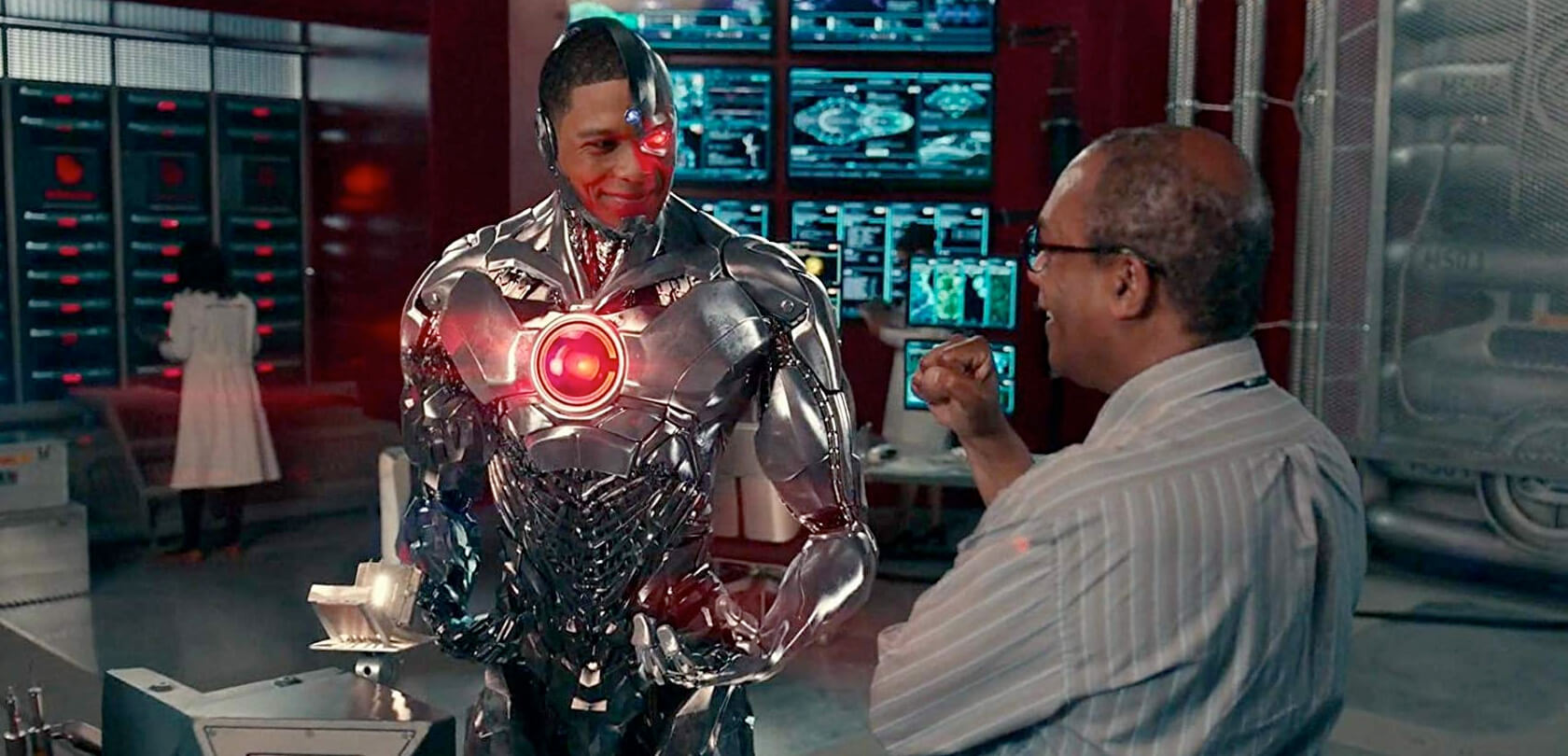
What was it like to work so closely with Ray Fisher, and what do you think that he really brings to Cyborg?
Ray is a really nice, lovely young man. I think he brings all of that genuine love of humanity to the character, and then because of the struggles that Victor goes through, I think that he brought that out really well. In terms of being a black man in this world, you struggle with how to deal with all of the mythology that people put on you. Whether those things are real or not, I think the same thing happens with Victor. There’s this book about Grendel. At the very beginning of the book, Grendel is standing on the side of a mountain, and there’s a goat near him, the goat sees Grendel and just simply scampers away, and Grendel’s response to that is “You’re simply running away because of the way I look, not for who I am. You don’t know who I am, what I possess, and what I can even offer you” Those are the things that Victor comes to terms with. People will look at him, and make decisions about who they think he is, because of what he looks like, and he has to overcome that. Ray brought all of that to the character.
And also, could you elaborate on how Cyborg compares to the other members of the Justice League, what makes him different/stand out?
He has no alter ego, no Clark Kent, nothing to hide behind so that he can have a private life. His life is his life. I think that’s what makes him different. Even Aquaman can roam around the earth, and you would not know who he is because he lives up North somewhere. He can dive in the water, where people will know who he is, but he can walk around other humans, and look like other humans. Victor can’t do that, and that’s what makes him very different to the other members of the Justice League.
Obviously, you’ve worked on many blockbuster movie sets before, what is it actually like to work on something of this scale, and how do you approach that as an actor?
It always feels strange to me. When I was a kid, I wasn’t a real comic book kind of kid. With the Terminator, I always looked at Terminator 2: Judgment Day as a modern version of the Frankenstein story, that basically a scientist invents something that is greater than himself, and that thing that he invents, ultimately in order to become a part of humanity has to destroy himself. The same thing sort of happens with the Justice League. Here you have a man who almost loses his son, who then finds a way to keep his son alive. In doing so, he almost loses his son. So I always have to take the size of it and reduce it to something that is human, to something that I can look at in terms of what it means to be in this world.
Looking back on Zack Snyder’s Justice League, and if it hasn’t already been covered, what was the most rewarding scene for you to do, and why?
In one way the scene when Victor is on his death bed and I vow to not lose him, and then I suppose, it’s a very small little moment, but in a way, it’s very large. It’s when Victor comes to save Silas when he is down in that pit, and we recognise each other, and I realise that he is there to save me. I think in that one tiny little moment, it begins to blossom into who they will become, which is a really lovely thing.
Your character doesn’t die in the 2017 version, if it did happen, what would you like to see from him in the future?
There was talk for a while of doing a sequel with Cyborg, and I would love to see a lot more of his life before he becomes Cyborg. That family life. We did a little of that in Zack’s version. You get a sense of who we are, a bit more than in the 2017 version, and I would like to see more of that. To understand who they were as a family before we move into who he is as a superhero.
Final question, there are at this point, a couple of superhero movies out there, but for you how would you say that Zack Snyder’s Justice League stands apart from them?
Zack was not just making an action-adventure movie. He actually was putting together what feels like mythology. It’s the kind of storytelling that has great depth, where it has great metaphors about what it means to be human in this world. Striving for a peaceful and loving world, but having to deal with very large human problems.
Zack Snyder’s Justice League is available on 4K, Blu-ray, and DVD as well as on digital platforms.