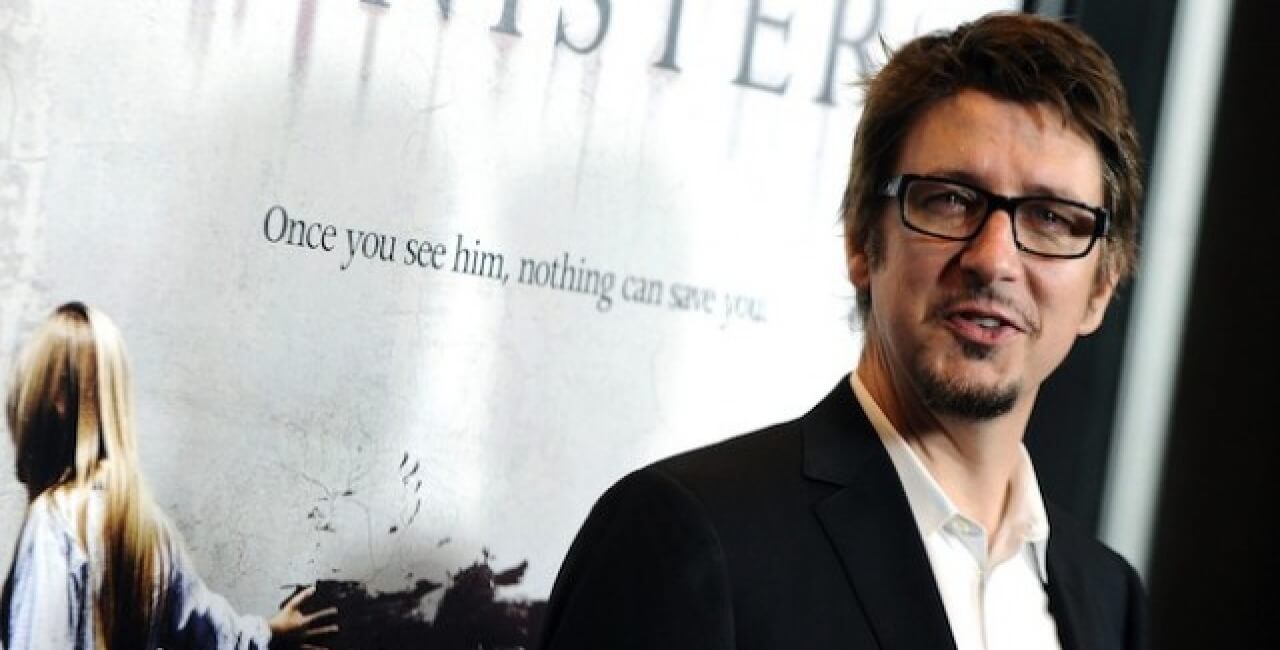
With Sinister being one of the scariest movies of 2012, Starburst’s Jon Towlson sat down with its director, Scott Derrickson, to talk about fear.
STARBURST: Do you test preview your films in the way studios often insist?
Scott Derrickson: We did that once with Sinister. How wide our distribution would be in the States was dependent upon a certain score with a test audience. We went pretty far beyond that score, which was great. But I didn’t use that screening or any subsequent screening to test out things or to make sure that things were working. There wasn’t a lot from the test screening that I didn’t have, I didn’t get a lot of information that resulted in changing anything.
You grew up in a movie-going family, and you’re what in Britain we call cine-literate…
That’s a good term. I know I’ve been called a cinephile, and I teach film history to college level so I’m about as cine-literate as it gets, I suppose.
So, as someone who’s seen a lot of films and brings that to bear on the making of their film, this talent that you have for horror and creating a sense of fear, is that something that you’ve consciously developed, something you’ve had from the start, or a combination of the two?
I think it’s certainly both to a degree. I’ve certainly developed it, in with the films that I’ve made and by studying what’s actually effective in scaring people in horror films. If you look at my first Hellraiser movie that I did (Hellraiser Inferno, 2000) it’s actually not scary! Those movies are really not scary in general – as a franchise they’re more gory than scary. But I think that the reason that I’ve been able to develop it and learn it is just because of my personal understanding of fear, and the emotion of fear that I’ve spent such a good portion of my life reckoning with and continue to reckon with. I’ve experienced some pretty extreme levels of fear in my own life. I think that qualifies me to become good at it and it’s why it’s so effective. Certainly in the case of The Exorcism of Emily Rose (2005) and Sinister (2012) the objective that I always had – both in terms of the general concept and right down to the beats of every scene – was to make something that I found genuinely scary, something that really disturbed me or really scared me, and I knew that when I was feeling uncomfortable in dealing with something conceptually or even in the minutiae of editing it – when it started to make me feel uneasy I knew that I was on to something! The bottom line is I know a lot about fear – I think it’s an incredibly powerful and complex emotion that isn’t explored in complicated ways typically, even in horror films. So my gravitation toward the genre – I love horror films but it’s not like I love that genre more than other genres – I just think it’s what I’m good at, it’s a skill-set that I just happen to have. So I’ve continued to invest myself in it because it’s – at least up until this point – that I’ve been able to do better than other things.
In Sinister you have this idea of evil captured or contained and transferred by images, be they photographs or Super 8 films. It’s almost an ancient or primal fear, the soul being captured in an icon. What drew you to that idea?
Part of it is exactly that. That it’s ‘Be Careful What You Watch’. Something about it is primal, going all the way back to the prehistoric. I saw Werner Herzog’s movie, Cave of Forgotten Dreams with this extraordinary and ambitious, incredibly beautiful artwork in these caves from thirty thousand years ago and I’m sure that with the guy who was creating that there were other people who were disturbed by these images just because the images are so disturbing. And I think in the modern era horror comments on the times in which it’s made – whether that’s consciously or unconsciously. I think Sinister’s great contribution if nothing else is that it’s one of a handful of films that really is effectively tapping into the day to day position that we find ourselves in which is that we’re all sitting in front of our computers with a glowing screen every night in the dark. Everyone does it and that wasn’t the case even ten years ago. The Ring tapped into the fact that we were all now starting to not just passively watch these TV shows at eight o’clock at night, but we were taking these video tapes and watching them at all hours and watching them in groups. There’s something about the personal private exploration of imagery that is a severe reality now beyond anything that human beings have ever been a part of. There’s no place in human history where we see people doing what they’ve been doing now for the last five or ten years, which is log just countless hours perusing imagery in the quiet darkness of their homespace.
That certainly would be the case with the Ethan Hawke character in Sinister. He becomes more isolated even though he’s amongst his family.
And I think that’s one of the main reasons why the movie connects with audiences. You have to have scary imagery and effective execution of suspense, but before any of that can work you have to have an audience identifying with a character and understanding the situation that they’re in, and I can’t think of another movie that demonstrates that night-time quality that we all seem to participate in now, which is just sitting alone in our offices or our bedrooms – or wherever it is that we’re in – looking at images, staring at images, scrolling through words and pictures. So when that turns supernatural and evil, it’s something that scares an audience more than something they can’t relate to.
There’s also another aspect to his character which is a sense of failed ambition. Is this part of a greater theme which The Exorcism of Emily Rose shares? You have these characters – like Laura Linney in Emily Rose – who start out desiring material success, material wealth, fame, but then they start to realise that there are forces beyond the material world which they can’t control and in fact they are controlled by these forces which influence their fate.
Very much so. In both cases it’s about elevating something above materialism. Maybe because I think that materialistic tendencies of the culture are so awful and worthless. I think that the things that matter most in life, that are the most significant things in life on a personal level, are not material things. I have tremendous appreciation for the material world in terms of science and in terms of health and all of that. But these things are only worthwhile in that they take us into things that are immaterial: joy, love – those sorts of things. In the case of Emily Rose, it was a conscious didactic attempt to posit materialism versus the existence of the demonic – other worldly entities and otherworldly realities – and the implications of that are in the movie. That is my thing, I think, as a person. I don’t mean it as a point of pride or to be condescending, but I think that – if there’s a continuum of materialism versus motivation for immaterial realities and other people – then I’m all about going in the extreme opposite direction of materialism. Basing your life around the quest for status, for money, material wealth – those things are traps. There’s nothing good about them. And yet, I think we’re all more motivated by those things than we realise – especially status!
Can you tell us about your new script, Beware the Night? About a cop who assists exorcists?
It’s based on a real guy, Ralph Sarchie, who I’ve gotten to know and have spent time with. He’s a tough, foul-mouthed Italian police sergeant who works in the 46th district in South Bronx – what the FBI calls the most dangerous square mile in America, a real shit hole. Through a series of events he ended up going from being a totally non-religious lapsed Catholic to being the guy who goes to investigate possible paranormal activity in people’s homes and cases of possession, and he spent many years of his life as an assistant during the practices of exorcism authorised by the Church of New York.
It sounds like an intriguing mix of genres.
It’s definitely that. When Jerry Bruckheimer hired me to work on the script he said, “I wanna make Serpico meets The Exorcist!” And I thought, ‘well that’s just the coolest sounding thing I’ve ever heard’.
Is it definitely a ‘Go’?
I would say ‘definitely’ – but it’s my experience in the business that once you say that it goes away! So I’m not actually going to say that! But, yes, it looks very likely that that will be my next film and we’ve cast Eric Bana in the lead role, and was the actor I really wanted. He has a lot of the qualities of this guy.
You also wrote the screenplay for Atom Egoyan’s new film, The Devil’s Knot, which is about the West Memphis Three. Did you write that as a riposte to Emily Rose?
I did. I was planning to direct it. I really loved Emily Rose, I was very happy with that film. I think one of the things that surprised me was even though I find the movie fairly even-handed – my writing partner both on Emily Rose and The Devil’s Knot is agnostic – and even though I feel the movie’s not a biased or weighted clash of faith versus reason – or faith versus science even – I was surprised by how many people – critics especially (probably because critics tend to be liberal and non-religious) took offence that the movie dared to take the demonic seriously. Even though I didn’t mind that – I think it says more about the critic than it does about the movie – I also understood that it’s a sore point because terrible things can happen when people take the Devil too seriously and the West Memphis Three is the case in point. So I essentially wanted to make what was a counterpoint, a complementary film to Emily Rose, a movie that really represents religion in America and what happens when things like belief in the Devil and these very religious concepts infect what is meant to be a very clean purely logical process, like police investigations, like the judicial process. Once you happen to have religion and religious bias entering into that process it just infects everything, and terrible injustice can result, and what we saw in that case really was a kind of modern day, Salem Witch trial.
Were you ever accused of contributing to the Satanic ritual abuse moral panic with Emily Rose?
No, nobody really thought that, because when Emily Rose came out that was all past. The Satanic ritual abuse craze was really the late 1980s and early 1990s. The McMartin Case really did a lot to ultimately expose the nonsense that all that was. Once you’re in a post-9/11 world all that stuff seems as silly as Alice Cooper. It’s kind of hard to believe now that people were taking it seriously and even in retrospect there’s nothing realistic or frightening or menacing about it. It’s just ridiculous.
Sinister is released on DVD and Blu-ray on February 11th.