Ghost of a Tale looks at first glance to be the sort of thing open betas were built for. It’s an original concept devised by an indie team which was open to the public despite a lengthy development cycle. Unfortunately, while this method spawned successes such as Sunless Sea and Subnautica, this one doesn’t quite measure up to them.
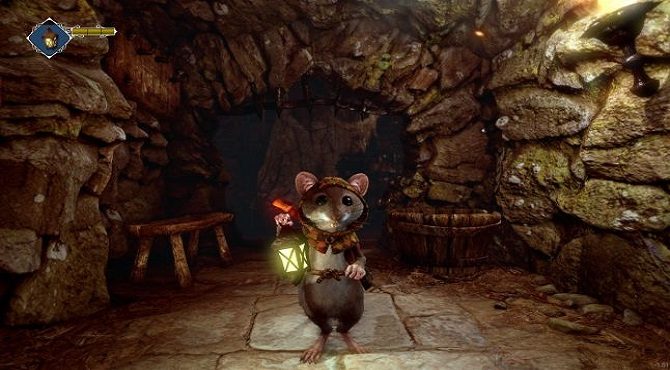
The game follows the story of Tilo, a mouse and minstrel born into a fantasy world. After being thrown in prison on an island fortress, it’s your job to escape and uncover the truth behind a centuries old conflict.
While this could have easily proved to be a by-the-numbers dungeon crawler, the game instead favours a very different approach. Enemies are not there to be openly fought so much as escaped, as you sneak about the place, evading guards and maintaining your supplies. Exploration also plays a major part in this, as you will often backtrack and return to older areas to uncover their secrets, or to resolve puzzles. This is a welcome return to a mentality we have not seen in years as it gives the location, Dwindling Heights Keep, a distinct sense of personality and atmosphere. The fact you grow to know so many major areas means that it benefits from the same quality which made Resident Evil’s Spencer Mansion such an iconic location.
The atmosphere benefits further from both stunning CGI and surprisingly strong character interactions. The game is obviously beautiful to behold and the scenery has been made specifically to foster a sense of wonder from the player. Even just a basic screenshot makes this evident, while the many figures you meet have simple, direct but very strong personalities. It’s the same sort of thing Zelda has always benefited from in its worldbuilding. It’s just a shame that, while it starts strong, it doesn’t take long for problems to arise.
What ultimately holds back Ghost of a Tale from greater successes is its unrefined status. The game is undeniably janky, both in how it handles a number of key mechanics and the bugs which arise as you play. These tend to be most evident as you try to explore through the game. The likes of maps will begin to fail you as you move into certain areas, marking the wrong location or (in the cast of the Catacombs) the opposite of where you actually stand.
Furthermore, the open feeling of the first few hours gives way to more condensed and enclosed areas later on. Several key locales have clearly been rushed, and suffer from notable padding or glaring shortcomings. At a few points you can even end up unknowingly sequence breaking past events or stuck at a dead end. This might have been excusable if Ghost of a Tale’s story held true, but it drops the ball at the absolute last minute, stopping just before it can give the player closure to events.
Ghost of a Tale is a game many will be able to love despite its flaws, and later patches might even fix some of the bigger problems. For the most part, however, it offers a grand opening and a wealth of potential, but much of the developer’s effort was focused purely on those areas. Give it a look, but decide carefully on just what you want out of it before buying.
GHOST OF A TALE / DEVELOPER & PUBLISHER: SEITHCG / PLATFORM: PC / RELEASE DATE: OUT NOW