There’s a particular kind of person who has a dog-eared science fiction paperback on their shelf and a handful of browser tabs open to whatever game caught their attention this week. If you’re reading this, there’s a reasonable chance that’s you. The overlap between sci-fi fandom and gaming culture isn’t some recent convergence – it’s been baked in from the very beginning, and the reasons why say something genuinely interesting about what both of these things actually are.
It doesn’t take much digging to see the shared DNA. The same restless curiosity that pulls someone toward Clarke or Le Guin also tends to pull them toward games that reward exploration, pattern recognition, and a healthy tolerance for not quite knowing what comes next.
Arcade Cabinets and Alien Invasions
The earliest video games didn’t borrow from science fiction by accident. Space Invaders, Asteroids, Galaga: none of these were designed in a cultural vacuum. They were built by people who had grown up reading pulp magazines and watching B-movies, people who understood instinctively. The visual grammar was identical: bright objects against dark backgrounds, geometric threat, the suggestion of infinite space just beyond the frame. Arcade culture and science fiction were already speaking the same language before either one had the vocabulary to articulate
That inheritance didn’t disappear when consoles and PCs took over – if anything, it deepened. The Mass Effect trilogy borrowed heavily from decades of hard sci-fi writing. No Man’s Sky made a direct wager that procedurally generated alien worlds could feel as satisfying to explore as reading about them, and for millions of players, it did. The overlap isn’t only aesthetic. It’s structural. Both are, at their core, about systems: rules that define possibility, constraints that make the impossible coherent enough to engage with.
The Psychology of the Unknown
What science fiction has always understood is that the appeal of the unknown isn’t really about space. It’s about the moment before resolution – the panel before the reveal, the chapter before the twist, the ship entering a new system before the scan comes back. The unknown is a promise. Gaming reached the same conclusion almost simultaneously. The loot drop. The level-up screen. The procedurally generated dungeon. Anticipation and reward, dressed in different clothes.
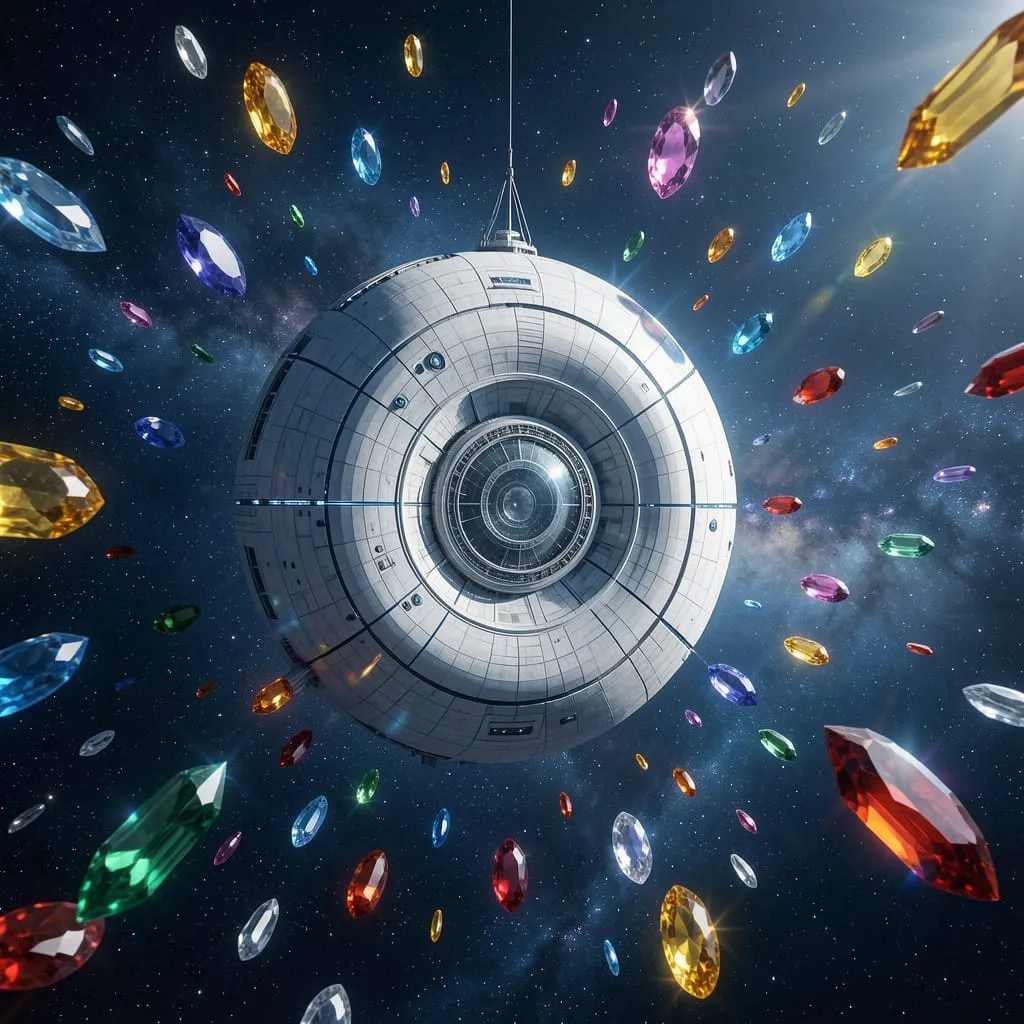
This is why so many games that have nothing to do with science fiction still reach for its imagery when they want to signal that something matters. Neon light, geometric precision, the deep black of space as negative space – these are reliable shorthand for scale and possibility. Even titles with no narrative ambition use the cosmic palette to communicate reward. The slot game Starburst at videoslots strips this down to its most elemental form: jewels detonating across a dark field, colour as event, symmetry as spectacle. It has no story to tell, but it draws on the same visual instinct that made 2001: A Space Odyssey feel close to religious — the idea that light appearing in the dark always carries weight.
Why is This Still Worth Talking About?
The reason this overlap deserves attention now is that the two cultures are more openly aware of each other than at any previous point. Studios greenlight games before their film adaptations are even finished. Game mechanics show up in prestige television. Amazon’s Fallout series didn’t just translate a game into a show, it demonstrated that the narrative logic of interactive worlds and the logic of serialised drama were already far closer than anyone had officially admitted.
Sci-fi fandom has always been comfortable holding contradictions. This is a readership that can rate Philip K. Dick and Star Wars in the same breath without needing to resolve the tension between them. The same openness tends to apply to the games people in this space gravitate toward. Not everything needs to be the next Deus Ex. Some of it is built around a single well-executed idea, and that’s often precisely where the most honest version of the genre lives – stripped back, direct, doing one thing with complete conviction.
The connection between sci-fi and gaming was never really about prestige or a specific platform. It was always about a wider palette or appetite: give me something unfamiliar, make it feel enormous, and let me lose myself in it for a while. Both have always known how to deliver that.