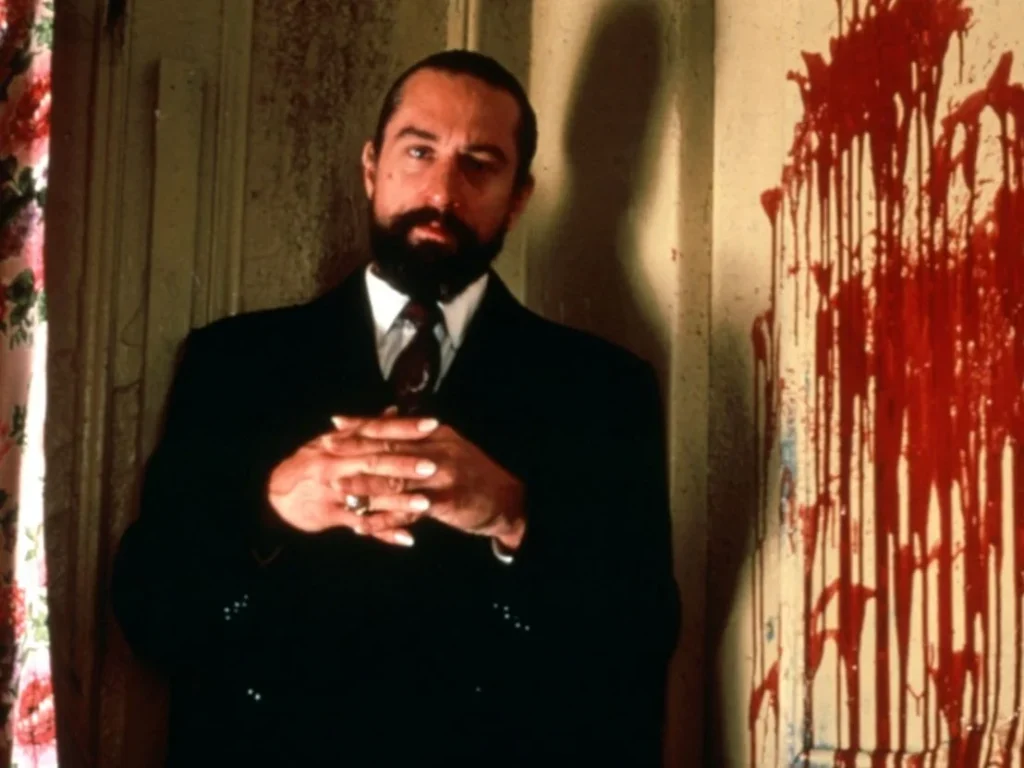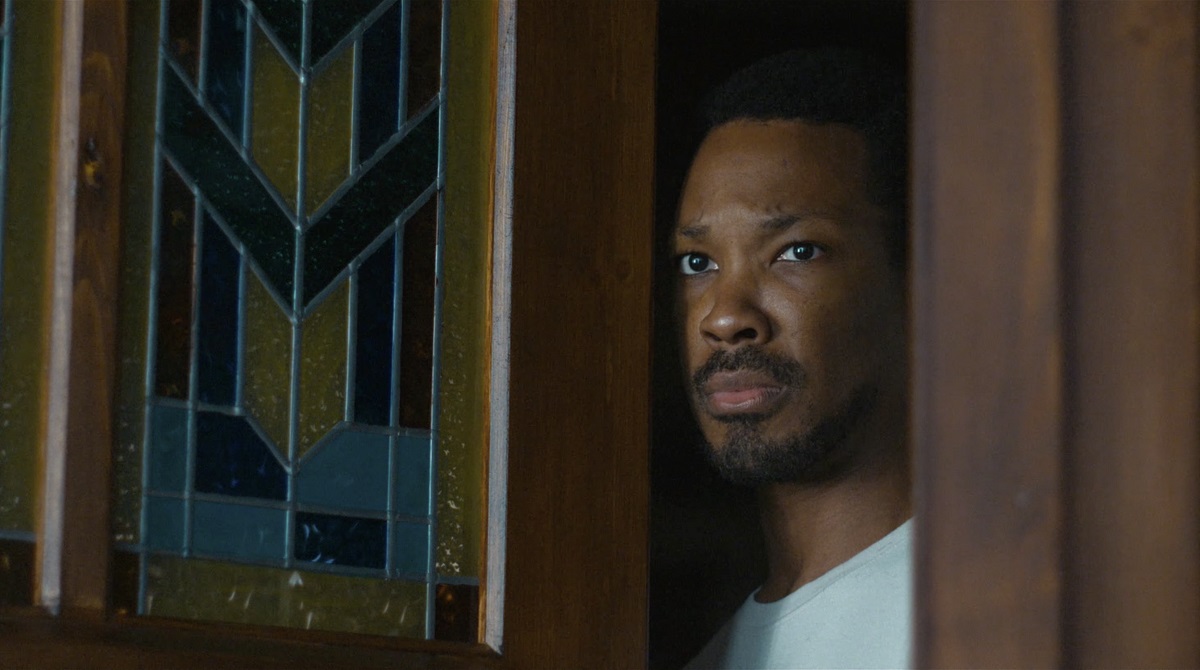
Based on the Walter Mosley novel of the same name, The Man in My Basement initially sees down-and-out protagonist Charles Blakey (Corey Hawkins) attempt to keep up with the mortgage of his inherited family home by any means necessary, while working on damaged relationships with his close friends and family. Events take a turn with the arrival of Anniston Bennet (Willem Dafoe), a mysterious figure that wishes to rent out Charles’ basement, potentially providing an end to his financial conundrum… STARBURST talks with Nadia Latif to discuss her first feature-length movie as a writer/director, her theatre background, incredible acting performances, and just some of the important themes that live at the core of this movie.
STARBURST: Can you tell us a bit about how you got involved with this project?
Nadia Latif: I read the book like twenty years ago, when it was published. I just loved it, and I was obsessed with it. There were so many images in it that stuck with me for decades. I was a theatre director, and I’ve been one for a long time. I made my first short film, and I got my first agent. I heard that a film adaptation was in the works. You know, you hear whispers. I’m not a jealous person, generally, but I was like, “This is one of those books that I’d just love to adapt.” Anyway, I go back to my first agent, and I’m like “Did you hear about what’s happening with that film? I kind of just wanted to see it” and she was like “Actually, they’re looking for a director!” and I was like “Get me in the room! Just get me in the room!” I hadn’t even finished my short film at that stage. I just turned up with a 90-page deck, going, “This is how we do it.”
I so remembered reading it, and how it made me feel. It wasn’t like I had an encyclopedic knowledge of the book; I just remembered how it made me feel. I really cared about which images and which characters stood out to me. It made me know how I wanted to skew the story in a way that I think everyone would respond to. I flew to America, went to meet Walter Mosley, who was down to a pound, and it sort of just rolled from there. Walter and I didn’t write together on the same drafts. He wrote some earlier drafts, and I wrote the later drafts. It was my first screenplay. I’d worked a lot with writers. I’ve just been at the Sundance Lab for a different film, which feels very apt to talk about with the passing of Robert Redford. There, they encouraged me to do my own writing. They were like, “You’re a writer, you just need to just do it!” This was my first screenplay; I’ve since written a lot more.

What was it like to work opposite Walter Mosley, and was there anything that he maybe really wanted to see from the movie!?
Walter was very much like, “My book is on the shelf, you’re making the movie” he is an adept screenwriter himself, and he understands that they are two totally different mediums. He was always like, “Take what you need, leave what you don’t want.” I think I refer to the book and the film as being cousins, not twins. Most of it is in there, but there is definitely a different tone in the film. I think the film is darker, more baroque. I think it’s more interested in kind of, loneliness and grief, maybe a bit more than the book is. There’s quite a big pivot in the female characters between the book and the film. I was interested in how you can make a film where the two men are the current leads, but it is still about strong women. I hate when people in the background aren’t fully realised in that way. They all have very interesting lives. They could all be a protagonist. That’s always my goal with secondary characters, that you feel like “Everybody in this is interesting enough to be the protagonist” it’s just not their story, the story just happens to be about somebody else. Walter is a deeply funny person, and we were just a tiff together premiering the film; he is just so much fun.
So, you, Corey Hawkins and Willem Dafoe all have an extensive history in the world of theatre! We were curious to know what that brought to the creative process for everyone?
A lot of the British actors were theatre actors that I had wanted to work with for years, such as Jonathan Ajayi, etc. These are all people that I met in the theatre in London. The thing about a theatre background means that you’re very interested in the process. You’re very interested in like the rigour of what’s in the text, what are the physical actions really telling us. How do we really mine down into what is in here. Also, it feels really exciting for me to direct with a camera, because when you’re making work for a theatre audience, obviously you are trying to be as clear as possible, make sure that the cheap seats are getting as great a view as the seats that are closer. That they’re getting the same clarity of storytelling. So, there’s only one POV, which is from your seat.
In film, it feels like I can take the camera and I can put it wherever I want, and I can give a totally different perspective on the scene. It’s like I’ve been colouring with pencils and now I’ve got pastels, and oil paints. When you write things like “Top down shot” you think, “Wait? Do I have to bring a crane in for this” what does this mean? And it’s just a shot of somebody throwing some sausages. You’re like, “If I had known, maybe I wouldn’t have written it!” I think that’s one of the great things about making films for the first time. My friend, Charlotte Wells (Aftersun) sent this to me as a piece of advice, before I started making this, she said “The best thing about making your first film is that you make it naively.” She said, “after that, you’re full with the anxiety of that, second album kind of thing” so she said to just “Make it naively, don’t worry about the how and the what, it’ll happen. If you write it, it’ll happen” but occasionally I’d be like “Damn, all of this happens, because I wrote this?” There’s one shot in the film, where it was like, “Fish POV” they’re looking down at a fish, they’re looking back up at him. Honestly, half of us nearly fell in the drink. It’s January, in a harbour in Swansea, all of us at a risk of drowning, all of that, just because of two words: “Fish POV”.
At the start of the movie, you really get this feeling that no one trusts Charles, which is quite a different idea for a main character! How fun was it to work around that idea, and what did you want viewers to see from him at the beginning of the movie!?
I was really interested in, we talk about all of these binaries of heroes, anti-heroes, good or bad. I remember talking to Walter about that once, saying, “What’s a hero to you?” and he was like, “A hero is a guy you would ask for help”, and I said, “No one would ask Charles for help, he wouldn’t help them.” He said something to me really early on, like “No one likes Charles, his lawn is untidy, he is not contributing.” I liked that idea. I always wanted to situate that in his loneliness. So I think, the first time you meet him, he is being so abrasive with his friends. You don’t know why, like “Why is he picking this fight with them?” I wanted to spend the rest of the beginning of the film, slightly unpicking why that is. You meet the fact that he has no money, that the bank wants to take his house, and that his parents have died. So that the audience is going through a, “Oh OK, initially I’ve misjudged him, and now I have to try and unpick the motivations behind that.” I think motivation is slightly overstated as an idea. I quite like a mystery behind someone’s motivation. For example, that first scene in the film, where he is picking a fight with his friend, Clarence, it’s not until much later that he apologises for it. It wasn’t the whiskey; he was just jealous. I feel like a lot of that male banter, the negging that is inherent in a lot of groups of men. It might be that they give someone a mocking nickname. I really want to have a scene where two men admit what that really is, which is jealousy. Like, “I’m deeply jealous of you” he wants everything that his friend has, so he has to put him down. That’s his rather unpleasant reaction to that. But in a way, you don’t then need to go into the whole “I was jealous, because XYZ” you just have to put those ideas out there. So yeah, he is not a very nice guy, but that’s OK, you can make films about not very nice guys, there are loads of films about not very nice guys, but he is not a villain, and that’s the difference. I quite like that. With men, we like to push themselves to extremes, they either have to be villains or heroes, I quite like someone who is in the middle of like, he is not a bad person, well, maybe he is, in the film he says “I used to think I was a good person with bad luck, but that’s not true” he is trying to figure that out, he is trying to figure out whether he is a bad person, and whether as a person you’re defined by your intentions or your actions which I guess is one of the biggest questions in the film, it’s like, “Do intentions matter more than actions” and it’s why you see so many accidents happening in the film.
Willem Dafoe was amazing as Anniston! As an actor I feel like he is just incredible at hiding secrets, which works really well for this movie. Can you tell us about what he was like to work with, and what you wanted him to bring?
I first met Willem four years ago, I think. We started talking about this film, and we’d been through a really beautiful process of quite like a gentle, watching things, listening to music, looking at art, discussing it. More as to kind of understand my point of view as a film-maker, as a person, and how that is in the script. Rather than it being fully literal. Willem is obviously a magnificent actor, but he is also, is never trying to over embellish anything. It’s like, “What is the action in this scene? What is my character doing?” and then the psychology just comes. He understands the character, but he is never trying to put a performance out in front of him. Half the time, when you’re on set, it’s like “OK, so I’m going to pick up the tray, I’m going to take it over there”. Those are the things that you’re actually like worrying about, and discussing, and then it’s like, let’s turn it up, or turn it down. Our processes are very aligned in that way, where people are defined by what they do, you don’t need to explain the psychology to me. Sometimes people do things that they don’t understand about themselves. I think the fixation with psychology first assumes that people are completely self-aware. Loads of people are completely self-unaware; they’re just like “I have no idea why I did these things, but I did”, so maybe I’m going to spend the next ten years figuring that out, but right now I don’t know. Across the film, his character begins to experience things for the first time ever. He experiences fear for the first time ever, and that’s really exciting for him, and that’s sort of where his psychology comes unpicked.

There are some incredibly important themes about race that superbly thread their way through the movie, what was that like to bring to life, and what messages did you just really want to get across to the audience?
I think that when you make something about a black person and a white person, race is just in the room. It’s like, what is the difference between these two men if you’re describing them, one is black, and one is white. And therefore their experience of all things is different. The way they experience history, the way they experience power, the way they experience life is fundamentally different. Walter jokingly said in an interview once, he was like “The reason I wrote the book is that I was in an interview for a different book, and a black man in the audience asked him, Mr. Mosley, what do you think every black man in America needs? And he said what every black man needs, is a white man locked in his basement, so he can ask him questions like, why didn’t I get that promotion?” this idea of like “If you don’t have power, then talking to somebody who does have power, is like learning about the world from a different perspective.” Therefore, I wanted people leaving the film, wondering about how different people experience the world. The film is a project of empathy. I wanted people to be empathetic to the world, but also, I guess, conscious about who gets to tell history. History is happening right, something that’s happening today, that is history, a piece of news, that is history. But are you asking, who is telling you that, and what their perspective is, and how they’re influenced by who they are, what their upbringing is, what their race is, what their gender is. In a way I think we’re encouraged to flat these things out, but actually, difference is key. Of course it is. Typically, history has been told by white men, and therefore is the telling of it fact, or is it just one person’s perspective? There’s a lot of big things in there, I think it’s trying to be a film of ideas, and questions, and it doesn’t necessarily have all of the answers. I really hope people are still asking themselves the questions the next day. A month later, or like a year later, suddenly they might see something, and be like “Oh, The Benin Bronzes restored to Nigeria, OK, now I’m thinking about that slightly differently”, which is why can’t countries have their artefacts back? Like, why are they held in the British Museum. It might just slightly, tune you into those things a little bit more.
THE MAN IN MY BASEMENT is at select cinemas now, and it will also be available on Disney+ this autumn.