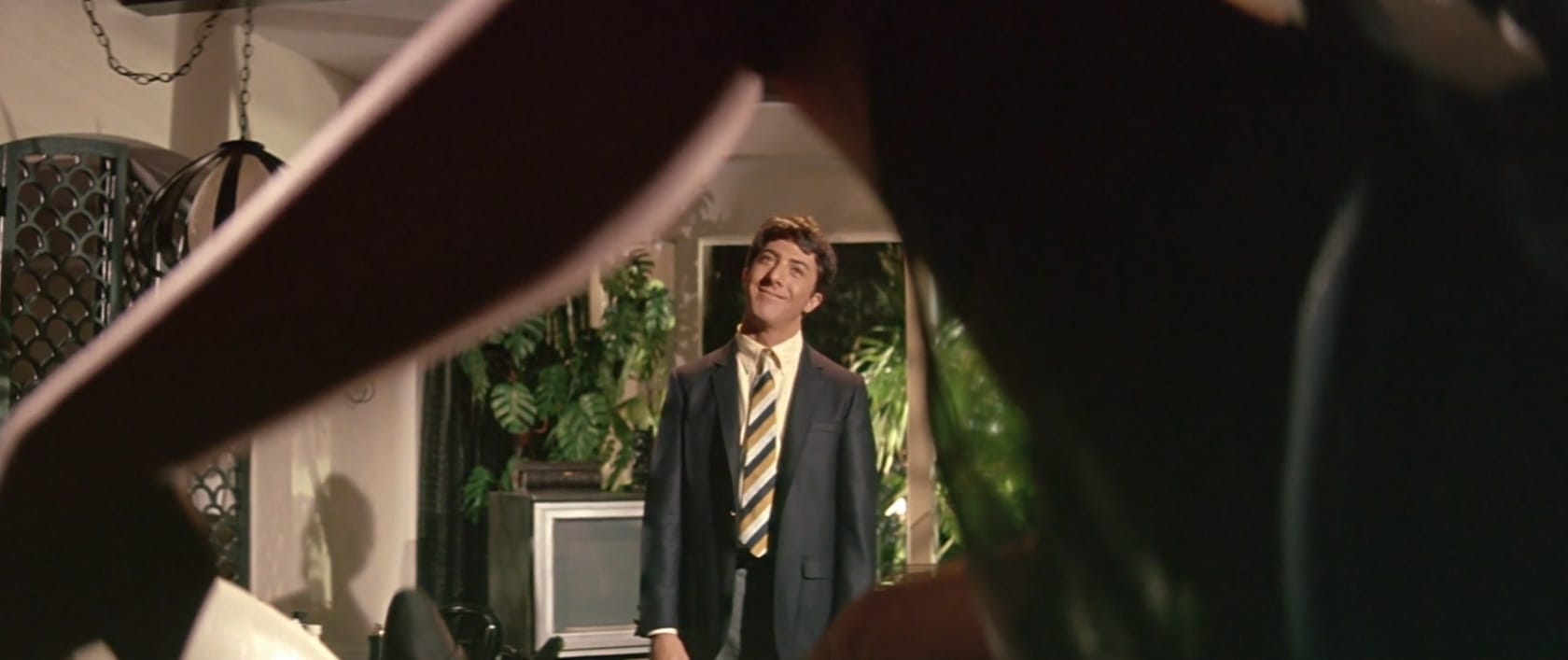
Mrs. Robinson is the most famous seductress in American film, and the quiet joke of The Graduate is that she is barely middle-aged. The 1967 movie built its whole engine on the distance between a 21-year-old and an older married woman. Hollywood has returned to the age gap ever since, and rarely for romance. The gap creates power, secrecy, and stakes that a same-age couple cannot supply. The pattern has held for nearly 60 years.
The Function of the Age Gap
The age difference is a mechanism, and the best films treat it that way. It is rarely the subject on its own. A wide gap hands a writer instant conflict: unequal power, divergent goals, social disapproval, and a clock that runs differently for each person. The younger partner often wants a future the older one has already lived or lost.
Directors use the gap for different ends. Mike Nichols used it for social satire, where an older woman controls an affair until the control slips and the story turns. The subject was authority and dependence, dressed up as seduction. That is the pattern worth watching for. The films that last are the ones using the gap to say something, while the decoration films, the ones that pair a famous older actor with someone half his age for no reason, fade within a year.
Off the Screen
Strip away the cinematography and these stories rhyme with real life. Real age gap relationships raise the same questions the films dramatize: who holds the power, whose plans win, and how outsiders read the match. Movies only turn the volume up.
The difference is that a film resolves in two hours. A real couple keeps negotiating the gap for years, as careers and health change and dependence slowly reverses. The screen version is cleaner, and far more dramatic, than the version people actually live. In life the questions rarely resolve. They only grow quieter as a couple learns to live with
The Graduate (1967)
Nichols made the power legible from the first scene. Mrs. Robinson sets the terms, chooses the hotel, and manages Benjamin’s nerves. The discomfort is the comedy. When Benjamin drifts toward her daughter, the affair collapses, and Mrs. Robinson turns from seducer to obstacle.
What dates well is the film’s refusal to make the affair aspirational. Benjamin is used by an older woman and uses her back, and both end up slightly worse off. The age gap exposes a hunger that neither character will name out loud. Audiences once took the story as liberation, though it plays now as a trap with two people caught inside it.
them.
Harold and Maude (1971)
Harold and Maude, Hal Ashby’s 1971 cult film, pushes the gap to its limit. Harold is a morbid young man in his 20s. Maude is 79, and she is the most alive person he has met. The film stays tender and strange at the same time, and it never treats the pairing as a punchline.
The peril here is mortality. Loving someone whose time is nearly gone is the subject, and Maude’s plan for her 80th birthday hands the romance a deadline the audience feels coming. Maude has survived far worse than Harold can picture, which is part of why he listens to her. Few films have used an age gap to say something so blunt about death and the will to keep living.
Lost in Translation (2003)
Lost in Translation, Sofia Coppola’s 2003 film, works at a lower volume than the rest. Bob Harris, a fading movie star, and Charlotte, a young woman adrift after college, meet in a Tokyo hotel. The roughly 35-year gap is never the plot. It is the reason two insomniacs recognize each other.
Coppola refuses to define what passes between them. There is no affair, or barely one, and the film ends on a whisper the audience cannot hear. The age gap becomes a study in loneliness, and the restraint is what makes it work. Tokyo itself isolates the pair, which is part of why the bond forms so fast and ends so cleanly. Two people can need the same thing at the same moment and still be unable to hold onto it.

Phantom Thread (2017)
Paul Thomas Anderson’s Phantom Thread turns the gap into a power struggle. Reynolds Woodcock, a celebrated dressmaker in 1950s London, takes Alma, a young waitress, as his muse and lover. He controls everything, from the breakfast table to the cut of her clothes, until Alma finds her own quiet method of control.
The film studies dependence more than romance. Affection and power become hard to tell apart, and the couple settles into a strange equilibrium that most viewers find unsettling. The age gap is only the setup for a study of who needs whom, and how far a person will go to stay needed. The pairing disturbs viewers precisely because it works for the two people inside it.
Carol (2015)
Todd Haynes’s Carol is a love story first, and the gap matters in a different way. Carol, an elegant woman in the middle of a divorce, meets Therese, a young shop clerk, in 1950s New York. The age difference overlaps with a gulf in class and in how sure each woman is about what she wants.
Here the older partner is the steady one and the younger is still forming. Carol knows herself. Therese is learning, partly by watching her. The film treats the gap as part of an education in desire, which is rare for a story about two people the world of that era already condemned. The difference between them looks like wisdom meeting hunger, and the film never apologizes for either.
Power in Plain Sight
The easy reading is that age gaps are trouble and these films are warnings. That is too tidy. What the strongest of them show is that a wide gap mostly magnifies what was already present. A controlling person keeps controlling, and a lonely one keeps reaching, whatever the ages involved. The difference is that the gap lets the camera see the dynamic without squinting. Age is the lens here. Power is the picture.