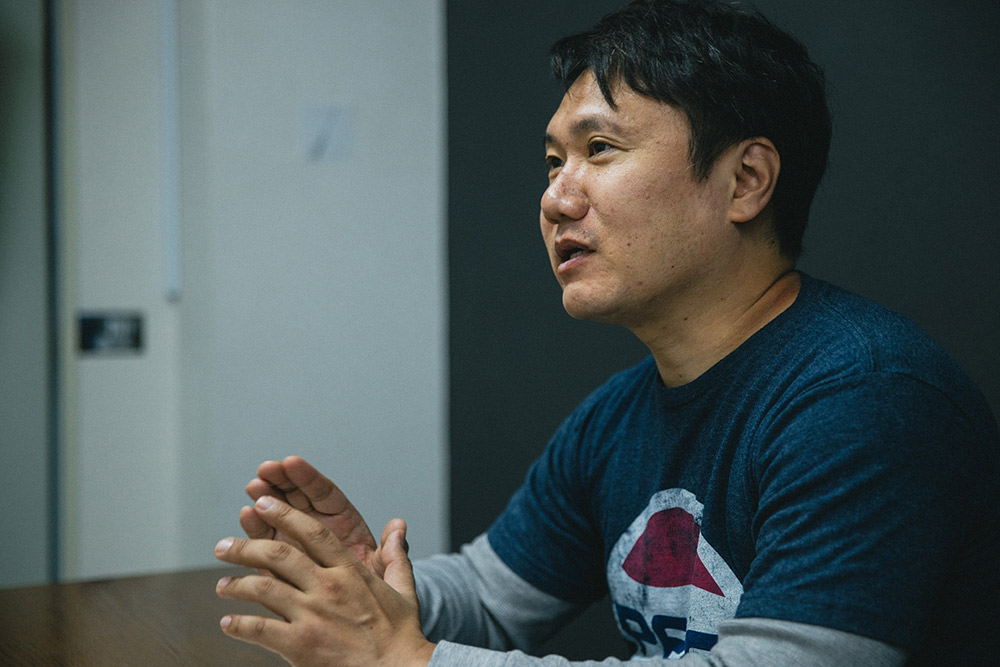
To celebrate the release of Ghost Killer, the newest epic action comedy from our friends in Japan, we sat down with director Kensuke Sonomura to talk about the film…
STARBURST: Congratulations on the release of Ghost Killer, it’s an absolute riot!
Kensuke Sonomura: Thank you so much, I’m glad you enjoyed it.
So Ghost Killer is a wonderful blend of impeccable action, J-drama and comedy. What was it about this particular project that drew you to being the director?
I’d worked with the distributor, RightsCube, before, and after that collaboration, they approached me about doing another film. I’d helped write the script for Baby Assassins, and this time they said, “Why don’t you direct, and let Mr. Sakamoto handle the script?” – so that’s what we did.
We are big fans of Baby Assassins, so it was great to see Akari Takaishi back in a big role. Essentially, she’s playing two polar opposite parts in quick succession, back and forth in some scenes. How was it working again with such a talented actor, and what made you feel that she had to be in the lead role for this?
When I first met Takaishi‑san, I already knew her work well. I’d seen her in so many films, and what struck me was her range – she carries so many different styles and emotional registers within her. There’s a real depth of material in her.
When I read the script for the first time, I could immediately picture her as the lead. It wasn’t even a question; the character felt like it had to be Akari Takaishi. No one else made sense in that role.
So I asked her to read the script, and once she was fully on board, we sat down and talked through the film in detail – everything from tone to character psychology. After that, I gave her the space to explore and build the character in her own way. I trusted her instincts, and I wanted her to have the freedom to expand the role beyond what was on the page.
Your history in film is very heavily involved with stunts and action. How important was it for you as a director to get everything right in terms of the stunts and the choreography? Because there’s a lot going on, especially in the final act of the film.
I come from the stunt world originally, so I oversaw all the stunt work and the stunt coordinators on this film. I brought in a team of people I trust – people whose ideas I really value. From the start, I laid out the direction I wanted the action to take, the tone, the physical language of the film. Once that foundation was set, we all started generating ideas together.
I’ve worked with a lot of professional stunt performers and action directors over the years, and I collaborated with many of them on this project. They’re incredibly skilled at figuring out how to make an action beat land in the most dynamic way.
After I shared my vision for how each sequence should feel, they’d come back with a range of concepts and possibilities. I’d look through everything, choose the strongest ideas, and then we’d refine them into the final choreography you see on screen.
It was a genuinely collective process – everyone bringing their expertise, everyone shaping the movement. That’s how we got the action to feel precise, alive, and true to the film.
Sound is a crucial element to any film, but especially in action. The sound design in Ghost Killer is exceptional. Every single punch feels visceral. How closely did you work with your sound team? What emotions did you want the audience to feel with every single punch?
I’ve built up a lot of experience working with sound – adding effects, stripping them back, and shaping how they sit in a scene. For this project, I worked closely with the sound team. They’d install the effects, send over the data, and I’d go through everything, checking how the speakers were behaving and how the sound was actually operating in the space.
There were moments where I’d ask them to shift things suddenly, or add a bit more nuance – maybe a sharper attack, maybe something softer or more atmospheric. We went back and forth a lot. It was a really collaborative process, and because of that, I’ve developed a very clear sense of what kind of sound effect actually lands, especially in an action-heavy environment.
I think a lot about intensity – how loud something should be, how restrained, what emotional texture it needs to maximise the impact of the moment. Once the sound designer created a track, they’d send it to me, and I’d listen closely. If I felt the scene needed a different nuance to really push the action, I’d suggest adjustments.
It was a very iterative process, but a really effective one. And because the film is so action‑driven, with so many moving parts, that level of precision in the sound design became essential.
What were some of the challenges that you faced and overcame during the production?
The hardest part for me this time was actually the comedy. I’ve never included comedic elements in my previous films, so stepping into that territory was completely new. Yugo Sakamoto’s writing has a very particular nuance to it – his humour is sharp but subtle – and I really had to figure out how to translate that onto the screen.
So the challenge became: how do I take the comedic rhythm he wrote and materialise it visually, without losing the tone of the film? That was something I had to work through carefully.
But even though it was a challenge, I’m really happy with how it turned out. The film manages to be funny, full of adrenaline, and surprisingly heartfelt all at once. Finding that balance was important, and I think we landed it.
What was your favourite sequence to film? And how important was your favourite sequence to you as a filmmaker?
My favourite sequence is actually the ending. I can’t go into detail without giving too much away, but there’s a very quiet emotional shift in that final moment that means a lot to me. Instead of leaning into a big, dramatic farewell – something you often see in Japanese cinema – I wanted to capture a different kind of feeling. It’s that subtle sense of loss that comes from not being able to say goodbye, the way someone can slip out of your life without fanfare.
That understated emotion was really important to me. By keeping the moment gentle and almost unnoticed, I felt I could express something more honest than a traditional tear‑jerking climax. That tone, that quiet ache, is why the ending is my favourite scene.
Could you share with us what you are working on next?
I can – It’s a period drama based on Shinya Umemura’s manga Chiruran: Shinsengumi Requiem. The adaptation is coming out this spring on U‑Next, the Japanese streaming platform. I had a great time making it – very different energy from my other projects, but a lot of fun to dive into.
Ghost Killer is available to watch in the UK on April 6th via streaming services, and is currently a part of the Japan Foundation’s Touring Film Programme.