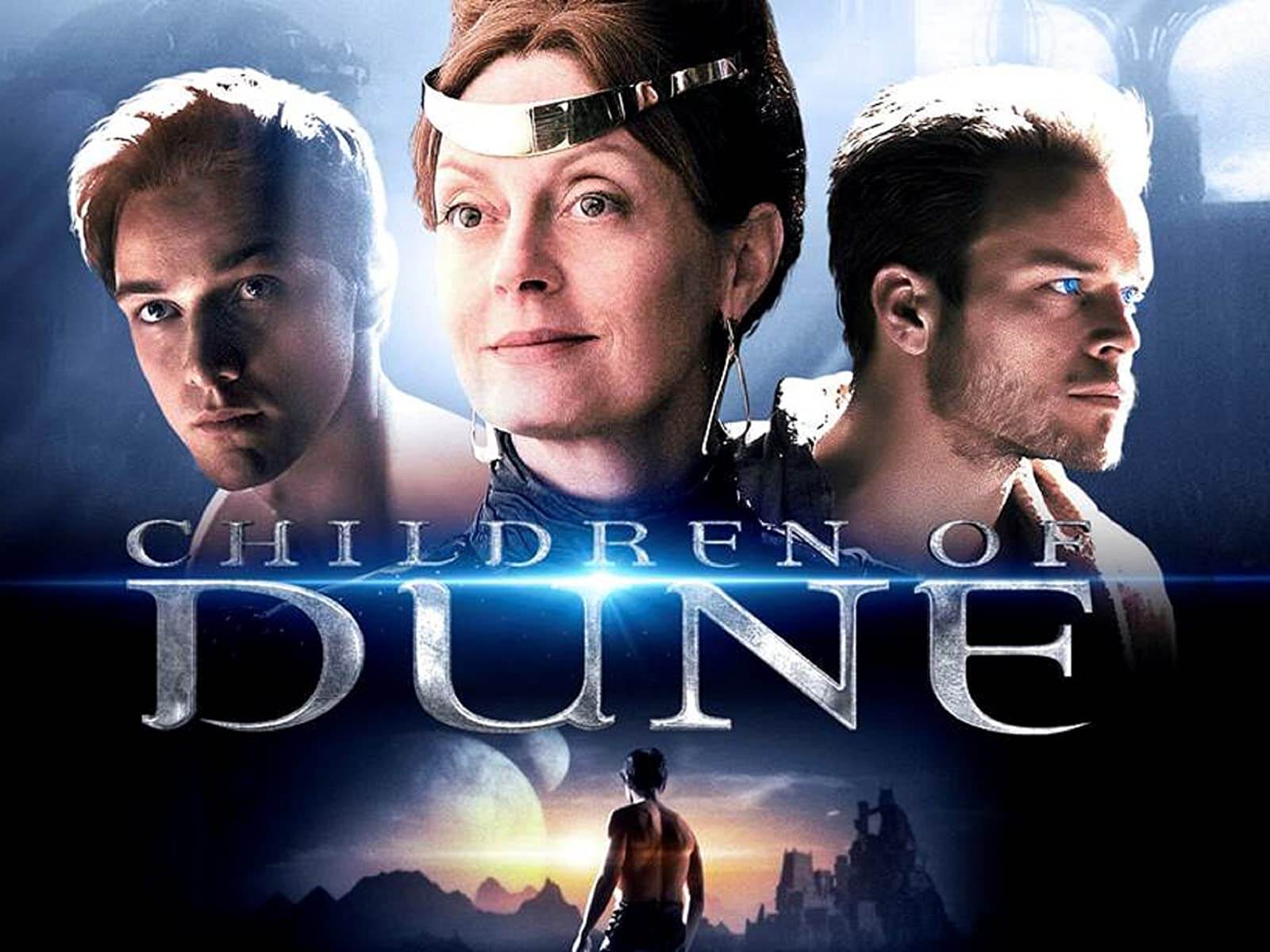
STARBURST catches up with writer/director/composer John Harrison to look back at the miniseries Children of Dune…
STARBURST: We’re always curious about whether a miniseries is more akin to making a film than making television or is it still TV, in the idea that you’re filming for beats where there are commercial breaks and episode breaks and things like that, or if it is it some sort of odd hybrid of the two?
John Harrison: With miniseries, the reason that I’ve loved doing any series is because, to me, they’re novelistic television. They are extended stories. They’re like long films – in the case of Dune, in particular, but also Supernova or Children of Dune – the story may be broken up into one two three nights or however many, but it is a complete story. It’s not episodic like a lot of television. Having said that, though, there are elements of the medium that have to be accommodated. First of all, there’s the money, which is always less than a feature film, so that constraint has to be factored in. Then there is the screen on which you’re delivering it. I think that has changed over the years, as we’ve gone to bigger and bigger screens, and the technology of what we can do with that as a field, All the sound production and everything else have changed and improved so that you can be much more cinematic with television than we used to be. So, you can think of production as film as opposed to just feel I’m just doing a television episode, so I think it is a kind of a hybrid.
The thing is, Dune has the people who love the book, and then there are people who love the book and the original film adaptation, and then there are people who love the miniseries. Is there something difficult when you’re tackling something that has already had a film adaptation?
Well, I was very lucky to have a different medium to play in. As much as I admire David Lynch as a filmmaker and as much as I admire a great deal of the Dune movie visually, I did not think it captured the essence of the book. We could go into hours of discussion about why that was: the difficulties that he had making it, about the choices the producers made – all of that is relevant.
I was approached and given the opportunity to take the book and have six hours to tell the story. David Lynch had two and a half hours – or four, depending on which cut you see – so I was able to think about it in a completely different way than had I been looking at it as a film adaptation. Denis Villeneuve is already breaking the book up into two parts, but if you know the book, you know how complicated that story is and how rich a tapestry it is – of characters and plots and environments – so it’s not something that can really be watered down if you really want to honour the story. I really didn’t reference the previous film at all.
When I was adapting Children of Dune, what I struggled with was how to turn this massive book into a visual experience. Luckily, as I say, I had six hours to do it. If you recall, the original book Dune is actually broken up into three sorts of sub-chapters: there’s Arrakis, there’s Muad’dib, and there’s The Prophet. There are three different sections to it and I was able to say to the producers, “This is how one can design the miniseries, with three different nights,” and so once I had that template, I was able to go back to the book and really start organising the drama along those lines. I really approached it as a completely unique, independent production.
Anybody who has any sort of issues with a new version of something based on something has to realise that like so many of the movies that we enjoy are, themselves, new incarnations of things that have come before, and if you want to get really into it, we can talk about the hero’s journey…
What you’re looking for is a filmmaker’s vision of his approach to that film, to that material. I mean, Kubrick took Steve’s book and he had a story in mind that came out of what Steve’s book was, and then there was a miniseries of Steve’s book, which may have been closer to the book. What I tried to do with Dune and then, subsequently, with Children of Dune – although that was a tougher adaptation – was to really find a way to honour the source material, because I happen to love the book. I saw no reason to veer from that.
What I had to struggle with was how to turn it into a different medium. For example, in the book, there’s a lot of internal monologue. Characters are thinking to themselves out loud and, in particular, Paul Atreides. Although David tried to do this, you really can’t be successful with having a character on screen staring at the camera and then hearing his voice, hearing his thoughts, his voice-over. The movie kind of comes to a dead stop at that point, so I had to figure out a way to externalise those interior monologues, either into dialogue or into some kind of visual representation of what the person was thinking.
Princess Irulan was another serious adaptation that I made. In the book, she is referred to, and each chapter has a lot of quotes from her memoirs later on but, to me, there was a very difficult way of translating those into a visual medium. I had to figure out, “Well, how am I going to get this information out?” There’s some really germane information going on here that, when you’re reading, is very important. How am I going to get it so that the audience watching this gets it?
I decided that I would just create the character on screen, so that she could say what she’s saying in the book. I didn’t invent this out of whole cloth. This was all in Frank’s book – I just had to figure out a way to make it to realise it on film. Those were the adaptations I had to do. Obviously, with any adaptations, there are things like shrinking time and conflating scenes together because you have to get the information out. You can’t have 20 scenes, when you can do it in two and so forth, but those are the normal adaptations that you do anytime you’re turning a book into a movie.
FRANK HERBERT’S CHILDREN OF DUNE will be available on Amazon Prime Video from June 26th.