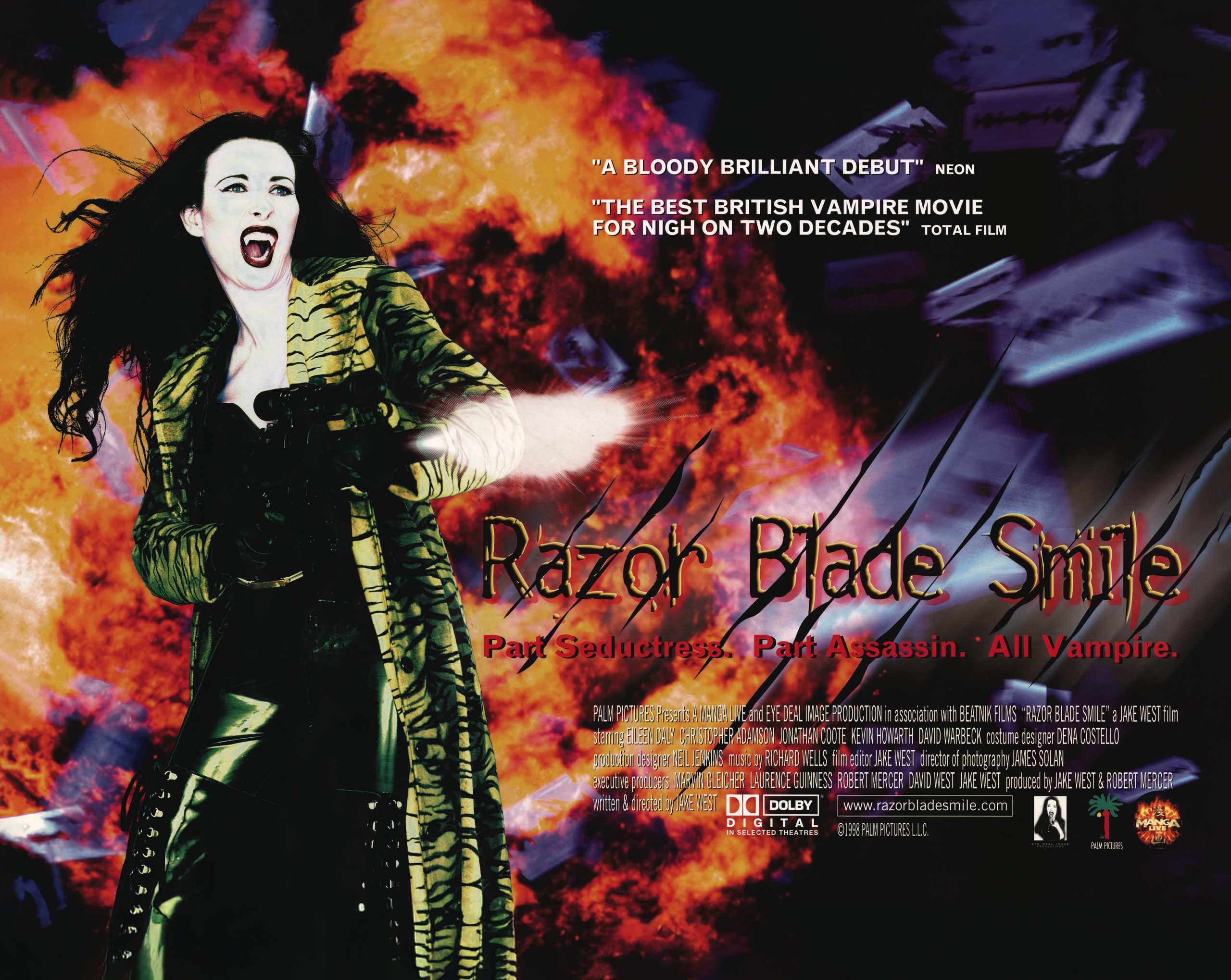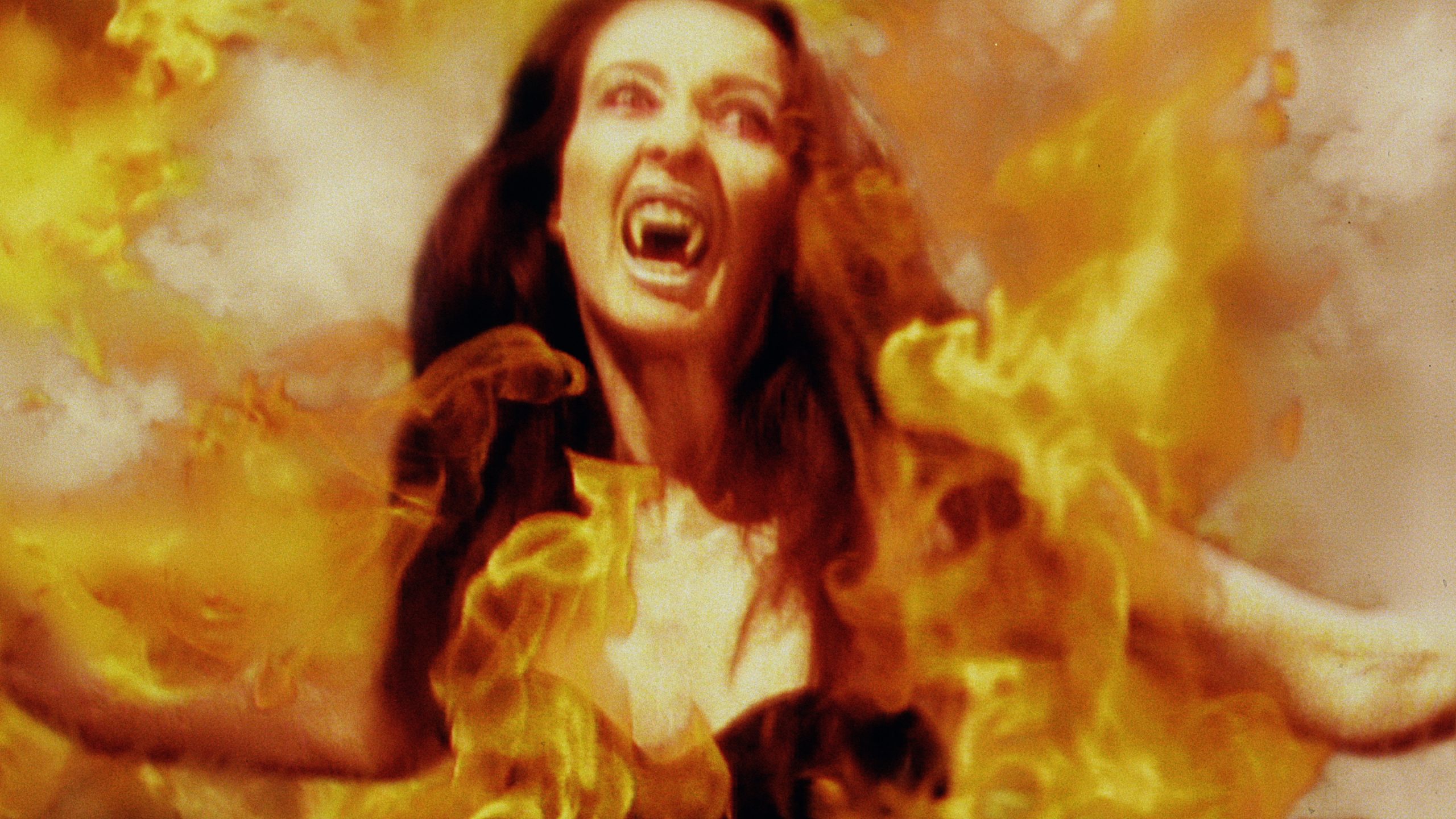
Back in 1998, Jake West made a British vampire film that gave the age-old monster a different slant. With model Eileen Daly playing the rubber-clad Lilith Silver and character actor Christopher Adamson as the sinister Sethane Blake, the movie followed the ageless Lilith as she carries out her chosen profession as an assassin-for-hire.
STARBURST: What inspired you to make the film?
Jake West: I grew up becoming a vampire fan, initially with the Universal Draculas, and then obviously the Hammer stuff. And from there, I was hooked. And being a kid in the ‘80s, I got treated to seeing like The Lost Boys at the cinema, Near Dark, Fright Night, and The Hunger on video. All these amazing vampire movies, which were cropping up at that point. Growing up as a sort of teenage goth, punk vampire fan, I thought that if I was going to do a low-budget film, a film about a vampire would be a great thing, because I was really into that scene. And there was a thriving cultural scene in the UK at that point. There were vampire societies and appreciation groups. And I started going along to the London Vampire Group and meeting the people there, many of them are extras in the film’s scenes at the Transylvania club. I thought ‘what can I do that would be different to other vampire films I’ve seen?’ My thinking was if I was a vampire and I was living in ‘90s Britain, I would still have to kill people to live. So what would be cool if I had a job where I got paid to kill people? So I thought, an assassin, a hit person. That would be really a great job for a vampire to do. As Lilith says, it would take all the angst out of deciding who she has to kill. She just has a hit list and she gets paid for doing it. It solves the problem. And then I thought, if she were an assassin, it’s quite likely she would then have a bunch of enemies. And the idea spiralled from there.
Can you talk about shooting on film?
This is this was shot in 1996, before digital video was even a thing. If you wanted to make a film and have any chance of getting it released, it really had to be shot on film to be technically good enough. Unless you did a Cliff Twemlow [laughs]. But then you would only get a video release at best. I didn’t want to shoot on video because it looked crap at that point. It was awful. Shooting on film gave it that aesthetic as well, and, having done the restoration, it looks better now than it did in the ‘90s. Being able to go back to the original camera negative is beautiful. Film has that beautiful image, and vampire films, particularly, work really nicely on film with all the grain and the analogue scratchiness of it, because they’re from another time.
What else did you do to stretch the resources?
An example of low-budget thinking was shooting in locations that I knew, and I’d grown up in, that I’d shot in before over the years, and I knew that they looked great on film. I wasn’t turning up to a place for the first time. I knew all these places, and they were all within striking distance of where we lived or where we were staying. That was a smart move. And stuff like props, for instance, Lilith Silver’s got two guns in the film, which are blank-firing guns, which I bought because back in the ‘90s, things were a bit more unregulated. You could buy replica weaponry, which actually fired, not through the front, but they literally eject the shells – they’re proper guns. Everyone else shooting a gun in the film uses the same two guns. They were being passed around. All the guys in the long shots are just holding plastic toy guns [laughs]. Lilith is effectively being shot at with the same gun that she’s holding. But that’s the fun thing about film, you figure out, I can basically service the entire production with these two blank firing guns. I think they cost about 120 -150 quid at the time, which was quite a big part of the budget, but it was completely necessary, and they were great.
What were the conditions of the film elements when you when you came to look at them?
Fortunately, I had all of the original elements because we’d done the theatrical release, which we’d blown up from 16mm up to full 35mm in 1998. Now, those elements have been stored in the lab after we did the telecine for the video release, back in ‘98. It was just an SD transfer because HD wasn’t a thing at that point. But in the early noughties, I got a phone call from Manga saying they don’t want to carry on paying for the storage of all these film cans. So I had an option. Either I can have them or they’re going to get binned.
What!? That’s crazy!
Yeah! I said, no, please make sure you get them sent to me! I was living in Camden at that point. I got a delivery of all the film cans, including all of the original camera negative cuts, all the A – B rolls and the C rolls for the VFX material. So I’ve got a load of film cans, which I’ve been carrying around with me for the last 27 years [laughs]. Fortunately, I’ve managed to keep them in fairly cool environments, but not stored professionally. I didn’t know what state the elements were going to be in as I hadn’t opened the cans, because there’s nothing you can do looking at rolls of film. I got in touch with Silver Salt Restoration, which is one of the best restoration companies in the UK. They’ve done a lot of stuff for Hammer, the BBC, Arrow, and loads of people. They use an ARRI XT film scanner, which is the best film scanner you can get. It’s like a quarter of a million pounds’ piece of kit. Marie at Silver Salt went hand by hand through all of the rolls just to check the elements. And they were in pretty good shape, considering. They then cleaned it and then they scanned it. I then had to rebuild the entire timeline in DaVinci Resolve. So it’s the third time I’ve fucking redone this because we originally did it on video, and then I had to re-transfer it to do the negative cut back in the ‘90s. So, the elements were in really good shape, but they did need a bit of manual de-spotting and painting out scratches, because at the beginning and end of the reels you get a bit more damage. I couldn’t afford to pay Silver Salt to do that, so I had to do it all myself. So that took about six months, going through frame by frame, because I wanted it to look as perfect as it could. That was really painstaking, but it was worth it. I saw details in there that I’ve never seen before. It was incredible. This is how I always kind of wanted it to look. I did a new grade on it as well. The grade was done in sympathy with the original grade. I didn’t want to change anything in the edit. I just wanted to make it look as good as it could. You’ve got so much more control with the grading tools now. I could really get into areas like isolating her eyes, blood, and things like that, which I wanted to do originally, but the technology didn’t exist at the time. Considering we shot on the smallest 16mm gauge you can get – this wasn’t Super 16 – it’s incredible the image detail that’s on it.
The film’s been very influential, as we see in the disc’s feature-length documentary…
Yes, and it was nice going back to the legacy and talking with others about it for Vampires Forever. What was really nice to learn was that the film’s legacy inspired many other people to do things. Obviously, there are people who didn’t like it, and they thought it was trashy and low budget, and that’s fine. But the people who did like it, the audience that embraced it, and there were a lot of filmmakers who were inspired to do their own movies because of it. That’s a really positive thing, and I get a lot of joy from it. As a filmmaker, you can’t ask much more than that. What’s nice is that when we took it to FrightFest, where we premiered the 4K restoration at the festival’s 25th anniversary, there were a whole bunch of people who had never seen it, and people were discovering it for the first time, and they really loved it.
For audiences who’ve only seen the video or DVD version, why should they check out the 4K version?
I hope they see that the film’s quality feels much more like a movie now. That original telecine was quite basic, and it was very bright. At the time, a lot of people didn’t even know it was shot on film, whereas if you watch it now, I think it’s pretty clear it was. You can get a sense of that texture because I didn’t remove the grain. It has that texture that was missing in the SD video. You forget how soft it was. The filmmaker Emma Dark said it feels more like a horror film now because it has a slightly more sinister tone. I’d really like people to appreciate the film, but also with this particular release and the sheer amount of extras on it, particularly the Vampires Forever documentary. There’s some incredible archive footage of all the stuff that was happening at that point in the ’90s, and I really think it takes you back to that period. It’s a standalone 96-minute documentary that took me nearly two years to do. And this is just an extra! If you liked my Cliff Twemlow documentary, Mancunian Man, then Vampires Forever is the goth equivalent
The 4K Blu-ray of RAZOR BLADE SMILE is released on April 20th from Nucleus Films. You can read more from Jake in the next issue of STARBURST Magazine.