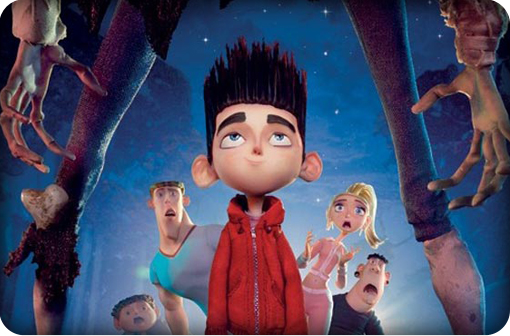

Halloween has come early this year, as the ghosts and ghouls of ParaNorman invade cinemas across the world. Starburst recently had the pleasure of sitting down with ParaNorman directors Chris Butler and Sam Fell to discuss the importance of zombies in society and the majesty of Scooby Doo.
Starburst: Let’s talk about the origin of ParaNorman. How did this story come to be?
Chris Butler: It began many years ago, once upon a time, probably about sixteen years ago, I thought, ‘Wouldn’t it be great to do a stop-motion zombie movie for kids?’ And a proper zombie movie and by that I mean using zombies as social commentary, but for kids. In this case, it was bullying and fitting in and I thought wouldn’t it be great to do a high school or a middle school drama comedy but introduce zombies into it. We always talk about it as John Carpenter meets John Hughes so it was the mix of those two things. Like the characters of The Breakfast Club dropped into the plot of The Fog.
Starburst: I’m sold.
CB: That was the initial idea to do zombies as a metaphor, but from a kid’s perspective. When you’re eleven and you don’t fit in, the kid who lives down the road who bullies you every day is far more terrifying than zombies you’d watch in a movie so it’s that fictional horror versus the horror of being eleven. That’s kind of where it started and over the years I just kept going back to it and eventually I had the first act of a script which I showed to the guys at Laika – Travis Knight – and he liked it enough to give it a go and then I wrote the rest and then Sam got involved.
Starburst: What was it like working together?
Sam Fell: It was cool, we weren’t forced together. I had actually just gone to the studio generally to look at a number of projects that were in development, just to help out because I’d done a few feature films and had been around animation for a while. I was just drawn to Chris’ project and I liked the script and we gradually talked over months about films we liked and the kinds of films that influenced this film and more and more we just found that we had a hell of lot in common and we agreed on a lot of stuff. Then we cooked up could be a director’s vision of the film and that went well . . . even through that process we were just rhyming with a lot of the same references and we just naturally became a directing team. It was organic.
Starburst: Can you tell me about those references? It’s a family film but also a horror movie which can be a tricky balance but when it’s executed well, like in Coraline, it can be quite beautiful and terrifying.
CB: Coraline is slightly different in that I think that’s more of a dark fairy tale whereas we were specifically referencing horror movie conventions and that’s as simple as what a zombie is. A zombie wants to eat your brains, but then playing with that, turning it on its head. You might think that but it’s wrong. I don’t think we were setting out to make a horror movie for kids. We were making this kind of fun, Scooby Doo-esque adventure and we were playing with horror conventions but actually, it’s more about Norman. It’s got an emotional, central story to it that’s far more than just goofy zombies.
SF: Yeah, the horror of the movie is the wrapping paper. It unwraps and it reveals a story about tolerance.
CB: In terms of specific references, obviously we looked at a lot of zombie movies – John Carpenter was a big influence. But then also more family, ’80s movies, so like The Goonies, Ghostbusters, E.T., with that Amblin vibe, that kind of irreverent adventure that’s maybe more risky than the kinds of movies you get today for kids.
Starburst: There’s no central villain in ParaNorman . . . can you talk a bit about abandoning that formula?
CB: We wanted to play with those conventions. You think a witch is going to be like this, or you think zombies are going to be evil and you think the cheerleader is bad, or whatever. I like the idea of making the audience complicit in that and then pulling the rug out from under them.
Starburst: There’s been quite a bit of talk about Mitch and the reveal at the end of the movie that he’s gay. He’s so open about it and there’s no shame and there’s no hiding. I read one review that said something like ‘It might force parents to have uncomfortable conversations with their children’ which seems odd considering they’d just walked out of a 90 minute movie on intolerance. What would you say to these people?
CB: You don’t have to say anything to them. One of my favorite reviews was like ‘it’s a good, important story about tolerance and trying to understand others, but then they go and ruin it by having a gay at the end!’
SF: It’s astonishing really. This is a contemporary movie and it’s the real world.
Starburst: And there are gay people in the real world.
SF: Exactly. It’s not something to be hidden from children.
CB: I think we’re all proud of it. We’re proud that this is a first, I think.
SF: I think most kids can deal with it, actually. It’s more the parents. Most kids are like “Yeah, whatever,” and they’ll deal with it.
Starburst: Because children learn to be intolerant.
CB: Right. They’re taught intolerance. And if we can change one person’s life, if we can have a parent have a productive, genuinely good conversation with their kids as a result of this, great. I’ve actually had a couple of things forwarded to me from parents. There was one parent who had a gay teenage kid and that kid had known they were gay for many years and that parent had come to terms with it and she was happy to be able to take her son to a movie that had a positive role model because there are none out there for kids.
Starburst: Do you think we’ll have another at some point in the near future?
CB: At some point.
SF: Well, is sort of positive. He’s not the sharpest knife in the box.
Starburst: Well, he’s not a villain and he’s not a one-dimensional character and it’s treated as normal.
SF: Right, it’s not the main thing about him.
CB: I think that’s the most important thing, that it’s normal. It’s funny how much fuss there’s been about this, really, because the movie overall . . . it’s tolerance. Tolerance for everything. I’d hate for people to get caught up in just one aspect of it.
SF: Well, this film was made in an unusual situation with Laika studio who are really, truly independent so they’re able to do things that other people don’t do and they want to do that. They’re outside of the mainstream. The reason that it doesn’t happen is that are afraid. They’re worried about the business side of it. So it’s an unusual studio.
CB: It has the strength of its convictions. But I think that’s absolutely right. There is a concern that you have to make a product that appeals to everybody.
SF: But everybody doesn’t mean everybody.
Starburst: There’s a sort of heteronormative default.
CB: Gradually, it will change. Gradually. I hope.
Starburst: What zombie stories – from movies, comics, literature, TV shows – served as inspiration for you?
CB: I have a good grounding in all zombie movies. I love them. Night of the Living Dead had a profound impact on me because I saw it when I was quite young and I thought I could handle it because it was black and white and it was old. And then it really kind of slapped me in the face. But even now, when you watch that movie through the end credits, it has an awful lot to say and I think that’s what’s cool about zombie movies. So all of them, really, at least the ones that change the world a little bit.
SF: The ones that have some kind of social commentary, which is not a lot of them lately.
CB: I think any conscientious zombie movie or director needs to do something different each time, because those are the ones that really stand out. I hope we did.
SF: I think so. There’s not been a kids zombie movie before.
Starburst: We think you might be pioneers in this field.
SF: There might have been a Scooby Doo episode like that though.
Starburst: Possibly, but Scooby Doo has done everything. Scooby Doo is the Shakespeare of our time.
CB: It really is, isn’t it!
ParaNorman is in UK cinemas now; head HERE to read our review.