Ask modern moviegoers who the ultimate Superman is and you’re likely to get just one answer: Christopher Reeve. No matter how many actors donned the red and blue tights of the Last Son of Krypton before, and no matter what happens in the Henry Cavill-starring Man of Steel in 2013, there is, and probably will only ever be, one true cinematic Kal-El for many film fans. It wasn’t always like this though. For a whole generation, the ultimate Superman doesn’t have Reeve’s broad shoulders and mild-mannered grace. In fact for many, the real Superman isn’t even flesh and blood. An animated deity, swooping through a 30s Metropolis battling evil hoods, megalomaniacal scientists and marauding monsters, the Superman of the Fleischer Studios cartoons is the one a generation of cineastes grew up on and look back upon as the defining rendition of the character. But for the Fleischers themselves, the Man of Steel would be a lead weight around the neck.
Dave and Max Fleischer were brothers with a talent for drawing. After working in the art departments of various New York publications at the start of their careers, they quickly moved into animation, first looking to get a foothold in the industry, then aiming to revolutionize it. Max, the more mechanically-minded of the two, was particularly eager for innovation. He thought animation was too rigid, the characters lacking sufficient realism to correctly capture the movement of human beings, so he created rotoscoping, the process by which live action footage is ‘traced over’ to create an animated cel. After a handful of experiments, this new technology was first put to use in 1918’s Out of the Inkwell, a short cartoon in which Koko the Clown (as ‘played by’ Dave) emerges from an inkwell and performs a series of stunts. The short proved a success and after a couple of years producing Inkwell cartoons for the Bray Studios, who in turn supplied them to Paramount, the brothers signed a contract with Paramount themselves and officially founded their own studio, Out of the Inkwell Films, Inc, in 1921. The Fleischer Studios name would later come in 1929.
With Max taking on production duties and Dave in the director’s chair, further innovation followed – notably in the shape of the karaoke cartoon series ‘Song Car-Tunes’. It wouldn’t be until 1930 that the studio would find its big break though. Betty Boop had originally begun life in an episode of Fleischer series Talkartoons, but proved so popular she quickly went solo. Featuring risqué scenarios and bawdy humour, Betty’s series was aimed largely at adults and it was eventually subject to sweeping changes thanks to the Hayes Code. The series’ popularity never diminished though and it soon helped spawn another star, Popeye the Sailor Man, whose individual series got underway in September 1933. It wasn’t long before cinema beckoned and the Fleischers’ first film, an adaptation of Gulliver’s Travels, arrived in 1939. Released just a couple of months after the outbreak of World War II, it flopped and proved the first of only two Fleischer features. The second, Mr Bug Goes to Town, fared little better, struggling to find an audience in the aftermath of the attack on Pearl Harbor.
In between these two disappointing releases came the Superman films. It’s a sad irony that a studio so integral in the development of animation technology, and responsible for creating unique characters as iconic as Betty Boop, should be remembered for someone else’s creation. Perhaps that’s why the brothers were hesitant at first. When Paramount initially approached Dave and Max over an animated Superman series the brothers quickly tried to put them off. They knew that such a project would be more complex than anything they’d ever tried before, requiring a greater attention to detail and demanding an unprecedented level of realism. In an attempt to dissuade Paramount, Dave quoted a production cost of around $100,000 per episode – an unheard of amount for a cartoon at the time. Paramount declined, but still wanted to push ahead, eventually settling on a budget of $50,000, a greatly reduced rate, but still much higher than the Popeye cartoons, which cost around $17,000 per episode. And so, production on some of the most influential animated films in history got underway, with both Paramount and the Fleischers nervously awaiting the results.
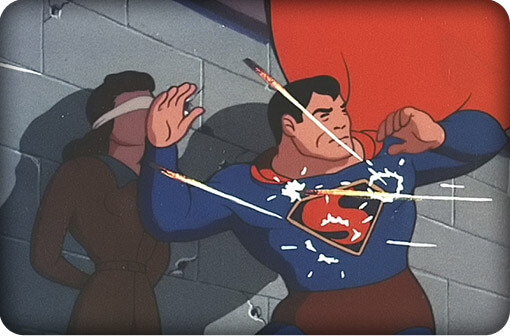
They needn‘t have worried. Every cent of the budget shows on screen. The first episode, simply entitled Superman, is a visual treat. Focusing on a mad scientist who plots to destroy Superman’s home city (then simply an anonymous metropolis rather than the Metropolis we all know), it’s a pulp dream, featuring shadowy newspaper offices, vast, shimmering cityscapes and a creepy lair for the bad guy. Heavily influenced by the art deco movement of the time, the Fleischers had a dramatic canvas to paint their cinematic tale on, and it’s shot through with noir flourishes, the chiaroscuro lighting and Dutch angles adding a level of intrigue and mystery to a story that is otherwise rather straightforward. As the series went on, the Fleischers would touch upon science fiction, gangster movies and even a splash of German Expressionist horror, but there was always a singular style to each episode. Every frame seems edged by the yellowing dog-earned corners of pulp literature. This is Superman as 30s Americana, Superman as it really should look.
But what about the Man of Steel himself? How should Superman look? Stylized though it may be, Metropolis is populated by real people not cartoon characters. Our hero couldn’t have Popeye-esque inflatable muscles and Lois Lane couldn’t wiggle Betty Boop’s waistline. The Fleischers’ got around this by again rethinking their approach and building their characters with structures of blocks and squares rather than circles and spheres, as had always been the tradition. The benefits of the change are two-fold. Firstly, it simply looks much more realistic – cartoon characters are round and cuddly; human beings look much more linear. Secondly, it allows for greater movement and articulation. The bad guys express their evil with more pronounced physicality, Lois Lane swaggers through town with a steely reporter’s stride and Superman doesn’t just fly, he soars.
Superman was released at cinemas in September 1941 and was greeted with universal praise from filmgoers and critics alike. The short even went on to win an Oscar nomination in the Best Short Subject (Cartoons) category. More episodes followed, each upping the ante. In Mechanical Monsters, Superman battles flying robots designed to rob banks; in The Bulleteers he fights criminals armed with a super-powered car; and in The Arctic Giant he brings down a dinosaur resurrected from the frozen depths of the Antarctic. Earthquake machines and gigantic telescopes followed before the Fleischers’ involvement with the series came to an abrupt end with their ninth episode, Terror on the Midway. It was released in July 1942 and is the weakest of the brothers’ cartoons – a rather tepid tale of a giant gorilla running wild at a circus.
By this time, America was well into World War II and the fighting in the Pacific and Europe made the fantastical exploits of an alien orphan seem somewhat trivial. As a result, profits were down and with plenty of money still being ploughed into production, not to mention Dave and Max’s increasingly fractious relationship, Paramount brought their partnership with the studio to an end. In the Fleischers’ place came Famous Studios, who produced the final eight episodes in the seventeen short long series. Though several Fleischer employees made the transition to Famous, the new studio’s productions lacked the visual verve and panache of their predecessors and a certain wonder had been removed from the cartoons too. While the Fleischers’ stories were escapist and predominantly science fiction based, Famous’s efforts were thinly-veiled war propaganda. Their first film, the self-explanatory Japoteurs, was a sign of things to come.
Lacking Paramount’s funding, the Fleischers struggled as much as the cartoon. The Studio closed its doors and the brothers moved on, Dave to Columbia and then Universal, Max to the Jam Handy Organisation and then back to the Bray Studios. They never truly recaptured the success of their early days and died either end of the 1970s, failing to resolve their rift. It was a sad end to two great talents. Between them, the Fleischers contributed hugely to Superman history and animation innovation. Without them, there’d be no rotoscoping, there‘d be less Boop-esque sass in cartoons and even the idea of the short film before the feature may not have taken off quite as it did. The Batman animated series of the 1990s, so lauded and so deeply influenced by the Fleischer Supermans, would have been very different too. The same can be said of animation as a whole. They were that important.
Even Superman himself may not have become the hero we all know and love were it not for the Fleischer Brothers. When the Fleischer cartoons first started, Superman was grounded. Sure he could leap tall buildings, but fly? That was a concept the Fleischers introduced because the sight of a man jumping great distances simply didn’t play when static comic frames were put into motion. So they asked DC Comics if they could put him in the air properly. They said yes, and the change stuck. Pretty soon, Superman was flying everywhere: in the comics, in the George Reeves TV series and, of course, in the films. This is the Fleischers’ legacy. Years before Reeve spent the 70s floating above a soundstage to the strains of John Williams, it was Dave and Max who really made you believe a man could fly. A fitting epitaph for two of entertainment’s true innovators.
Ask modern moviegoers who the ultimate Superman is and you’re likely
to get just one answer: Christopher Reeve. No matter how many actors
donned the red and blue tights of the Last Son of Krypton before, and no
matter what happens in the Henry Cavill-starring Man of Steel in 2013,
there is, and probably will only ever be, one true cinematic Kal-El for
many film fans. It wasn’t always like this though. For a whole
generation, the ultimate Superman doesn’t have Reeve’s broad shoulders
and mild-mannered grace. In fact for many, the real Superman isn’t even
flesh and blood. An animated deity, swooping through a 30s Metropolis
battling evil hoods, megalomaniacal scientists and marauding monsters,
the Superman of the Fleischer Studios cartoons is the one a generation
of cineastes grew up on and look back upon as the defining rendition of
the character. But for the Fleischers themselves, the Man of Steel would
be a lead weight around the neck.
Dave and Max Fleischer were brothers with a talent for drawing. After
working in the art departments of various New York publications at the
start of their careers, they quickly moved into animation, first looking
to get a foothold in the industry, then aiming to revolutionize it.
Max, the more mechanically-minded of the two, was particularly eager for
innovation. He thought animation was too rigid, the characters lacking
sufficient realism to correctly capture the movement of human beings, so
he created rotoscoping, the process by which live action footage is
‘traced over’ to create an animated cel. After a handful of experiments,
this new technology was first put to use in 1918’s Out of the Inkwell, a
short cartoon in which Koko the Clown (as ‘played by’ Dave) emerges
from an inkwell and performs a series of stunts. The short proved a
success and after a couple of years producing Inkwell cartoons for the
Bray Studios, who in turn supplied them to Paramount, the brothers
signed a contract with Paramount themselves and officially founded their
own studio, Out of the Inkwell Films, Inc, in 1921. The Fleischer
Studios name would later come in 1929.
With Max taking on production duties and Dave in the director’s
chair, further innovation followed – notably in the shape of the karaoke
cartoon series ‘Song Car-Tunes’. It wouldn’t be until 1930 that the
studio would find its big break though. Betty Boop had originally begun
life in an episode of Fleischer series Talkartoons, but proved so
popular she quickly went solo. Featuring risqué scenarios and bawdy
humour, Betty’s series was aimed largely at adults and it was eventually
subject to sweeping changes thanks to the Hayes Code. The series’
popularity never diminished though and it soon helped spawn another
star, Popeye the Sailor Man, whose individual series got underway in
September 1933. It wasn’t long before cinema beckoned and the
Fleischers’ first film, an adaptation of Gulliver’s Travels, arrived in
1939. Released just a couple of months after the outbreak of World War
II, it flopped and proved the first of only two Fleischer features. The
second, Mr Bug Goes to Town, fared little better, struggling to find an
audience in the aftermath of the attack on Pearl Harbor.
In between these two disappointing releases came the Superman films.
It’s a sad irony that a studio so integral in the development of
animation technology, and responsible for creating unique characters as
iconic as Betty Boop, should be remembered for someone else’s creation.
Perhaps that’s why the brothers were hesitant at first. When Paramount
initially approached Dave and Max over an animated Superman series the
brothers quickly tried to put them off. They knew that such a project
would be more complex than anything they’d ever tried before, requiring a
greater attention to detail and demanding an unprecedented level of
realism. In an attempt to dissuade Paramount, Dave quoted a production
cost of around $100,000 per episode – an unheard of amount for a cartoon
at the time. Paramount declined, but still wanted to push ahead,
eventually settling on a budget of $50,000, a greatly reduced rate, but
still much higher than the Popeye cartoons, which cost around $17,000
per episode. And so, production on some of the most influential animated
films in history got underway, with both Paramount and the Fleischers
nervously awaiting the results.
They needn‘t have worried. Every cent of the budget shows on screen. The first episode, simply entitled Superman,
is a visual treat. Focusing on a mad scientist who plots to destroy
Superman’s home city (then simply an anonymous metropolis rather than
the Metropolis we all know), it’s a pulp dream, featuring shadowy
newspaper offices, vast, shimmering cityscapes and a creepy lair for the
bad guy. Heavily influenced by the art deco movement of the time, the
Fleischers had a dramatic canvas to paint their cinematic tale on, and
it’s shot through with noir flourishes, the chiaroscuro lighting and
Dutch angles adding a level of intrigue and mystery to a story that is
otherwise rather straightforward. As the series went on, the Fleischers
would touch upon science fiction, gangster movies and even a splash of
German Expressionist horror, but there was always a singular style to
each episode. Every frame seems edged by the yellowing dog-earned
corners of pulp literature. This is Superman as 30s Americana, Superman
as it really should look.
But what about the Man of Steel himself? How should Superman look?
Stylized though it may be, Metropolis is populated by real people not
cartoon characters. Our hero couldn’t have Popeye-esque inflatable
muscles and Lois Lane couldn’t wiggle Betty Boop’s waistline. The
Fleischers’ got around this by again rethinking their approach and
building their characters with structures of blocks and squares rather
than circles and spheres, as had always been the tradition. The benefits
of the change are two-fold. Firstly, it simply looks much more
realistic – cartoon characters are round and cuddly; human beings look
much more linear. Secondly, it allows for greater movement and
articulation. The bad guys express their evil with more pronounced
physicality, Lois Lane swaggers through town with a steely reporter’s
stride and Superman doesn’t just fly, he soars.
Superman was released at cinemas in September 1941 and was
greeted with universal praise from filmgoers and critics alike. The
short even went on to win an Oscar nomination in the Best Short Subject
(Cartoons) category. More episodes followed, each upping the ante. In Mechanical Monsters, Superman battles flying robots designed to rob banks; in The Bulleteers he fights criminals armed with a super-powered car; and in The Arctic Giant
he brings down a dinosaur resurrected from the frozen depths of the
Antarctic. Earthquake machines and gigantic telescopes followed before
the Fleischers’ involvement with the series came to an abrupt end with
their ninth episode, Terror on the Midway. It was released in
July 1942 and is the weakest of the brothers’ cartoons – a rather tepid
tale of a giant gorilla running wild at a circus.
By this time, America was well into World War II and the fighting in
the Pacific and Europe made the fantastical exploits of an alien orphan
seem somewhat trivial. As a result, profits were down and with plenty of
money still being ploughed into production, not to mention Dave and
Max’s increasingly fractious relationship, Paramount brought their
partnership with the studio to an end. In the Fleischers’ place came
Famous Studios, who produced the final eight episodes in the seventeen
short long series. Though several Fleischer employees made the
transition to Famous, the new studio’s productions lacked the visual
verve and panache of their predecessors and a certain wonder had been
removed from the cartoons too. While the Fleischers’ stories were
escapist and predominantly science fiction based, Famous’s efforts were
thinly-veiled war propaganda. Their first film, the self-explanatory Japoteurs, was a sign of things to come.
Lacking Paramount’s funding, the Fleischers struggled as much as the
cartoon. The Studio closed its doors and the brothers moved on, Dave to
Columbia and then Universal, Max to the Jam Handy Organisation and then
back to the Bray Studios. They never truly recaptured the success of
their early days and died either end of the 1970s, failing to resolve
their rift. It was a sad end to two great talents. Between them, the
Fleischers contributed hugely to Superman history and animation
innovation. Without them, there’d be no rotoscoping, there‘d be less
Boop-esque sass in cartoons and even the idea of the short film before
the feature may not have taken off quite as it did. The Batman animated
series of the 1990s, so lauded and so deeply influenced by the Fleischer
Supermans, would have been very different too. The same can be said of
animation as a whole. They were that important.
Even Superman himself may not have become the hero we all know and
love were it not for the Fleischer Brothers. When the Fleischer cartoons
first started, Superman was grounded. Sure he could leap tall
buildings, but fly? That was a concept the Fleischers introduced because
the sight of a man jumping great distances simply didn’t play when
static comic frames were put into motion. So they asked DC Comics if
they could put him in the air properly. They said yes, and the change
stuck. Pretty soon, Superman was flying everywhere: in the comics, in
the George Reeves TV series and, of course, in the films. This is the
Fleischers’ legacy. Years before Reeve spent the 70s floating above a
soundstage to the strains of John Williams, it was Dave and Max who
really made you believe a man could fly. A fitting epitaph for two of
entertainment’s true innovators.