by Ed Fortune
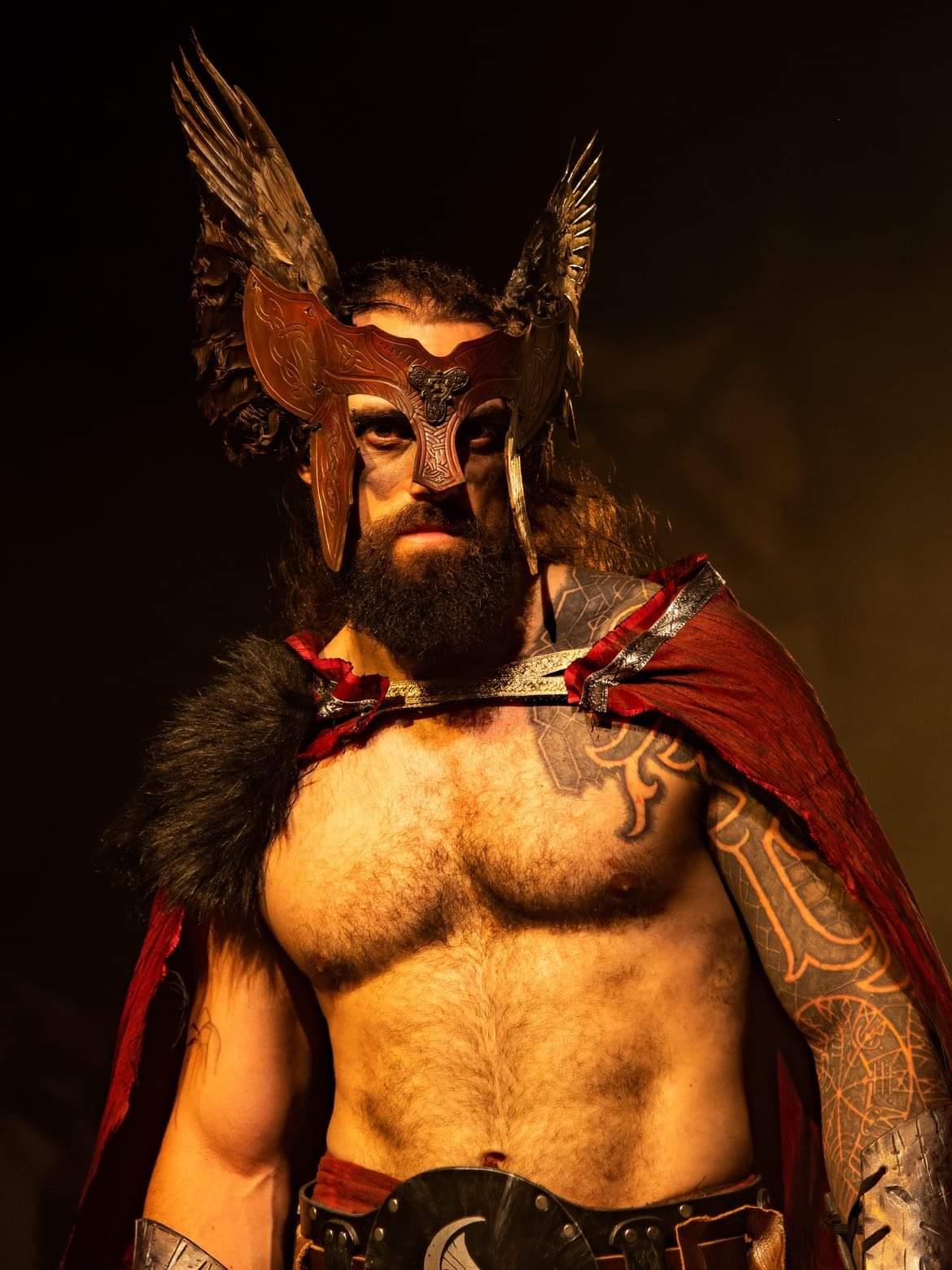
Ed Gamester is an actor, stunt performer, and ex-professional wrestler who is also the writer, director, and producer of Mythos: Ragnarok, the tale of the Norse Gods told in the form of wrestling. We caught up with him to find out more about this amazing show.
STARBURST: What’s the pitch for Mythos: Ragnarok?
Ed Gamester: It’s an adaptation of ancient myths, retold through a unique combination of storytelling, theatre and stage combat. It follows the struggle for power between the Norse Gods from the creation of the world to the final battle of Ragnarok, which makes it equally enjoyable for fans of the myths and those who are totally new to them. It’s also the only theatre show in the world performed by a cast of professional wrestlers and the only time their skills have ever been used in this context!
Why are we so fascinated with Norse Myth?
The Norse myths are in our blood! They’re there alongside countless other ancient cultures and mythologies, too, of course, but the Nordic myths are relatively well documented and recorded compared to other Northern European mythologies, which makes them easy to share and reference.
From runestones, Wagner, and Tolkien to Zeppelin, Marvel, and Gaiman, references to the stories and characters within Norse mythology are scattered throughout our culture in a way that makes the themes and characters easy to recognise and relate to.
Quite aside from all that, the Norse myths are great! They’re weird, dark, hilarious, violent, shocking and sexy: they deal with universal experiences in a way that is very human and easy to relate to, and that means they’re still fresh and exciting 1000 years later.
How long did it take to coordinate the fight scenes?
Wrestlers coordinate fight scenes differently to – in my opinion, more efficiently than – other fight performers. We speak a physical language that allows us to link ideas and movements together extremely quickly, which allows us to coordinate fights in minutes – or in some cases, not coordinate them at all. Wrestling is also a very expressive art form that requires more fluidity and freedom than the stringently-rehearsed stunts, stage combat and dancing that people are used to seeing on stage and screen.
That means although some choreography stays the same every night, other fights change. Some of them we make up as we go along! Everything in Mythos is a work in progress: I’m still developing this form of theatre, and it’s important that we keep tweaking and changing and developing with every show.
Why has wrestling lasted so long?
Because it’s real! People love to call wrestling fake because of the choreography and pre-determined outcomes, but compared to the camera angles, crash mats, retakes and CGI in films and TV, there will always be something fascinating about seeing people do these things in reality.
It’s like watching sports live compared to watching a recording the next day: there’s drama, intensity and danger to know that there is no filter between what is happening and what you’re seeing.
Of course, what we do in Mythos isn’t pure wrestling: there are no rules, there’s no referee, there’s not even a wrestling ring – it’s not a sport in any way, shape or form. Mythos uses the performance combat style of wrestling to do something totally new and unique, which wrestling fans seem to appreciate, and people who have no interest in wrestling seem to find much more palatable.
Why theatre? What does theatre bring to this story that other formats don’t?
In live theatre, there can be a unity between the cast and the audience that is simply unachievable through a screen or the pages of a book. Whatever happens in that room happens to all of us – but only us – and it happens just once. It’s a very special way to tell any story, but particularly one as intense and physical as the struggle for power between Norse Gods!
At the end of the day, as fun as it can be to read or listen to a story about Thor fighting a giant, it’s much more exciting to cheer him on as it happens right in front of your eyes!
Of course, we’re not traditional actors, and our story isn’t a traditional play. When we perform, the audience shares in our excitement, fear and pain; we don’t hide it away in the wings or in the outtakes: it’s right there, dripping down our faces – because what we’re doing is surprisingly real.
Nobody knows what it feels like to be hit with the force of a neutron star, so when it happens to Marvel’s Thor, it’s difficult to care. By contrast, most people know (or can imagine) what it feels like to be punched in the face or slammed to the ground, so I think it’s fair to say everyone feels like they’re in it together with the actors in our show.
Why the Edinburgh Fringe?
I want to share my story and show off the talents of my astonishing cast with as many people as possible because I want to reignite their passion both for these ancient myths and for the art of professional wrestling, which so many people overlook.
When it comes to getting your work seen and appraised by as many people as possible, you can’t beat Edinburgh Fringe: it’s the biggest showcase of performing arts in the world and – as difficult as it is to perform there – it’s the best way to test and improve your work in real-time.
There are thousands of shows at the fringe. Why should STARBURST readers seek this out?
There is no other show like this in the world, let alone the Fringe. We’ve had everyone come through our doors, from mythology PhDs and WWE fanatics to people with no interest whatsoever in Vikings or wrestlers, and they’ve all come out grinning. In fact, don’t take my word for it – you can read their opinions about the show on our website: I’ve kept and published every review we’ve ever been given. With my hand on my heart, I can tell you I don’t believe you’ll find a more intense and rewarding 70 minutes in Edinburgh.
This is a return to the fringe for you. Will this show run and run?
I’d like to think so. These stories have captivated us for a millennium, so I hope my version will run for a few more years at least! I think it will because the response has been phenomenal: people can see how hard we’re working and how much it all means to us, so they’re supporting us as passionately as wrestling fans support those who work in that industry too.
I’m constantly astonished by the number of people who come back to see the show time and time again and the number of places they come from. We’ve had people fly from the USA, Czech Republic, South America – even from Australia to see the show in London!
When we arrived at Edinburgh Fringe 2022, we had done three shows. Arriving at Edinburgh Fringe 2023, we’ve done 56 shows. By the time we make it to Edinburgh Fringe 2024, we’ll have done something like 200. So I feel like we’re just getting started.
How would you describe your process?
My process is unconventional by virtue of my own ignorance. From script writing and producing to acting and directing, I have no formal training or education in any of the roles I’ve taken on to create Mythos, and I’m sure it shows. I’ve simply focused on creating a show that I would want to see myself in while making opportunities for other people that I would appreciate too.
What media are you currently enjoying?
I know this sounds ridiculous, but I don’t have the time. At the start of this year, I bought a load of video games and added all kinds of things to my watch lists in an attempt to force myself to take some downtime. Thus far, I’ve not got any further than watching an episode of Detectorists while I eat my dinner… One of these days, I’ll hire a producer to take on some of my work while I focus on performing my show, but for now, I spend around 16 hours per day making sure the show actually goes ahead.
How can we help?
The best way to help is to see our show and then simply tell people what you think. That’s what took us from having one person in the audience on our first night of Fringe last year to sell out the rest of our run.
Our show is a collective experience: the more people there, the higher the energy and the better it is for everybody. Yet because nobody has ever made a show like this before, it’s challenging to explain what it is and why people should come in the first place. That’s why it means the world to us when people who have seen our show tell other people about it and bring them along to see it too.
Where can we see the show?
You can catch us at 9.20pm every night at the Assembly Roxy Central. If that sounds like a lot of high-impact shows, you’d be right: we’ll be very sore for a long time afterwards!
You can book tickets for the Edinburgh Fringe show here. And learn more about the show here.