With Badlands, Dan Trachtenberg once again rewires a classic genre from the inside out. After 10 Cloverfield Lane’s claustrophobic reinvention of alien invasion and Prey’s stripped-down frontier survival story, his latest Predator film continues to push boundaries: now is the time for the Predator itself to step into the role of protagonist.
For the first time in the franchise’s nearly forty-year history, the Yautja – long defined by its brutal efficiency and mythic menace – becomes the hero. But Trachtenberg isn’t out to redeem a monster so much as to reframe what strength, empathy, and belonging mean in a universe built on violence. Badlands follows Dek, a runt cast out by his own kind, on a mythic journey of exile, discovery, and hard-won connection, paired with an android companion whose optimism mirrors his wounded resolve.
The result is an unexpectedly soulful epic – part survival saga, part anthropological deep dive – that reimagines Predator not as a tale of domination, but of self-definition. Speaking with STARBURST, Trachtenberg reflects on flipping the lens of the franchise, finding inspiration in Clueless and Conan, humanising one of cinema’s most enduring icons, and why, sometimes, the most radical act in a story about hunters is to make us care for the prey.
You’ve done something bold with Badlands – for the first time, we’re following the Predator as the protagonist, maybe even the hero. What drew you to that inversion?
Dan Trachtenberg: As long as the franchise has existed, we’ve never seen the Predator win. I thought, sure, we could make a film where he just wins in the end – but that felt uninspired. I didn’t want to make another slasher movie people have already seen.
The more interesting challenge was: what if you were rooting for the Predator? What if you actually cared about this modern movie monster? That idea felt totally new—not just for Predator, but for science fiction in general. That’s really what sparked Badlands.

You create real empathy for this Predator, even though the species has always been known for its violent legacy. How did you want audiences to reconcile that?
Trachtenberg: Movies exist in their own worlds. It’s why we can empathise with hitmen in Goodfellas or The Professional. In reality, we wouldn’t necessarily feel that way, but when you meet them in the world of the movie, that’s where you form your bond.
I didn’t want to sanitise the Yautja. Their world is brutal and ferocious. If you’re the runt of the litter, you’re meant to be discarded. So while we acknowledge that there’s a reason why these Predators would be considered villains and monsters, by tethering the story to the runt and outcast, it allows us to tap into something very human and empathetic.
Dek begins as an outcast but goes on this mythic hero’s journey. What did you want that arc to say about belonging, strength, and self-worth?
Trachtenberg: Every Predator movie has explored what true strength means. Badlands continues that, examining the ideal and the idea of strength, and that there is more for us than what we’ve been burdened with by our legacy. Where we come from does not have to determine where we go.
There’s also that found-family element. Standing up to abusers, finding connection in unlikely places – that’s a kind of strength too.
The Predator has often been regarded as a symbol of hyper-masculine power. What does it mean to humanise a creature that historically represented dehumanisation?
Trachtenberg: What’s interesting is that Predator is that it came out around the same time as all the other slasher movie icons – Freddy, Michael Myers, Jason. They were all forces of nature. What made the Predator so scary to some, and captivating to others, was its intelligence. It wasn’t just a force of nature – it was a sentient being that had intelligence, a culture, a code.
I remember being more on edge, seeing that as a kid, because you always felt that you could outsmart the thing that walks really slow, or stab it, or jump out the window. But because this Predator was so intelligent, it was almost like meeting yourself and having to go toe to toe with something that was as capable, as smart.
That’s always fascinated me. From the first film, it wasn’t about random slaughter – it was about a hunter seeking the strongest opponent. Badlands just takes that obsession and reframes it through empathy and introspection.
Do you see this as a reflection of how we’ve redefined strength and masculinity as a culture?
Trachtenberg: Those conversations are much more visible now, but they were there in 1987 too. That first Predator came out during the height of Stallone, Schwarzenegger, and Van Damme – a year before Die Hard shifted the archetype from musclebound hero to the everyman. Predator was already questioning what “tough” really meant.
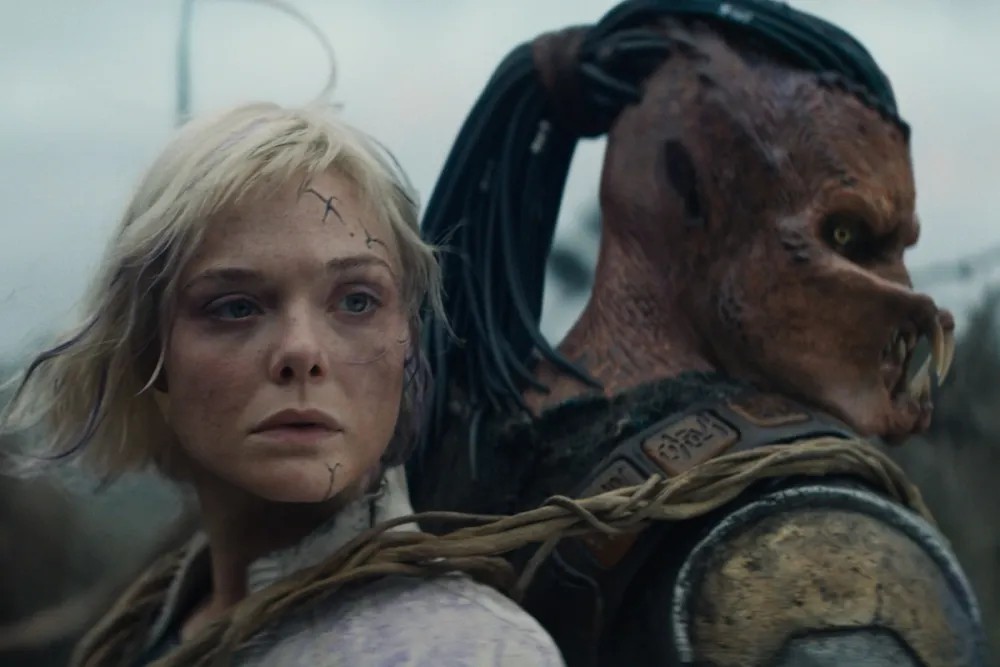
Beyond Dek, there’s Thia, the android. Their dynamic feels like primal instinct meets synthetic empathy. How did you approach that relationship?
Trachtenberg: I loved the idea of two broken beings helping each other heal. Each sees in the other what they think is their own defect.
Oddly enough, I revisited Clueless during production. I remembered Cher as this superficial valley girl, but she’s actually incredibly optimistic and sees the good in people. That’s what makes her cool. That spirit is in Thia – she’s joyful, fearless, excited for adventure. She’s the glass-half-full counterpart to Dek’s wounded stoicism.
There’s a bit of Chewbacca and C-3PO energy too – this wild, often stoic creature paired with a nervous but endlessly curious companion.
One of the film’s strengths is how deeply it roots itself in Yautja culture. You’ve built a language, symbols, social customs, and approached it like an anthropologist. What was your guiding principle in making the culture feel authentic, as opposed to serving merely as cool sci-fi design?
Trachtenberg: I was inspired by Spartan society, Conan the Barbarian, and Frank Frazetta’s paintings – these brutal, nomadic, harsh, almost pirate-like cultures. There’s some Predator lore in the deep, deep ancillary Geekdom that suggests the Yautja were once a slave race who had an uprising, and their technology came from the race that oppressed them, the Amengi. I always thought that was really interesting, and could certainly inform what their culture would look and feel like.
We worked closely with Alec Gillis, who’s been with the franchise since 1987, and with linguist Britton Watkins to develop both the spoken and written Yautja language. Even the sounds make sense with the mandibles and throat structure. Everything had to feel real, not just cool.
With the franchise having such a long legacy, how do you decide what to keep, what to subvert, and what to leave behind when it comes to creating your own chapter?
Trachtenberg: We always start from the DNA of the franchise. For example, the idea of Predators wearing their trophies on their armour started with Prey and evolved here – it’s new, but it feels authentic to their culture. Given how much they pride themselves on hunting and collecting trophies, why would they not want to present them as part of their armoury? That was a new thing, but it stems from the spirit of what preceded it.
My rule is: if something could exist in Star Wars or Star Trek, it doesn’t belong. Every choice has to be something that could only happen in a Predator movie – something that’s uniquely of this universe and that only makes sense in the frame of this specific film.
Between Prey, Killer of Killers, and Badlands, you’ve built what feels like a trilogy of perspective, from human to historical to alien. Is Badlands a closing chapter or the start of a new one?
Trachtenberg: It feels more like an opening than a closing, or maybe the middle of something bigger. We’ll see.
Predator: Badlands is in cinemas from November 7th. Watch the trailer here.