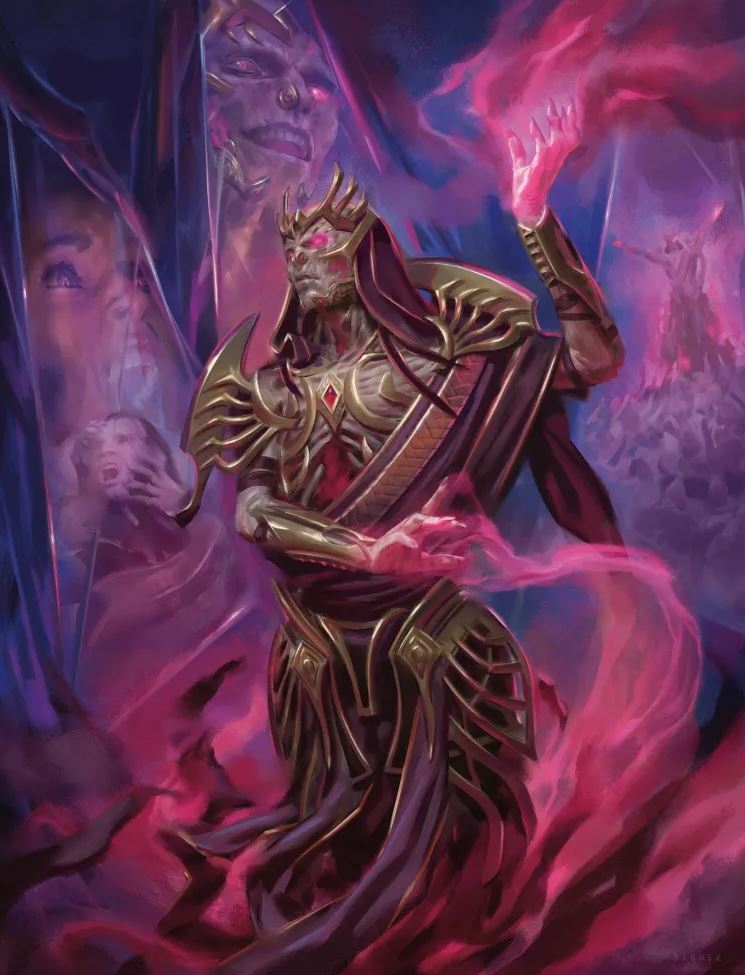
If the many worlds of Dungeons & Dragons have anything in common, it’s that they are all threatened by Vecna, the ancient mage turned lich turned almost god. D&D celebrates its 50th anniversary this year, and it simply couldn’t be a party without this talking corpse turning up to make things difficult for everyone.
Vecna Eve of Ruin is a 250+ page hardcover adventure for high-level adventures. It’s actually one of the few high-level books officially produced for fifth edition D&D. A digital supplement called Vecna: Nest of Eldritch Eye also exists for Dungeon Masters, who currently have a lower-level party but hope to incorporate Eve of Ruin into future games. Nest introduces players to the cult of Vecna early on when they don’t seem that scary. But mostly, Eye of Ruin seems designed for D&D players who want to explore the various worlds of D&D with one character.
Scenario-wise, it’s an epic fantasy-style fetch quest. Vecna is building a reality-destroying machine that will remake everything into an undead paradise. This is a bad thing and needs to be stopped before the cosmos becomes wall-to-wall ghosts, wights and zombies. To stop him, the party need to find and assemble bits of a magic item called The Rod of Seven Parts. This is an incredibly powerful artefact that lets you cast some of the silliest spells in the game, from opening gates to other realities to making magical clones of yourself. The item itself has been in the game since 1976, and it’s pretty much the One Ring of D&D.
The various bits of the rod are scattered across the multiverse. Your party is going to have to travel to other worlds, and as they do so, get to take in a nice dose of nostalgia for previous games published under the D&D banner.

There are some nice touches in the set-up. Vecna is a god of secrets as well as a god of the undead, so secrets are something that can be used against him. Each character is expected to have their own secrets, which can revealed over the campaign. (This is an idea we see in the Icewind Dale book; it’s a neat idea for creating coherent themes across a long-running game because, let’s face it, players don’t remember every detail from every session, and stuff like this keeps them on track.)
Each part of the rod has its own adventure. Of course, there’s getting the mission and dealing with Vecna, so it’s a story told in roughly nine parts, and experienced DM’s may want to chop this up a little to wrap other campaign elements in or to add a trip to the world’s not covered in this book. (Theros or Aebrynis, perhaps?). Each adventure highlights a cool bit of the worlds of D&D. So there’s an Eberron scenario with a strong post-apocalyptic magical machine vibe, the Spelljammer-themed scenario has some swashbuckling and so on. We meet major characters from many of the books along the way as well, and so on.
This is so packed with nostalgia that we’re honestly surprised there isn’t a fight on a fairground ride to hammer home all the history of D&D, but then they already did that with The Wild Beyond The Witchlight. More mature players will recall that way back in the year 2000, Die Vecna Die! did a similar thing, using the incredibly powerful and sneaky death god to herald in a new edition, and though this new work isn’t quite as cheesy, it is as much fun. This is a great tool kit for Dungeon Masters looking to explore D&D without having to run endless individual campaigns. The book also has some nice new high-level monsters, many of which could be the focus of entire lower-level campaigns.
Overall, a loving send-off to 2014’s edition of D&D.