by Ed Fortune
Daniel Locke is a Brighton-based graphic novelist who works in science education and created the TTRPG Helms of The Multiverse. David Blandy is an artist whose work has been shown in the Tate and the Wellcome Collection. He’s also a TTRPG writer and designer whose work includes Babel and Lost Eons. We caught up with the pair of them to talk about ECO MOFOS, a mid-future ecopunk ruin-delving survival game currently on Kickstarter.
STARBURST: What’s the pitch for Eco Mofos?
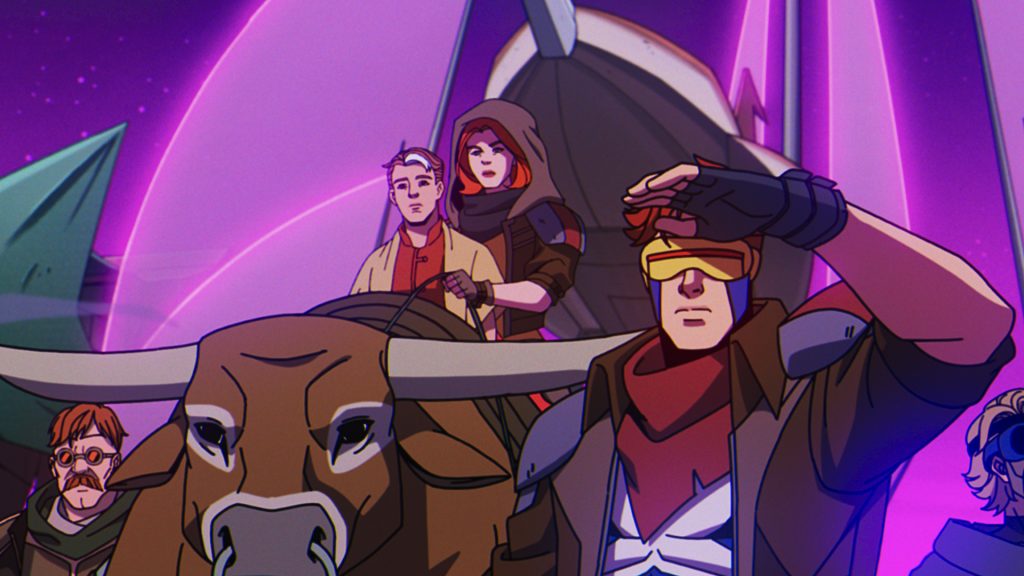
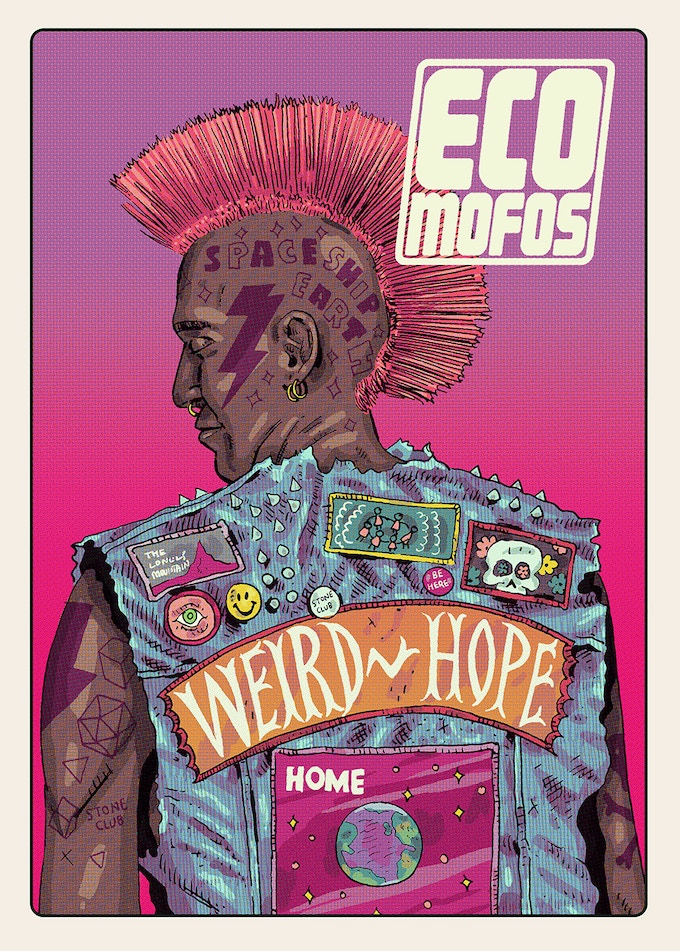
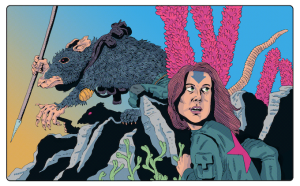
Daniel Locke: ECO MOFOS!! is a weirdhope science fantasy tabletop roleplay game in a world of Punks, Wasters, Bandits and Corpos. It is fully written, with pages of tables to explore, and supports group and solo play. For the physical release, the entire book is being redesigned for simple use at the table while incorporating reams of intricate, colourful art by Daniel Locke. It’s a streamlined and flavourful game, with procedural adventures, using random tables to build journeys and sites, and gameplay building on the great work of Cairn and Into the Odd, but with a number of innovations.
It will be edited by Iko of the Lost Bay, and we have confirmed special guest writers for a series of adventures by Zedeck Siew, Sam Leigh and Logan Dean, and Brandon Yu is creating a Solo play aid. Iko, Daniel and myself are also writing modules.
What’s Weirdhope?
David Blandy: Simply, Weirdhope is a fractal mirror of Grimdark. Rather than assuming that in a broken world, life will get far worse, perhaps we can imagine the situation fostering new communities brought together by difficult times. Perhaps a radical shift in what is considered normal could open up the world to positive change. That the world will be full of beauty and wonder. But Weirdhope also acknowledges that any altered future is going to be strange, as change creates new situations and new relationships that can be unsettling or uncanny, even horrific. So it’s weird. But it’s hopeful.
Daniel: What David said. I’d also add that Weirdhope is a kick-ass battle cry, a call to action. It’s a refusal to roll over and accept that things can’t get better.
Why rules lite? Don’t more complex rules make for more complex play?
David: I’ve been building and tinkering with game systems since I was a kid rolling dice for my Action Force (GI JOE in the USA) figures in the garden. But for me, play always comes first. What is fun? What allows the game to flow? So after exploring dice-pool systems and the FKR (Free Kriegsspiel Revolution, a collection of understandings for playing games with minimal rules), I became increasingly impressed by the simplicity and elegance of the Into the Odd lineage of games, particularly what Yochai Gal has created with his open source system, Cairn.
It has that feel of old-school dungeon-delving but boils it down to a simple form with very little maths. Play is fast and eventful, only rolling when there’s a risk, and combat is brutal and swift with no to-hit rolls, just damage that can be partially absorbed by armour. The key to the system is putting the player’s choices first, so I’d argue it actually becomes more complex, in a good way, difficult decisions demanding decisive answers.
Daniel: If I’m honest, I don’t think more rules necessarily equates to more complex play. Though perhaps it depends on the reasons an individual has for playing in the first place. I mean, a lot of this comes down to personal preference, and one of the things that I love about TTRPGs is the variety and the ‘big tent-ness’ of the scene.
My personal focus is on what happens between the players at the table. I just love the experience of being with a group of people and collaboratively building a narrative and a world full of stories. I find that too many rules or crunchy systems can get in the way of that, and rather than making the experience of playing more complex, they can make it more disjointed. So rules lite suits me. Having said that, I do like to roll a die every now and then! And I just love a randomiser table. Honestly, I can’t get enough of them. It’s a bit of a problem for me.
Do you have similar games planned?
David: I always have several games and adventures in the pipeline. Currently, I’m working with a team on a Cairn conversion of an old D&D module from 1981 called Palace of the Silver Princess that has a complex history as the first published D&D module by a woman, Jean Wells, which was then pulped and completely reworked due to either some egregious art or plain sexism, depending on who you believe. It also has real resonances with Japanese RPGs like Zelda and Final Fantasy, and apparently, it was one of the two modules that first reached Japan, even before the rules books themselves.
I also have further plans for my post-colonial collaborative map-making game, Gathering Storm, which could be expanded into something intense. Maybe build a video game around it or something.
Daniel: Always, there’s always more to do, always other games planned. I have this idea for a game, or maybe a setting – not sure yet – that places players in an unbelievably fragmented and hostile environment full of totally mad NPCs. It’s in a very bullet-point state at the moment, but I’m very excited by it and looking forward to sharing it as it develops. I’m also keen to write and draw some settings and adventures for ECO MOFOS!! I absolutely love that world and can’t wait to contribute more to its expansion. I say that as a creator but also, and, I’d say more importantly, as a player too.
David and I have used this project to set up a creator’s cooperative. It’s called Copy/Paste, and I’m very much looking forward to seeing what happens in that space too.
Why a TTRPG? Why not a novel or comic book?
David: What I love about TTRPGs is that they give a space for people’s imagination, a space to make their own narrative. It’s a world to inhabit. Of course, novels and comics and video games and films all create fantasy spaces for our minds to inhabit, but only TTRPGs offer you a limitless window into that other world. And there’s a sociability to TTRPGs that I love, that it can be just a good excuse to hang out with your favourite people with no agenda but to have fun. And with its potential as a solo game, it can be a space to explore on your own terms. You decide where the story goes when the session ends. A TTRPG is the most collaborative of media, only completed by play.
Daniel: I think comics and TTRPGs are very, very different beasts. The point, at least to me, for a TTRPG is to provide a place where stories can be told. A TTRPG book offers up some resources, ideas and procedures that hope to stimulate the collaborative creation of a story. A comic seeks to tell a story. They might use some of the same tools, but they are very different things. The world of ECO MOFOS!! could most definitely be the setting for a totally kick-ass comic book series. But one of the things that makes it so interesting to me as a TTRPG is the fact that putting aside the magic and mutations and all that brilliant jazz, it’s a really relevant world that speaks directly to many of the problems we are living with. I like the idea that this game could help people address those issues, think about them and engage with them.
Why make the players Misfits by default?
Daniel: There’s a worrying trend in the world that is seeing global resources pooled and gathered by increasingly smaller numbers of people. There are way too many billionaires. Way too many food banks. Life is too hard for too many people, and it needn’t be. I think in such a world, everyone (other than the one per cent) should consider themselves Misfits, or rather Punks, and demand back what should, by right, belong to us all: a community, a safe home, and fair, equal access to the world’s resources.
David: It’s an angry game, a game of resistance against the ‘normality’ that’s got us in this mess. And players in all RPGs, certainly at my tables, act as agents of change, often of chaos. So it felt natural to assign that sort of role to the players. This game started as a mashup of Yochai Gal’s Cairn and Micah Anderson’s bastards. as a way of finding a new way to approach the world of my more Solarpunky game, Lost Eons, and I think a lot of that attitude survived in the DNA.
What makes this game different to others?
David: The setting is clearly unusual, a post-post-apocalyptic world in recovery, a world of resistance, wonder and horror only a few steps away from our own, imbued with magic. The combination of elements in the gameplay, with procedural adventures that can be created as the table as you play, generating intriguing stories and events to react to, alongside the factions that surround the players making their own moves to alter the world. There are also story-game elements to this ruin-exploring game, partially developed from an element of Chris McDowell’s Mystic Bastionland, where the Punks take on emotional Burdens if using spells or adding new Adaptations that require certain needs to be fulfilled in order to remove them from your inventory.
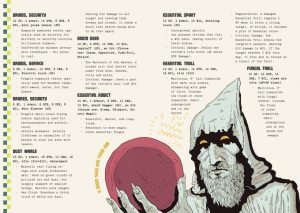
The game is built on a huge d666 table of Items, also called Stuff and Loot, that you roll on when you come across it at certain points in play, some of which are ‘key items’, implants, weird substances, Orbs, that you have to absorb into your body to gain new abilities. So the game becomes a search for new abilities in the detritus of the old world, the treasure being your own development, your own ability to negotiate the difficult world around you. In OSR terms, it circumvents XP for Gold, as by adventuring, the treasure you find helps you grow both in the narrative and in the game.
What was the art direction? it’s got a unique look.
Daniel: There isn’t really any art direction, though I’m pleased you think it has a unique look! Thanks so much.
The aesthetic of the book has developed out of the friendship David, and I share. We constantly talk and show each other things that inspire us. We offer up the things that we’ve made for others to consider, and I guess the look of ECO MOFOS!! Has just sort of bubbled up out of that soup. I think it helps that we have very complementary skill sets, and we trust and understand each other. We’ve been close friends for decades.
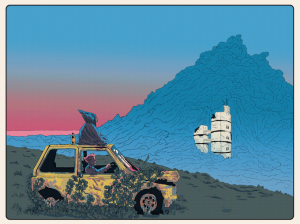
David: I think that what might be referred to as ‘art direction’ is really an organic development of our collaborative aesthetic. We worked on a TTRPG together before, LONE EONS, and that was where we first talked of mixing a Saturday-morning cartoon feel with elements of a more Old School art style (like the late great Russ Nicholson), illustrations from books like The Warlock of Firetop Mountain and Romantic art like Caspar David Friedrich. For ECO MOFOS!! We really wanted to make something fresh and colourful, hopeful, but that had loads of attitude, and a touchstone became the 80’s illustrations of 2000AD, artists like Carlos Ezquerra. Add to that Moebius (eerie weirdness) and Miyazaki (organic beauty), and I think you can start to see where we’re coming from. Punk zines have also been an inspiration; growing up in the UK in the ’80s, very into grunge (I was in a grunge band for years) in the ’90s.
Why are TTRPGs cool now?
Daniel: TTRPGs have always been cool! At least since I first discovered them, alongside comics, in about 1986. Seriously though, I think the rise in popularity of TTRPGs has many causes. I mean, it’s easy to point to their inclusion in shows like Stranger Things, but I think there’s more to it than that. And I’m pretty sure it has something to do with our fragmented way of living.
Role-playing games offer a way to personally connect with each other, a way to test out ideas. They provide a space to explore notions that might be terrifying, notions like climate change or resource scarcity or conflict. That’s got to be for the good, hasn’t it? Feels to me that the world right now can use as many things in it as possible that facilitate sharing, conversation and collaboration.
Which creators inspire you?
David: Authors like Ursula Le Guin, Octavia Butler, Marge Piercy, Samuel Delaney, Philip K Dick, Hayao Miyazaki, and Moebius. Then TTRPG writers like Zedeck Siew, Luke Gearing, Chris McDowell, Patrick Stuart, Wendi yu, Chris Bissette, Jack Harrison, and so many others. I’m so in awe of this scene, to be honest.
Daniel: Yeah, I’d get behind a lot of the list David has offered there. I love the likes of Ursula Le Guin, Philip K Dick, Hayao Miyazaki, and Moebius too. I’d add Taiyō Matsumoto and Becky Chambers. As far as TTRPGs are concerned, Luke Gearing, Chris Bissette, Daniel Sell, Brandon Yu and all the people on David’s list! It’s honestly bewildering the amount of talent that is in the scene right now.
How would you describe your process?
David: Making TTRPGs is both my relaxation and my obsession. Probably not a healthy combination, but there you go. I’m constantly tapping at tables, noodling out little rule changes and tweaks in my spare moments when working, waiting for a video to render or making a cup of tea. Then I have intensive periods of layout and writing where I put everything together, incorporating the ideas I’ve been having, roughing out a zine or pamphlet or book before refining again and again. It’s very organic, with ideas leading to more ideas, reacting to those, testing and changing. And if I get to an impasse, I move on to one of my other projects for a while and try to freshen my mind. The fun stuff is just imagining tiny scenarios or characters and trying to capture them in as little prose as possible. I love writing tables.
Daniel: Organic. I find it really hard to describe my process, if I’m honest. It tends to boil down to a system of trial and error. I make something, step back and then go back in and tweak. Ultimately what I’m hoping is that I can find my way to a place that feels defined by a sense of discovery. That sweet spot where you’ve not finished making, but you’re excited to see where it lands. It’s a journey picked out by following your nose.
What games are you playing?
David: Recently, I’ve been running one-shots for a group on Discord called The Game Pube, which is the gaming wing of The White Pube, and the whole community seems to live somewhere between art and games. We’ve been playing rules-lite horror; I ran Ghost of Ypsilon 14, a Mothership adventure but using a Cairn hack, Meteor. That was incredible, really intense.
Then this week, we played Wet Grandpa by Evey Lockhart using Cairn and had an absolute blast, one character ending up with minus one hand. Good times.
Daniel: I’ve been working my way through the fighting fantasy books. I’m currently on Midnight Rogue, it kicks ass. And with some friends (David included), playing the new Star Wars RPG, is it called Age of Rebellion? Something like that. I used to play the 2nd edition when I was a kid, so it’s been nice to revisit the galaxy far, far away.
How can I support the game?
Daniel: You can support the game by clicking on the link and following or pledging support for the project, depending on when you’re reading this. We can’t wait to get this beautiful book in your hands so you can start playing.
You can contribute to the ECO MOFO’s Kickstarter here.