Set against the stunning backdrop of the Italian Dolomites and directed by Renny Harlin (Die Hard 2), Cliffhanger is a legendary ’90s action film that literally grips its audience from its iconic opening sequence. To celebrate its new digital release on StudioCanal Presents, STARBURST magazine caught up with villain/muscle Craig Fairbrass to nostalgically reflect on an exciting journey through Hollywood, which led to a career-changing role as Delmar. We also discuss picturesque filming locations and what it was like to work alongside an incredible cast, which included Sylvester Stallone, John Lithgow, Janine Turner, Caroline Goodall, and Michael Rooker, to name just a few…
STARBURST: Can you tell us how you got involved with Cliffhanger?
Craig Fairbrass: To go right back to the beginning, I was in a TV series called Prime Suspect, with Helen Mirren. An American agent saw me in the show and was talking to my agent in London about bringing new acting faces out. This is in 1991. They were asking if they had any young actors who they felt might be right for the market out in the States. My agent said, “they love your look, they love everything about you, why don’t you do a six-week trip to LA?” I had always dreamt about Hollywood – it was this magical place. So I did, I lent some money, got an airline ticket and went out there.
I had a lot of meetings because, when you’re fresh and new, people want to meet you. Because they never know if they’re going to discover the next big thing. One of those general meetings was with a lady called Mindy Marin, who was the casting director for Cliffhanger. I went in, met her, had a really good meeting with her, and she told me they were putting this movie together with Renny Harlin from Die Hard 2 as the director. At the time, I was obsessed with Die Hard 2; I’d watched it about 100 times. Because all of my mates used to say to me, “See all of them geezers walking about, you could easily be one of them!” and that was one of the things that stuck in my mind when I met Mindy. I said, “Listen, I would love to meet Renny Harlin. I’m a massive fan. Whatever becomes of the film, I don’t care, I just want to meet that guy!” She set up a meeting, I met him, and he really liked me. He said, “We are trying to put this international group of villains together” They are all from all over the world. There’s no reason why we can’t have a cockney kid in there.” So basically, that was it. I did two scenes; everybody had to read the Qualen sides, the role that John Lithgow played, so I did that. I was going home in about a week, and I heard that they liked the tape. I went back to do Series 2 of Prime Suspect, and time went on, so I thought that had gone away.
Anyway, got a call from the agent, and he said to me, “Listen, they want you to do another scene in London” I said I’d already been up for it three times; they know what I look like; they know what I can do; they’re driving me mad! Anyway, you have to jump through those hoops; it’s all part and parcel with the root and the game you have to play. I did another scene. Originally, I was going to play Kynette, which was the role I read for and the one I was offered. Two weeks had passed, I’m in the bath one night, and the phone goes. My wife said, “It’s your agent, Mark.” I ran downstairs, soaking wet, and he said, “Craig, you got an offer on Cliffhanger, do you want to do it or not?” It was like a dream come true. It wasn’t until we got out there, when they put everybody together, in Cortina in Italy. They looked at us all, deciding who would do what, so that was it, I became Delmar. I was one of the team! I was the smallest one. I’m 6 feet 3, and I was standing there on tiptoes, trying to push myself up a bit.

A lot of the stunt sequences in Cliffhanger are legendary, could you tell us a bit about what you remember the most about working with the stunt team on this movie, and why you think their work on the film went on to become so well known?
Oh yeah, Joel Kramer was the stunt co-ordinator. Really lovely man. Very experienced. Everybody who was on that film was the same people who did all the epics, from Predator to Die Hard; it was the same teams. If there was a big, giant movie being done, this was the team. So I went in, I moved about with them, fighting and throwing punches. They loved that I could throw punches, but it wasn’t until Sylvester Stallone got involved that they were like, “We want to pull back from that.” We want to use your ethnicity, where you’re from, you’re British, it’s the football thing, the soccer thug, as they called it. So we went down that route. Michael Rooker, who I did a lot of my scenes with, is a naturally hard geezer. He was keen, did everything himself. Working with them, and then working on the film, over the four months, being around it, and watching Stallone do his stuff, they were very careful to treat everybody, look after them, abide by the rules. That was it. So one of my fights ended up being very football-oriented.
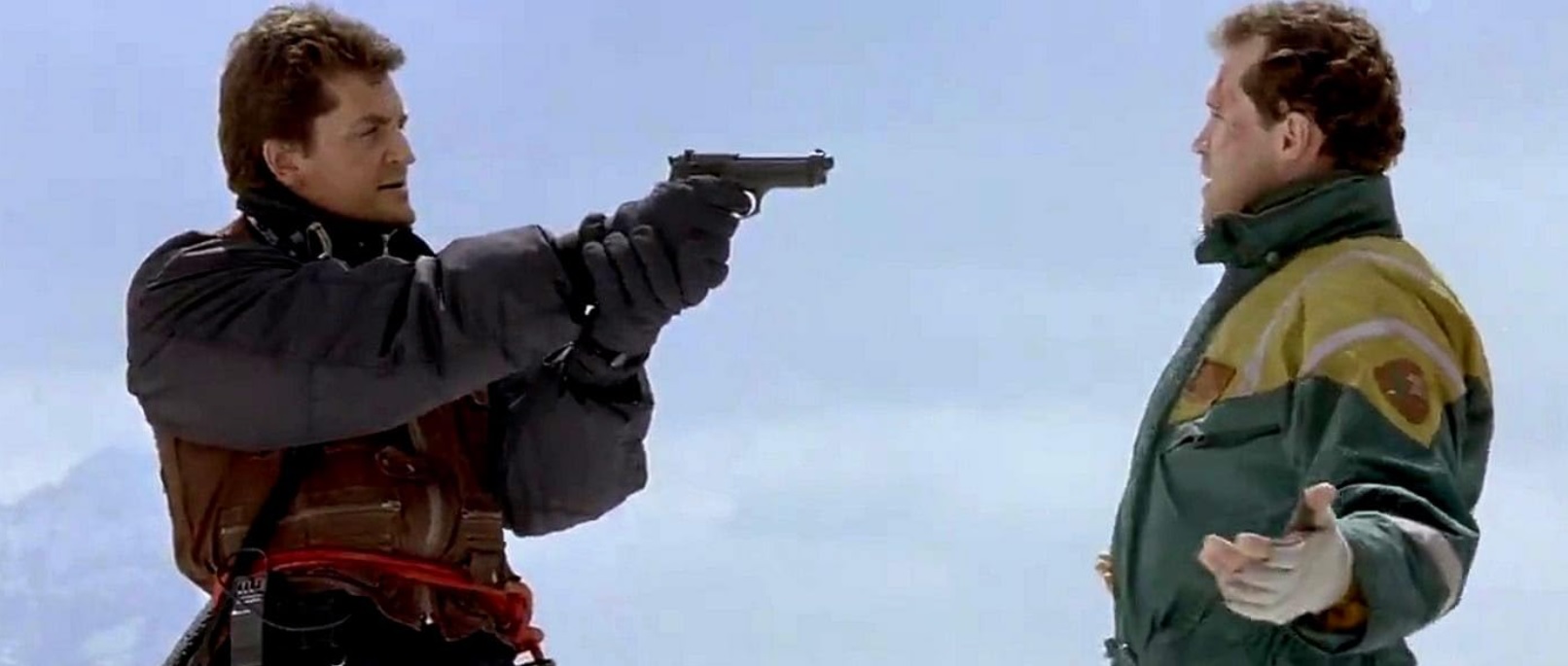
Your fight/death sequence with Michael Rooker (Hal) is iconic, and it’s set on top of a mountain, with a stunning backdrop! Can you tell us about how that whole sequence came together?
The problem was that it was pushed back three times because everybody was waiting to do their fight scene. Everyone’s anxious. In a movie like this, they’ll shoot over two or three days. It’s not like you do a low-budget film in England, and it’s done in a morning. We were fighting against the elements of the weather, so every time that fight was scheduled, you’d get constant, new schedules. New schedules were constantly coming in due to the weather because of where they wanted to film that actual fight, with that cinematic precipice, as far as the eye can see, mountains and blue sky. We had to wait until it was a really good day, and finally those days came around.
There was a lot of apprehension there for me, because it was quite a big deal. You’re always concerned, you don’t want to mess it up, you want to do the best job you possibly can, even though I’m under no illusions that the role I played was very small. It was integral because it counted down each baddie’s death. It was quite a big deal. I didn’t really realise, because of the undercurrent, and the undertone of the fight, the racism thing, the violence of it, the character I played, a lot of my stuff got cut. It wasn’t until I think many years later that the uncut version came out, because that fight was deemed the most violent in the film, because of the snapping of the bones, the stamping, the language that went with it. It was softened down in the original, cinematic, theatrical version when it first came out.
What was it like to work alongside Sylvester Stallone (Gabe), and what do you remember the most about that kind of acting dynamic with him?
It was a very special time for me. I was an unknown actor, I’d borrowed the money for an airline ticket, I’d gone out to the states, I had a lot of auditions, I got an offer on another little job that fell through, then all of a sudden, I sort of hit the jackpot. I was a massive Stallone fan; I was obsessed with the guy. He’s one of the reasons why I became an actor. When I first arrived in Cortina, our hotel rooms were side by side, because his villa wasn’t ready. So I had him as my neighbour for a couple of weeks. I remember the first time I met him. He came out, standing there, and he shook my hand, saying, “Welcome aboard! We love this. If you want to change or do anything, then just let me know”, and I just thought, “I’m standing here, talking to Rocky!” he is a lovely man. He gave me a lot of great advice, a lot of confidence. On a lot of occasions, if I wasn’t doing anything – we had a lot of time off, because it was such a massive shoot – you could always go to the set, and watch sequences being filmed. He was so gung-ho to do everything, always throwing himself about, jumping off things, doing stuff. He was a massive driving force, you just look at that man and you think about what he has achieved, still to this day, I idolise the guy.
Digging into the dynamic between the group of villains, what do you think Renny wanted to see from that, and what was that like to work on/develop alongside John Lithgow (Eric Qualan), and Caroline Goodall (Kristel)?
The funny thing is, Lithgow was cast right at the last moment; someone else was going to do it, and then he came in. I thought he was a fantastic Qualen, because he had the size, the presence, and the accent. Even though there were a lot of us, there was still a natural competitiveness. American actors can be very much like that. We’re all together in a line, I’ve never experienced that, working in London. I realised on the second day that it was every man for themselves, but I think the dynamic worked, because there was a lot of tension between the group, even though we had all been employed and pulled in from around the world. Everybody thought that they were the best, and that’s the attitude that Renny wanted. That brutal, care-for-nobody attitude.
Can you tell us a bit more about some of the locations? We heard you spent six months in Italy? Like, what did those particular locations bring, and why did they work so well?
I was finishing off Prime Suspect, and I flew from Manchester to Venice. I was picked up and driven to the top of the Dolomites in Cortina. It was like a constant dream, pinching myself, thinking, “Is this happening?!” We were based there for the first three chunks of the movie’s filming schedule, while they were building the sets. So then the three units moved. I was getting in helicopters to go to work, landing on top of mountains as the sun was rising, or going down. It was an incredible experience. It was an experience that I will never ever forget. Personally, for me, it was a massive achievement. I had a lot of negativity at the time, and I was 29. My background isn’t really in acting; I haven’t got another mate who’s an actor. All the geezers I grew up with, my mates, they were in the building game. So for me, it was quite a big deal to take that chance. I had two young babies as well. I’m glad I took that chance. I took myself out of my comfort zone, and I chased the dream. I still look back on it now, because it is on all the time. When I hear that music, it brings back all of those memories.
There’s a lot of really, ambitiously incredible cinematography in the movie. What was it like to have helicopters flying around, filming in the distance?
There were no drones then. So it was, as you said, mainly helicopter shots. It was one of the first films to use the big python, you know, with the big arm that would come out again, and go out again, like extend, extend, extend. You could sit on top of the cliff, and that camera could come around, like, an inch from your face. Renny’s choice of shots, and the DOP, Alex Thomson, achieved beautiful cinematography; those big, massive landscape shots are just breathtaking, they are just beautiful. They really take you there.
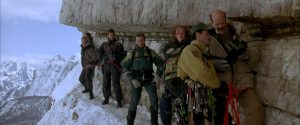
The rope bridge sequence, in particular, looked really intense to do!
They were! Because when you’re standing there, you think that a lot of these things have been built for the film, you’re going around mountain tops, changing ropes to clip yourself in. You look down, and you think to yourself (Even though we were really looked after), you’ve really got to be careful. You’ve got to have your wits about you, you’ve got to be on your toes, you can’t take any silly chances, because you could die quite easily.
We’ve talked about how visually epic the film looks. I was curious to know, like, what do you remember the most from watching the movie for the first time? That must have been quite a cool moment for you?
It was, don’t get me wrong, I was just glad to be there, but obviously, I would have loved a bigger role. That’s just an actor’s thing; you can’t help it. In hindsight, when I look at it, I’d love to go back and redo it, because I was young, I was inexperienced, I was naive. I was plopped in there because, at that time, at 29, they liked the look I had. Obviously, over time, I’ve grown as an actor, and I’ve learnt my craft. It was the right role for me at the right time. I remember going to the premiere at Mann’s Chinese Theatre in LA. I’m thinking, “I’m sitting in Hollywood, watching myself in a Hollywood movie!” This was the biggest dream I had from the age of 10, and I’m now doing it. Then I went to the premiere at the Marble Arch, another big, beautiful cinematic screen. You think to yourself, “This is all part of the journey”
Delmar did survive for quite a long time in the movie, so for an actor, it was still a huge achievement!
I remember Renny Harlin telling me, “You will definitely last until the end!” So I was pleased about that, because no one wanted to die on page two, even though the actors who did were in Italy for the entire time!
This interview is to celebrate the new digital release of Cliffhanger. Why do you think the movie has had such longevity? What makes it stand out in 2025?
For me, it’s an iconic film. Any action movie that is shot in the snow, tends to have a really long shelf life, plus it’s a beautiful film. It was Stallone’s comeback movie; he was eager, hungry, and driven in that film. He looks incredible. It was that era of the Die Hard movies, and everybody was looking for “What scenario can we put this in?” Then, Cliffhanger came along, set in the snow, in the mountains, with beautiful cinematography, the Dolomites of Italy. A gripping storyline. I just think it’s a film forever.
Cliffhanger is available to watch on STUDIOCANAL Presents (Prime Video) right now! Visit the Craig Fairbrass website and Craig Fairbrass on Instagram.