
DVD Review: Death to the Daleks / Cert: PG / Director: Michael Briant / Screenplay: Terry Nation / Starring: Jon Pertwee, Elisabeth Sladen, Duncan Lamont, Julian Fox, John Abineri, Arnold Yarrow / Release Date: June 18th
By 1974 the Daleks had firmly re-established themselves in Doctor Who after their protracted absence between 1967 and 1972 and the production team were now routinely commissioning a new Dalek serial each season, with their creator Terry Nation given first refusal on providing the scripts. With Nation having cheerfully plundered his own debut serial from 1963 for Planet of the Daleks in 1973, he opted to cherry-pick bits and pieces from his subsequent stories in writing 1974’s Death to the Daleks, a good-old fashioned space opera romp for Jon Pertwee’s final season. The result is an ambitious, colourful, utterly predictable four-parter which nicks bits from Nation’s own 1960’s serials The Dalek Invasion of Earth and The Chase and, in attempting to take the Daleks into new territory, ends up making them a bit bland and colourless.
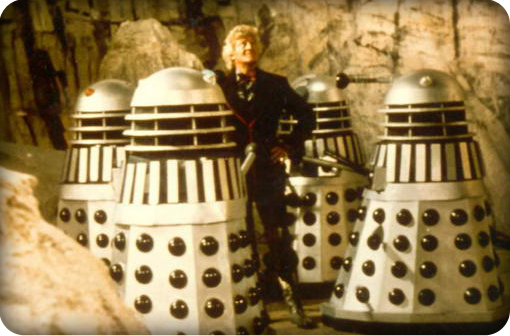
Nation’s on familiar ground in episode one where, as usual, he dumps the Doctor and Sarah Jane Smith on an alien planet, the TARDIS incapacitated by some hostile power source. The travellers are quickly separated in the eerie mists of the quarry-like planet Exxillon; the Doctor falls in with a bunch of stiff upper-lip Earth astronauts searching for a rare mineral which will cure a devastating space plague, Sarah Jane captured by the planet’s sack-cloth inhabitants the Exxillons and taken for sacrifice for daring to violate their sacred monolithic city. The Earth crowd are delighted when what they assume to be a rescue ship (although it looks more like a lampshade) touches down; they’re not so delighted when a troop of silver-painted Daleks sweep out squawking their traditional battle cry. But these Daleks, it turns out, are powerless too. Whatever’s causing the power losses (and brighter viewers might have already made the connection with the Exxillon city and its pulsating beacon) has robbed the Daleks of their firepower and they find themselves as vulnerable to Exxillon bow-and-arrow attack as the Doctor and the humans they’re reluctantly forced to team up with.
The best that can really be said about Death to the Daleks is that it’s a sturdy, workmanlike bunch of episodes. Once we’re used to the concept of powerless Daleks, the story’s only real USP, there aren’t any real surprises in store and the serial trundles along with typical unfussy Terry Nation efficiency. The Daleks are inevitably untrustworthy and duplicitous (their death-rays being replaced by clattering machine guns is, admittedly, a stroke of genius), the humans are dull and largely one-dimensional, the alien Exxillons disposable, clichéd Nation cloaked-aliens-who-might-be-hideous. But there are some interesting ideas, even if some of them aren’t especially well-executed. Bellal, the timid, shrunken underground Exxillon is an interesting foil for the Doctor when Sarah Jane is busy with her own subplot and the city’s root-like self-defence system is a bravely-ambitious idea even if its realisation is way beyond the show’s capabilities. Nation’s clearly run out of steam by the end of episode three (which under-ran, necessitating the moving of material from episode four to pad it out – leading to one of the most underwhelming cliff-hangers in the show’s history) and he has to pad out his final episode with an extended sequence where the Doctor and Bellal penetrate the city and have to contend with a series of mundane booby-traps designed to prevent intruders reaching the control centre.
Directed in perfunctory style by Michael Briant who was pretty underwhelmed by the scripts, Death to the Daleks suffers from over-familiarity and the same air of tiredness which pervaded much of Pertwee’s final season. The actor himself, no great fan of the Daleks, is clearly going through the motions as he coasts towards his finishing line and the guest cast, such as they are, have so little to work with they really don’t make much of an impact, with even character actor Duncan Lamont failing to invest the traitorous Galloway with much character beyond the odd sneer or shifty look.
Impressive location filming is undermined by clunky studio sets, Carey Blyton’s incidental music is so inappropriate it seems to have been lifted from the soundtrack of an entirely different programme and the special effects are at the distinctly shoddier end of the BBC’s 1970’s spectrum. Yet despite all its faults and its oh-this-again Nation storytelling, Death to the Daleks just can’t help but be fascinatingly entertaining. The Daleks are always good value and it’s hard to fault the production team who, aware of the Daleks’ shortcomings at least tried to find a new way of depicting them on screen. But, bearing in mind that this serial would be the last time for over thirty years that the Daleks would appear on Doctor Who without their creator Davros (introduced the following year in Tom Baker’s debut season) directing their machinations, it can’t help but feel like a bit of a damp squib, Daleks-by-numbers from a cast and crew who had become a bit bored by the series’ most popular monsters. But hey, it’s 1970s Doctor Who, it’s the Daleks; it’s got to be worth your time.
Special Features: As a story it’s a bit of an ignominious end to the BBC’s DVD releases of complete Daleks serials but, as ever, there’s good stuff amongst the extras. The usual ‘talking heads’ making of (with just a bit too much Nick Briggs) is joined by a genuinely-interesting – if anachronistic – look at the making of the 1965 Doctor Who and the Daleks feature film with silent behind-the-scenes footage and comments from director Gordon Flemying’s actor son Jason, a feature on the Dalek operators and over twenty-minutes of studio footage which is worth slogging through for an hilarious unused sequence featuring whispering Daleks. Martin Wiggins’ production subtitles are witty and informative and the usual commentary, photo gallery and trailer for the next release (Troughton’s ‘The Krotons’) round off a typically-eclectic and thorough selection of bits ’n’ pieces for a fairly ordinary slice of Doctor Who.