PLATFORM: PC, PS5, XBOX SERIES (REVIEWED) | RELEASE DATE: APRIL 17TH
In Pragmata – Capcom’s first major new IP since Dragon’s Dogma all the way back in 2012 – players are cast in the role of Hugh Williams, a space soldier who finds himself trapped on the Cradle, a colossal 3D-printed (for reasons that will become clear) moon base, after a routine mission goes awry. Rescued by a childlike android who Hugh names Diana, the pair team up and attempt to find a way back to Earth but quickly find themselves sidetracked as events take an unexpected turn…
Throughout this semi-linear action-adventure, Hugh and Diana travel through four distinct areas of the base, each becoming accessible after the previous area’s boss has been defeated, all with with a clearly defined path to follow but still allowing enough room to hunt for hidden secrets. The 3D-printed world gives plenty of scope for some inventive locations, and while the opening New York-esque area is a highlight, the environments remain beautiful and engaging the whole way through, with impressive visuals that make you slow down to take in your surroundings and plenty of puzzles and well-hidden secrets that offer useful items to reward the more determined explorer.
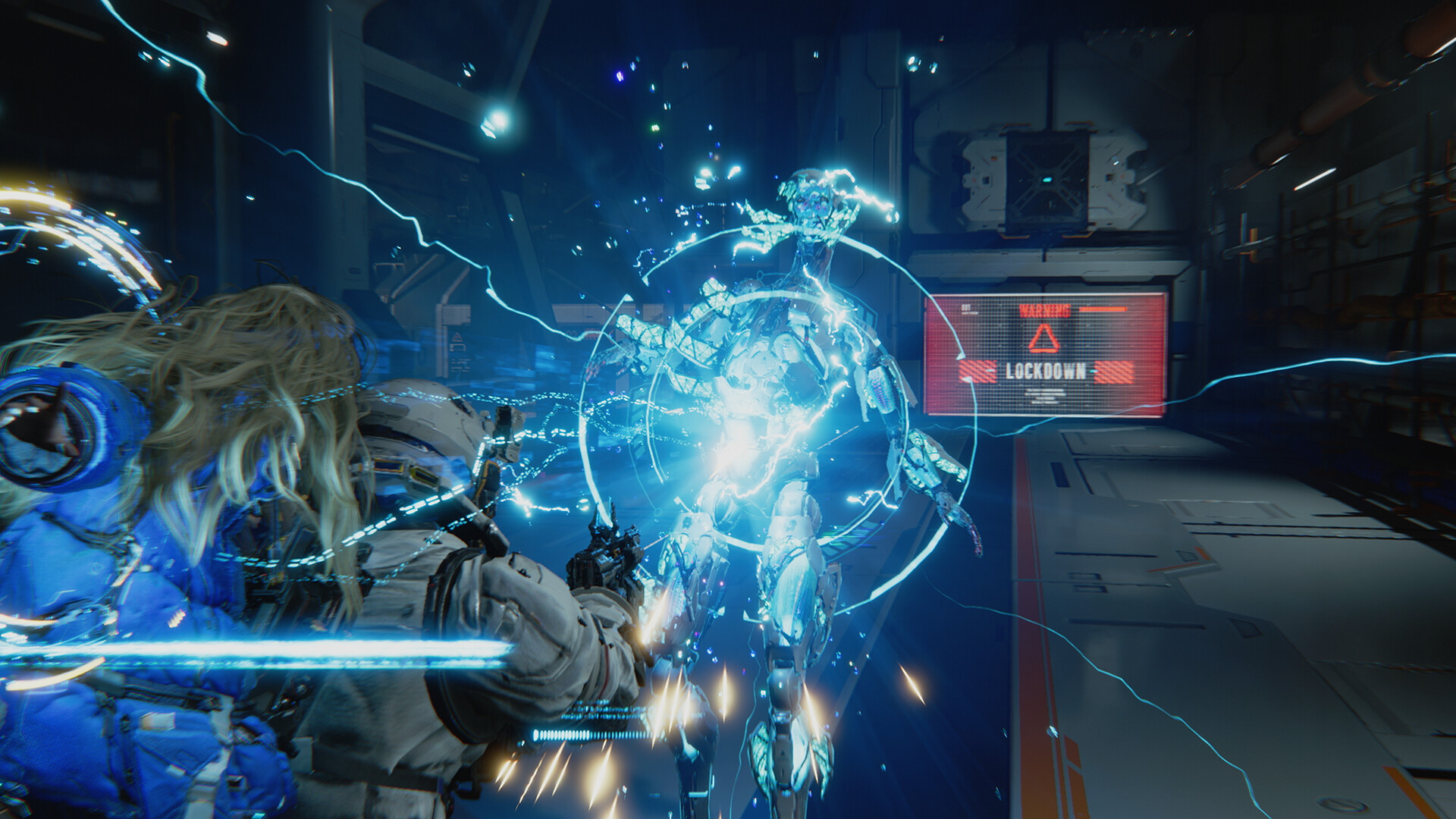
But Hugh and Diana aren’t always welcome in the Cradle, and legions of robotic enemies will try to stop them at every turn. While Hugh is able to equip a selection of firearms to damage, stun and immobilise enemies, bullets alone don’t have much effect on the heavily armoured androids. From her vantage point on Hugh’s back, though, players use Diana’s hacking skills in realtime, moving a cursor around a grid, passing through nodes to add various effects. A successful hack will break open its target’s armour, allowing Hugh to open fire and deal as much damage as possible. Dealing with all of this on the fly sounds like it would be overly fiddly and complicated, but the perfectly-mapped control scheme allows you to hack with the face buttons while simultaneously moving Hugh out of trouble, even dodging, hovering and shooting at the same time. On the whole, enemies are fairly slow, giving you enough time to reposition and collect your thoughts, and there are a few different ways of slowing them down further if the need arises. It’s a highly unusual mechanic, but it works really well and adds a new dynamic to the usual aiming and shooting.
As the game progresses, you’ll find new nodes that add a variety of abilities to Diana’s hacks, many of which are upgradeable to make them even stronger, as well as collecting new weapons for Hugh’s arsenal. Travelling to your Shelter from various points within each level, you’re able to upgrade your weapons and nodes, unlock mods and abilities, and change the loadout for your current mission. You’re also able to take part in some fun unlockable training missions to earn extra upgrade materials, and cash in any Cabin Coins you might have found to unlock prizes on a bingo-like stamp card.
Taking around 10-12 hours to complete on the standard difficulty setting (the trickiest one available when you start the game), some might find that Pragmata isn’t the most challenging of games. Those who finish the campaign will unlock a couple of fun features, though. New Game Plus allows you to replay the game equipped with most of your unlocked mods and abilities (apart from those learned as part of the story) right from the start, and without giving any spoilers you’re also given a good incentive to revisit each location and reach 100% completion in each area. A new “Lunatic” difficulty setting is unlocked as well, making the game much more tense and nerve-racking and allowing you to upgrade Hugh’s abilities even further.
Pragmata brings to mind games like Remember Me, Ghostwire Tokyo, Vanquish and Astral Chain, titles that stood out by taking a chance and trying something a bit different. Much in the same way that those games did, Pragmata feels new and exciting, and its unique mechanics mean that you’re never quite sure what’s going to happen at any given moment. It feels like it’s been years since a game has felt this fresh and interesting, and even longer since something that might be considered “a bit experimental” was pulled off in such a stylish and fun way. Both of its central characters are very likeable (how they managed to make a child companion who isn’t completely irritating is anyone’s guess, but they pulled it off here!), and the relationship between them – with Hugh being the self-aware fatherly protector to Diana’s childlike inquisitiveness – builds really nicely throughout the game. The overarching story might be on the weaker side, but serves its purpose well enough as a backdrop to the addictive combat and exploration that are Pragmata‘s undeniable high points. Overall, an excellent, if unusual, debut!