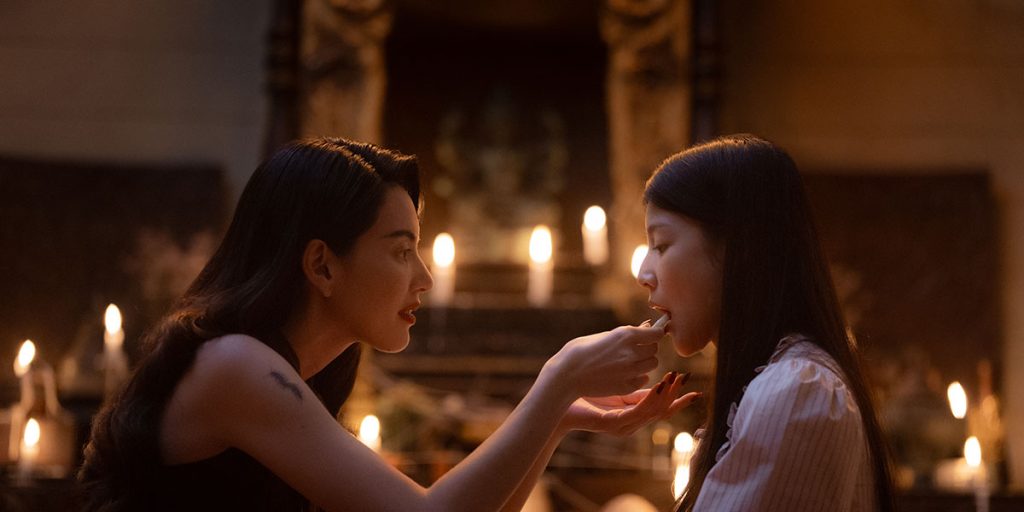
Well Behaved Women is a new comedy from writer Amy Yeo, who has written plays that have come to the Edinburgh Fringe in previous years. This play is set in 1883, and has the distinct air of Oscar Wilde about it.
Opening as your standard drawing room comedy, things soon start to look more interesting than was perhaps initially expected. For a start, we’re in what is a very unconventional household for 1883. Hattie is the lady of the house, but is really a lesbian. Her husband (never seen) seems to be perfectly happy with that, and there’s a hint that it’s because he’s following a Wildean path through life.
Hattie’s maid, Marianne, has been all but excused from domestic duties, and wants to be a writer. She’s at the stage of receiving numerous rejections, but the editor of the Telegraph will give her a by-line, if she can provide him with scandalous gossip. Making up the happy trio is Emma Fairfield, a music teacher, who is of mixed race, being the daughter of a colonial administrator and his wife. This is not the ‘colour blind casting’ we have come to expect in recent years, this actually will be a plot point later on.
Hattie wants her girlfriend to move in. Emma wants to find a husband so that she can stop being reliant on her allowance provided by her father, and Marianne needs a juicy lead to secure her by-line. There’s a side plot about the trio annoying one of the posh local neighbours, but Hattie is also Lady Aldridge, so there’s not a huge amount of scandal there.
Also living in the house is Fred, Hattie’s brother, who is about to depart on his travels. He’s rather sweet and well-mannered, and the actor here gives a great performance as a man utterly confused by the chaos that occurs around him.
Into this pleasant lifestyle comes Chester Hunt, Hattie’s cousin. He is not sweet, or well-mannered. He is in fact pompous, and boorish, and those are some of his more attractive qualities. He also might have murdered his wife, which becomes another sub-plot. What Chester wants is another wife, and he has some very strong views about what sort of woman is suitable for his needs.
There’s a lot going on here, and the opening ten to twenty minutes of this seventy minute play has quite a lot of noise. It can be difficult to understand quite who everyone is, and this is something that could be worked on for future iterations of this play.
Once we have established who everyone is, and what their intentions are, we move to the next bit of plot. For reasons that are not entirely clear, the women are going to hold a seance, even though Hattie in particular is quite sceptical about the entire endeavour. This is a nice use of an era-appropriate cultural reference. The late nineteenth century was one of the times when Britain was having a ‘spiritualist medium’ craze, and even though the Fox sisters are stated within the play to have recently been exposed as frauds, both Emma and Marianne are keen to see if their invited medium can find out what happened to Chester’s wife.
It’s at around this point in the narrative that there’s a slight tonal shift, and a build up of energy, and suddenly, we’re in a farce. There’s people disguising themselves with a curtain, people knocking on tables, and an awful ot of running on and off stage. This is all brilliantly well done – this style of comedy takes exceptional timing and energy, and the cast handles what’s asked of them remarkably. The narrative keeps going too, and then, shockingly, an actual real spirit arrives.
Technically, the play then becomes quite clever, with the lights flickering, books jumping off the fireplace, and curtains flapping in a breeze that doesn’t exist. This is well done in any event, but especially within the constraints of the Fringe, which require very quick change over periods, and less technical interventions than might otherwise be usual in most theatre productions.
Back to the story, and Chester reveals himself to be an opportunistic, class-ist, racist, sexist, misogynist, who is out for himself entirely. It’s not a surprise, and the actor does do very well with making such an absolute abomination of a character so nuanced.
Underneath the farce, there’s a serious point being made here, about how women have always wanted to make their own way in the world, and how being in your twenties has always been a time of confusion and bewilderment, as everyone around you seems to be more settled, and making ‘better’ progress through life.
A bold attempt at creating a farce, this is a solid play that could perhaps be longer, so that all of the characters, and their background stories, could be more firmly established before the chaos begins.
Well behaved women these characters are not, but they’re having a whole heap of fun, and that’s the spirit of the Edinburgh Fringe.

You can get tickets for the Edinburgh Festival Fringe run of Well Behaved Women here, and find out about future shows here.