PLATFORM: PC, PS5, XBOX SERIES (REVIEWED) | RELEASE DATE: 17TH JANUARY
This latest entry in the long-running Dynasty Warriors series takes us back to the early days of the pre-Three Kingdoms era of Chinese history, following the story of a nameless traveller who arrives in a desolate village and gets caught up (and, some might say, a bit carried away) in the corruption and violence that’s spreading throughout the land. Selfish rulers fail to help their subjects, with some going as far as to purposely make things even worse for those under their watch. Civil unrest leads to a widespread rebellion that culminates in the largest battle that the country had ever seen, and the part you play in the events that unfold will change the course of history.
Following 2018’s Dynasty Warriors 9 open-world experiment, Origins goes back to basics with a more familiar (and much more enjoyable) formula. The open world has been replaced with a simple overworld map, dotted with settlements, points of interest, and battles. You’re able to check messages and purchase new weapons in towns and villages, while characters and collectibles can be found all over the land which help to increase your abilities. The battles are, of course, the main draw, and three different types are available here – a small-scale “skirmish” will give you a single easy objective, while medium-sized missions are a little more involved. The main story quests are of course much longer and more involved, making full use of the skills and abilities that the game gives you to play with.
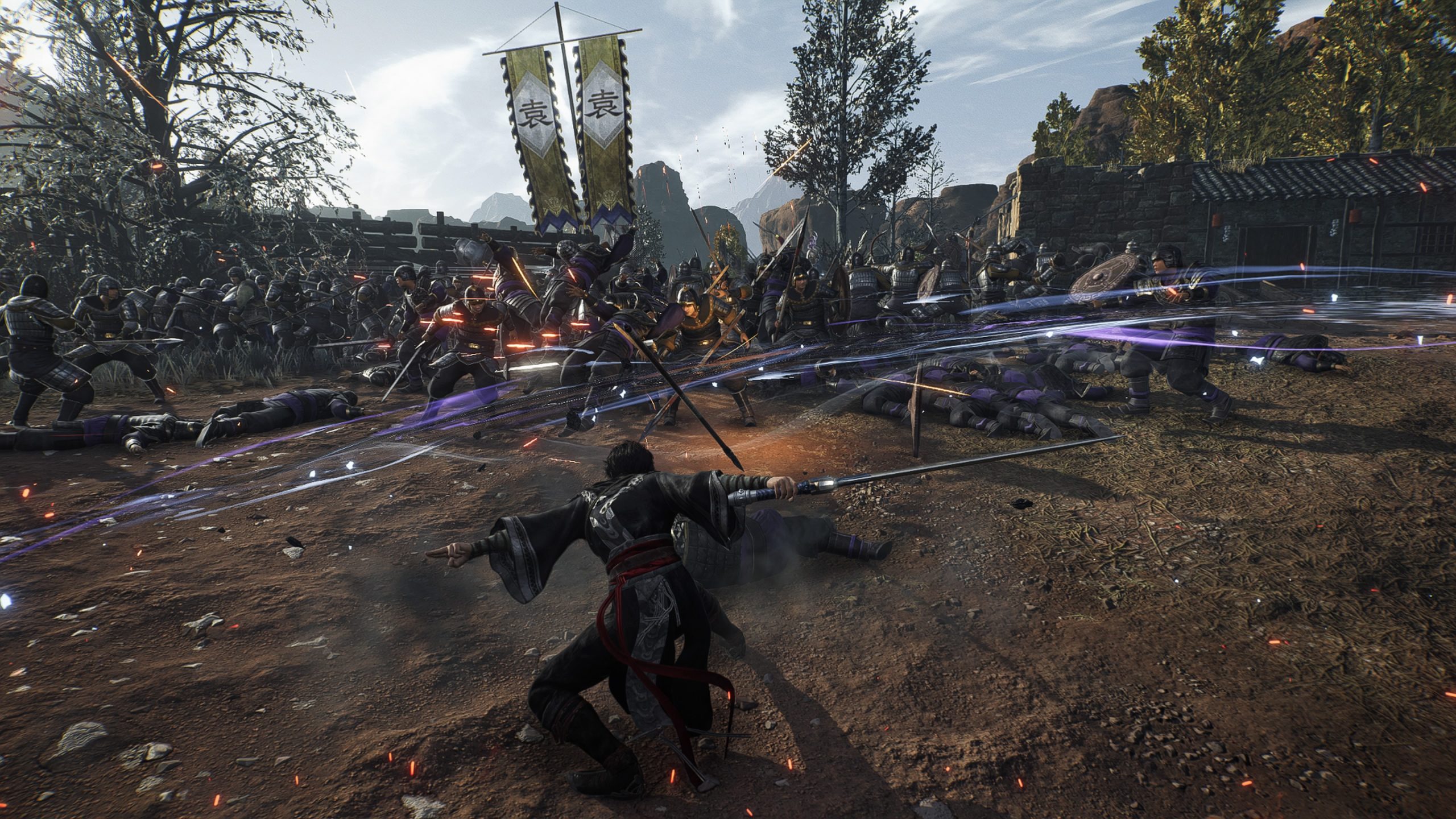
As always, a single battlefield consists of multiple bases that you’ll need to travel around and defeat their leaders to take over the area. The familiar Warriors 1-vs-1000 formula is in full swing here, as you hack and slash your way through thousands of enemies as you make your way to your objective. Origins crams a lot of mechanics into its gameplay, with a morale system affecting the performance of your own troops as well as those of your enemy, “large forces” that combine multiple enemy troops into a single cohesive unit that requires skill and strategy to take down, and various other charges, ambushes and tactics that can be used to turn the tide to your advantage. There might be a lot going on, but everything is introduced at a decent rate that allows you to figure out how one thing works before turning your attention to something else. There’s nothing overly complicated, and everything comes together beautifully in the fast-paced and exhilarating battles where you truly fulfill your role as an “army of one”. However, even when you’ve mastered everything that’s going on, any difficulty level other than the very easiest setting will still test your skills like no other Dynasty Warriors game has done before – enemy troops are relentless, there really are thousands of them, and their commanders will employ a wide variety of tactics to stop you from achieving your goals. Sure, you can hack and slash and hope for the best, but a bit more thought and effort is often needed to take down the enemy forces.
Nine different weapons are available throughout the game, from standard swords and spears to the more fanciful mostly sharing the same control scheme and combo inputs. While this makes combat easy to get to grips with, it doesn’t mean that each weapon is the same – far from it. Each weapon has its own unique set of attacks, and handles very differently to the others, while a few have additional gimmicks that require a bit of extra practice to master. “Battle Arts” are special moves that are restricted by their reliance on a meter that builds up as you land standard attacks, while your musou gauge also builds up to several levels allowing you to perform an ultimate attack that can wipe out hundreds of enemies in a single blow. Allies on the battlefield can boost your Battle Arts and musou attacks even further, and building up the relevant meters is relatively quick and easy thanks to the satisfying ways that your regular attacks and combos can be chained together.
You’ll likely settle on a favourite weapon, but the game encourages you to mix things up by giving you plenty of combat challenges, often asking you to use specific weapons to complete the objectives. These are completely optional, but reward you with handy skill points which, along with those that you’re given when succeeding in battles, can be spent on unlocking new abilities where you’re able to increase your attack and defence stats as well as learning new Battle Arts and tactical skills – there’s nothing too out of the ordinary, but it all helps to build a good sense of progression. Your character will also level up automatically along the way, increasing your stats to ensure you’re always gaining momentum and unlocking additional skill trees to spend your hard-earned points on.
While Origins is set within a historically accurate era, many liberties have been taken with its characters, weapons and skills. A lot of the attacks you’re able to perform are incredibly over the top, there’s a bit of sorcery here and there, and you’ll often find yourself almost breathless with the amount of carnage happening on screen. At first glance it might look like a serious chin-stroking historical epic, but Dynasty Warriors Origins definitely understands the importance of allowing players to have fun. After DW9‘s uneven reception, fans of the series might be slightly apprehensive about how Origins would turn out. It’s slightly disappointing that you’re restricted to playing as a single character (others are available but only in certain battles for a limited amount of time), but you’re given so many mechanics and tools to play with that you may well forget that playing as other characters used to be an option in previous games. This is certainly the most chaotic entry in the series so far (in the best kind of way), and the combat, performance and gameplay is easily the most refined to date. Definitely a return to form!