![DM_Barbie-Image_RGB[1]](https://www.starburstmagazine.com/wp-content/uploads/2024/07/DM_Barbie-Image_RGB1.jpg)
Barbie: The Exhibition is a retrospective examining the history of Barbie the doll and Barbie the brand. It is now open at the Design Museum in Kensington and will remain open into 2025.
STARBURST was invited to a press preview of the exhibit, which was preceded by a brief Q&A. Curator Danielle Thom was keen to impress that the planning for this exhibition has been ongoing for several years, specifically since well before last summer’s blockbuster Greta Gerwig helmed movie was even in production.
Kim Culmone, who had made the journey from Mattel HQ in California to attend the opening, spoke to Barbie’s overall impact as a consumer product. She informed us that most successful toys have a life span of 3 to 5 years, during which they are incredibly popular and will then generally cease production as sales fall. Barbie celebrates its 60th anniversary this year, and the success is a genuine phenomenon in global toy retailing.
Some of this enduring success may be due to the stated aim that Barbie is both ‘timely and timeless’, and these qualities were certainly on display throughout the exhibition. The exhibit’s stated aim was to demonstrate Barbie – both the doll and the brand – as a design and cultural phenomenon and examine how the brand exists today in relation to different design principles.
The exhibition has arranged rooms around loose themes to facilitate this. The aim is to show us that design requires networks of collaboration and to demonstrate how these come together to facilitate Barbie’s world.
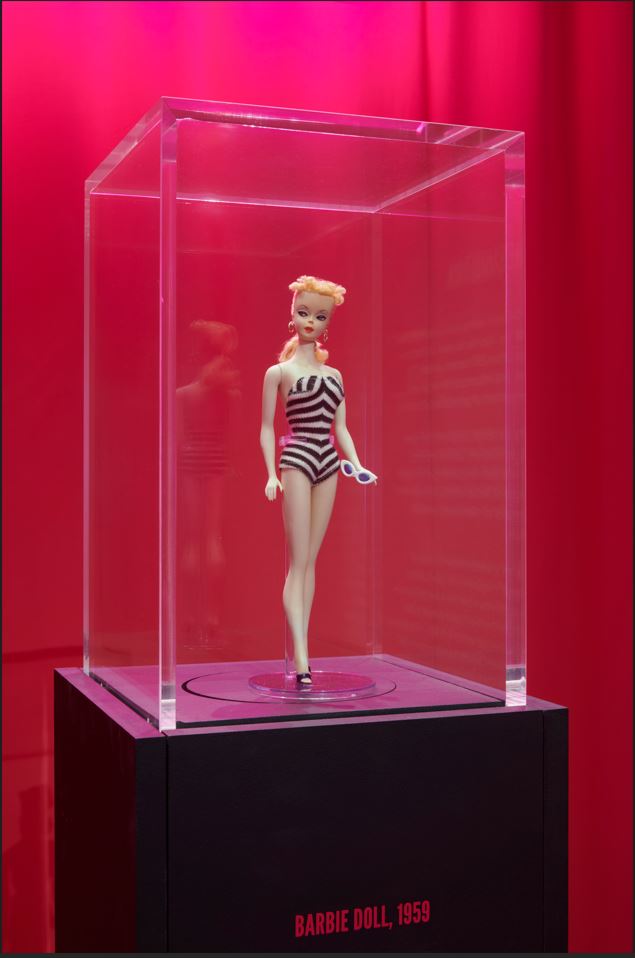
We begin by entering an entirely pink room – a theme which, unsurprisingly, is revisited throughout. Here, proudly on display, is the Design Museum’s recent prize acquisition – a ‘Barbie No.1’. This is the stereotypical ‘Barbie’ – the design you’d almost certainly automatically think of when you think of Barbie – a teenager in a black and white swimsuit, her blonde hair pulled back into a ponytail. Indeed, this is one of the images that is now globally renowned, having been featured heavily in the 2023 movie and notably worn by Margot Robbie in that film’s 2001: A Space Odyssey homage sequence.
This now iconic design is referenced in a later part of the exhibition, where the design and modelling process for the 60th Anniversary model is broken down into stages, as the visitor is taken from conception to shelf through a series of design templates and informative videos.
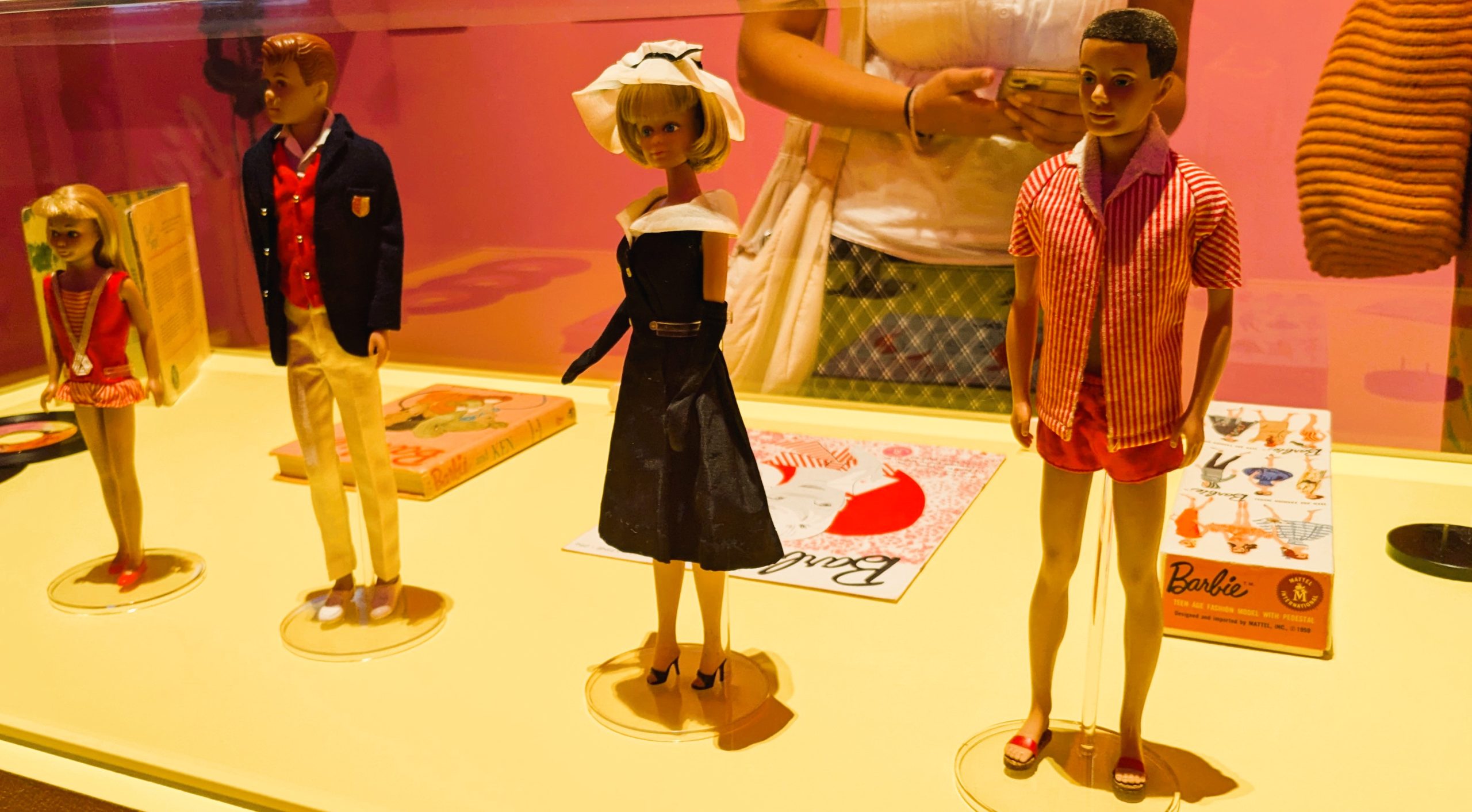
Initially, however, the artefacts presented have a small, albeit intriguing amount of information presented alongside them. Once past Barbie No.1, we are presented with a timeline of major developments within the brand’s evolution, together with the first examples of the other major characters within the Barbie Universe. This includes Ken, Midge, Allan, and Skipper, and it’s astonishing how much Ken has changed and how familiar Midge and Skipper remain.
Also within this section of the exhibition is a copy of the original design submitted as part of the Barbie exhibition. This is fascinating, and we wished that there had been far more information about both this initial application, its reception and legacy, as well as any subsequent patents or trademarks granted or applied for. The evolution of a design and the documents drawn up to provide legal protection to those ideas often offer a fascinating glimpse into the thought process of the core creators of a product, and it would have been interesting to have been presented with a timeline of technical drawings, to accompany the dolls and other items on display.
There’s a little of this, included as part of a timeline demonstrating how Barbie evolved to have movable limbs, but it feels like there’s more hiding in Mattell’s archives than we’re being afforded access to here.
This part of the exhibition also included the original box in which Barbie was sold. Far from the large, bright pink plastic packaging, which, crucially, allows Barbie to be seen, this is a small cardboard item. Again, as nostalgic as this is, it provides an opportunity for the development of this aspect of the brand to be detailed and would have allowed for the evolution of graphic design to be explored.
Where the exhibition does go into incredible detail is in demonstrating the various elements that make up the models of individual Barbies (and Kens), such as faces, hair, and features. There’s a fascinating level of detail here, along with some revelations about the different ways the same moulds are used to deliver completely different end results.

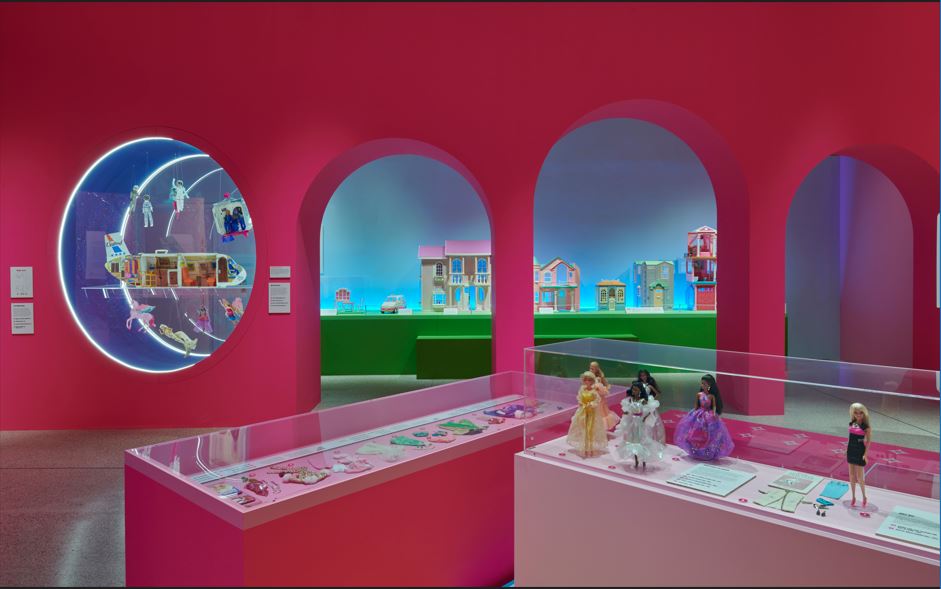
The different models of the doll are shown in various tableaux, and it becomes obvious that Barbie exists in a fantasy world. The first Barbie astronaut was launched to market in 1965, and different iterations of the model have ‘run for President’ eight times. Barbie also worked in various careers for years, sometimes even decades, before women were allowed to.
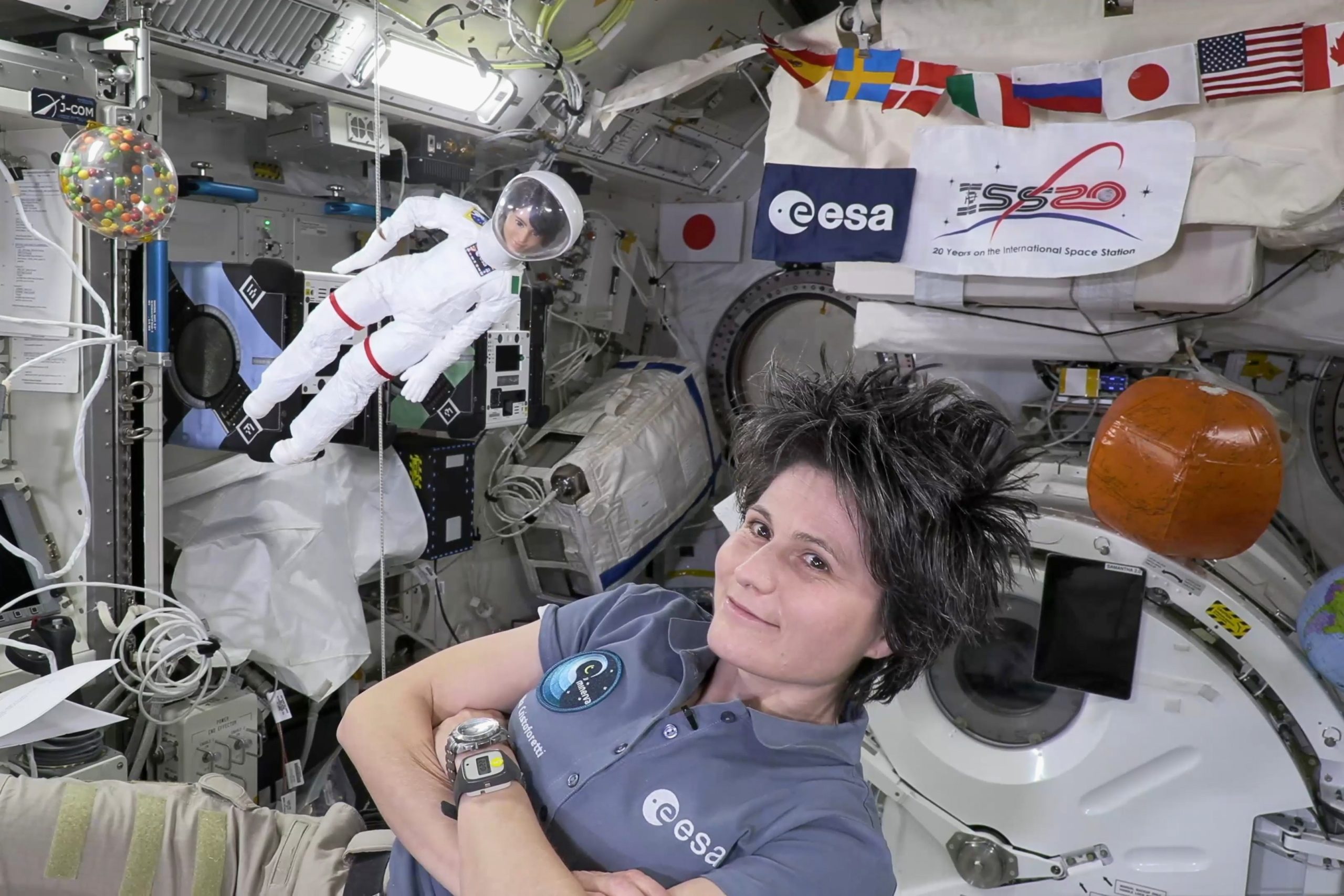
Thankfully, the world has caught up with Barbie’s ambitions, and not only can women now be astronauts – but Barbie can actually travel into space. On display is the model named ‘Samantha Cristoforetti Barbie’, a Barbie doll modelled after the ESA astronaut who travelled to the ISS in April 2022, taking the Barbie doll with her. Alongside the display are snippets of the video conversations Cristoforetti had with young girls back on Earth. Again, this is really interesting, but we’d have liked to have seen more than the roughly 3-minute long video that was on constant repeat.
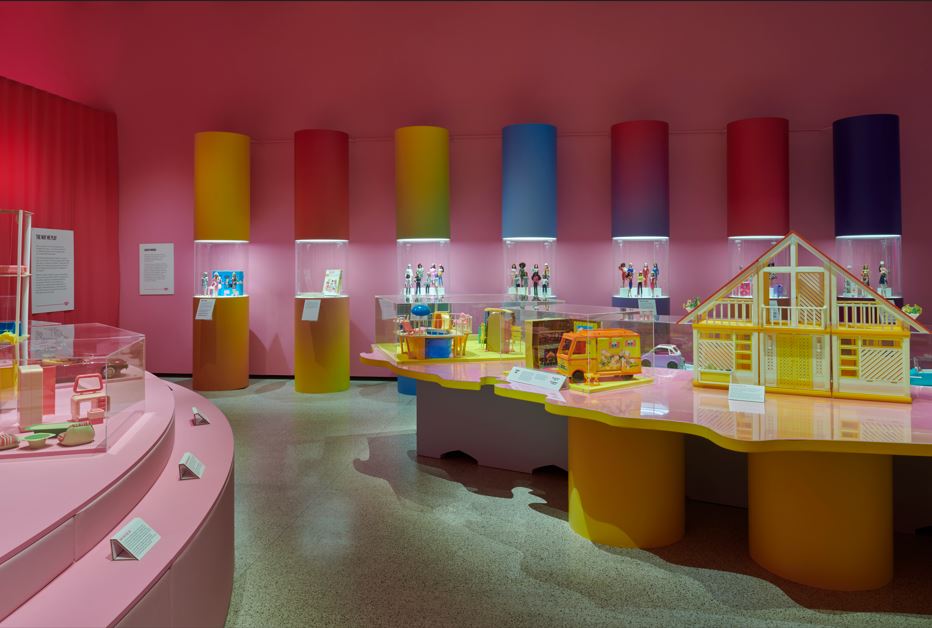
Barbie also has her own ‘dreamhouse’, again something women in America, and much of the world, were not able to do without the involvement of a male guarantor. The largest space in the exhibition houses 60 years’ worth of evolution in the design and ambition of Barbie’s living accommodation. Initially, one multi-function room, the house has evolved to include multiple rooms, multiple storeys, and even a lift. The information boards mention the influence of various interior design and architectural movements and also press the importance of the influence of California – the home state of Mattel – on the design of the houses and various other Barbie accessories.
In this central area, we see many of the accessories that contribute towards the 300 to 400 items within the Barbie brand that Mattel produces each year. The advent of ‘Barbie Pink’ is obvious, but again, more information on the decisions behind the choice of this specific shade would have given more depth to the artefacts on display.
Having allowed a deep sense of nostalgia to permeate through the exhibit so far, the final room brings Barbie to the present day, as the displays focus on Barbie’s appearances on screen and on the covers of various marquee American magazines. Within this room, as well as coverage of Margot Robbie’s turn in the behemoth movie, there are also the more ‘middle grade’ animated movies featuring Barbie as a younger girl than we’ve become used to, trying to dismantle the patriarchy by confronting inequalities and what Mattel are terming ‘the gender gap’.
Overall, there’s a lot to look at, and the assistance of Mattel has obviously been considerable and the key to the exhibition’s existence and hoped-for-success. It’s also obvious, from the contents of the Museum’s Barbie-fied Gift Shop, that the intended audience here is perhaps younger than might usually be expected to be spending time in the museum’s leafy west London Kensington location.
Given that, we feel that there needs to be a greater amount of information on the influences at play in realising the items shown. Whilst we here at STARBURST can look at the fashion section of the exhibition and understand that the fashions of Jackie Kennedy and the mods of 1960s Carnaby Street are being referenced, these reference points may well be less apparent to a younger audience. And whilst this information is contained within some of the very weighty books on sale in the gift shop, we do feel that at least some of this information could have been included within the information boards in the exhibition.
There’s a great deal to enjoy here, and it’s obvious that Mattel has been generous with the access to their archives, as have various individual collectors, who have lent their prized collectables to the Design Museum for the duration of the exhibition. However, it’s hard to escape the feeling that much of the content is merely scraping the surface of what could have been covered in terms of design discipline influences. This may be due to the overall small size of the space that has been allocated for the exhibition, which occupies a part of the basement of the museum’s High Street Kensington building.
Where are the contemporaneous images of the building and interior design styles that influenced the Dreamhouse? Where are the architectural blueprints? Where are the historic photographs of the fashions that were adapted for Barbie over the last six decades? Whilst we are given a lot to look at, we aren’t given a lot to reflect on, and it feels like a missed opportunity to reinforce the obvious aim of Barbie being taken seriously as an important piece of design history.
We’re left with an experience that feels as if it could have been so much more and which is over far too quickly. It also somehow manages to avoid much of the fun sense of playfulness that Gerwig managed to retain in her foray into translating Barbie into a screen smash.
Expect to spend around an hour, certainly no more than 90 minutes, at the exhibition, and enjoy the walk along ‘High Street Ken’ – a piece of wordplay that is at least played upon from the moment you alight at the eponymous tube station – to find your way to a temporarily very pink Design Museum.
Barbie: The Exhibition, continues at the Design Museum in Kensington, London, until February 23rd, 2025.