Having established himself in his two ‘breakout’ titles, The Lobster and The Favourite (an unlikely but deserved multi-Oscar nominee), Yorgos Lanthimos cements his reputation as one of the film industry’s most unique, audacious, and possibly even divisive talents. His films are like nothing else; weird, angular, and awkward, his stories hewn from the darker side of human nature, often leavened by arch and almost slapstick humour and studded by bizarre, sometimes shocking, imagery. Based on Alasdair Gray’s acclaimed 1992 novel, Poor Things is not only the director’s best work yet, but it’s also his most extraordinary, marrying beautiful, surreal imagery in a Victorian era that’s slightly off-kilter with the one we’re familiar with from our history books to a bizarre, often unsettling story that exposes the human compulsion for cruelty and selfishness yet counterpoints it with the naïve innocence and simple joy at being alive of its unusual protagonist.
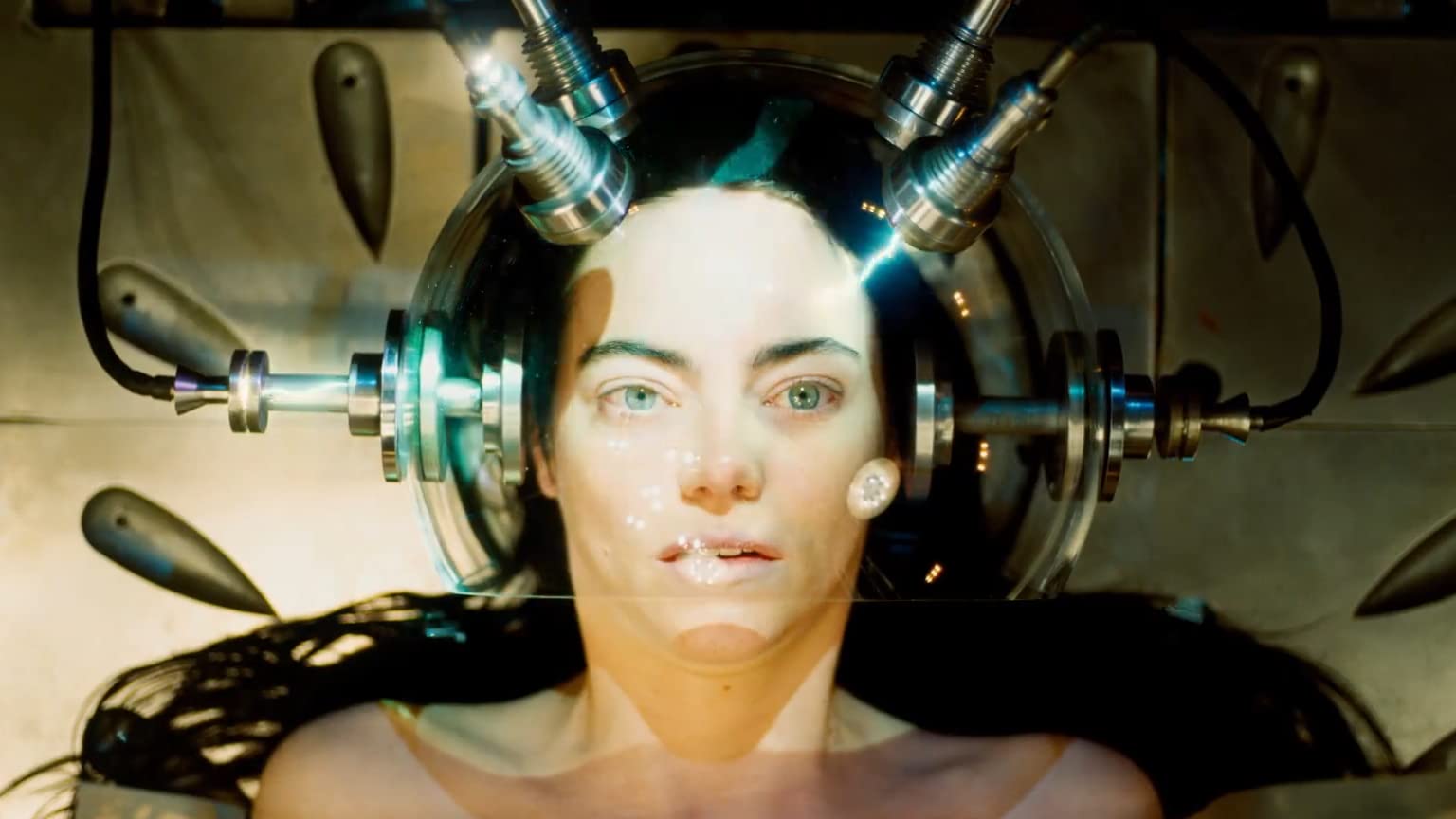
Bella Baxter (Emma Stone, outstanding here) is the child-like young ward of eccentric, disfigured surgeon Godwin Baxter (Willem Defoe). Medical student Max McCandles (Ramy Youssef) is recruited by Godwin to chronicle Bella’s physical and mental development. Bella, it turns out, committed suicide by hurling herself from a bridge whilst pregnant. Godwin recovered the body and replaced her brain with that of her unborn but still alive baby. Bella has the body of a young woman but the mind of a tottering toddler. As she quickly develops full mobility, her intelligence grows, and she becomes increasingly curious, discovering her own sexuality and sensuality. Bella becomes engaged to Max but craves independence and is lured into a life of travel and adventure by the leering, rakish Duncan Wedderburn (Mark Ruffalo), who takes her off on a grand cruise. But Wedderburn finds that Bella is not easily tamed, and her insatiable curiosity and her relentless naivety, coupled with her aching compassion, find the pair pitching up at a snowy Paris where Bella’s life takes a very sharp – and quite dark – turn that will change her forever.
To say more would be to spoil the untold stunning delights of this gorgeous, evocative and sometimes quite shocking piece of modern cinema. Lanthimos creates a world – entirely on soundstages – that is richly detailed, bursting with vivid colour (although the film opens its account in moody monochrome) and populated in places by grotesques living side-by-side with the innocent and the exploited. Through all its visual and narrative extravagances marches Stone’s Bella, wide-eyed and innocent, a human blank slate but learning the ways and the wiles of the world and always managing, often entirely inadvertently, to turn them to her advantage. It’s a film alive with astonishing, nuanced and very Lanthimos performances – Ruffalo brilliantly showing his acting chops again after years shackled to Marvel as the louche, sleazy Wedderburn and Defoe at his best as the troubled surgeon, a man who has himself become a monster thanks to his own ghastly childhood. But this is Stone’s film, a role that she embraces fearlessly, hurling herself into some outrageous and explicit set pieces with gusto.
Poor Things is many things – it’s an extreme fantasy, steampunk sci-fi, and a twisted take on Frankenstein. It’s frequently hilarious, too (Vicki Pepperdine as Godwin’s maid, Mrs Prim, gets the biggest laugh) as it continues Lanthimos’ speciality for stilted, awkward dialogue delivered almost deadpan. It’s also a masterpiece, albeit one that many will find infuriating and, at places, hard to watch, much less stomach. But for those of a sturdier disposition, Poor Things is an absolute joy, mesmerising and magnetic and surely quite unlike anything else the year ahead in cinema has in store.
POOR THINGS is in cinemas now.