by Anne-Louise Fortune
Woven is a new musical interpretation of part of the story of Homer’s The Odyssey, focusing here on the female characters who exist in the life of Odysseus.
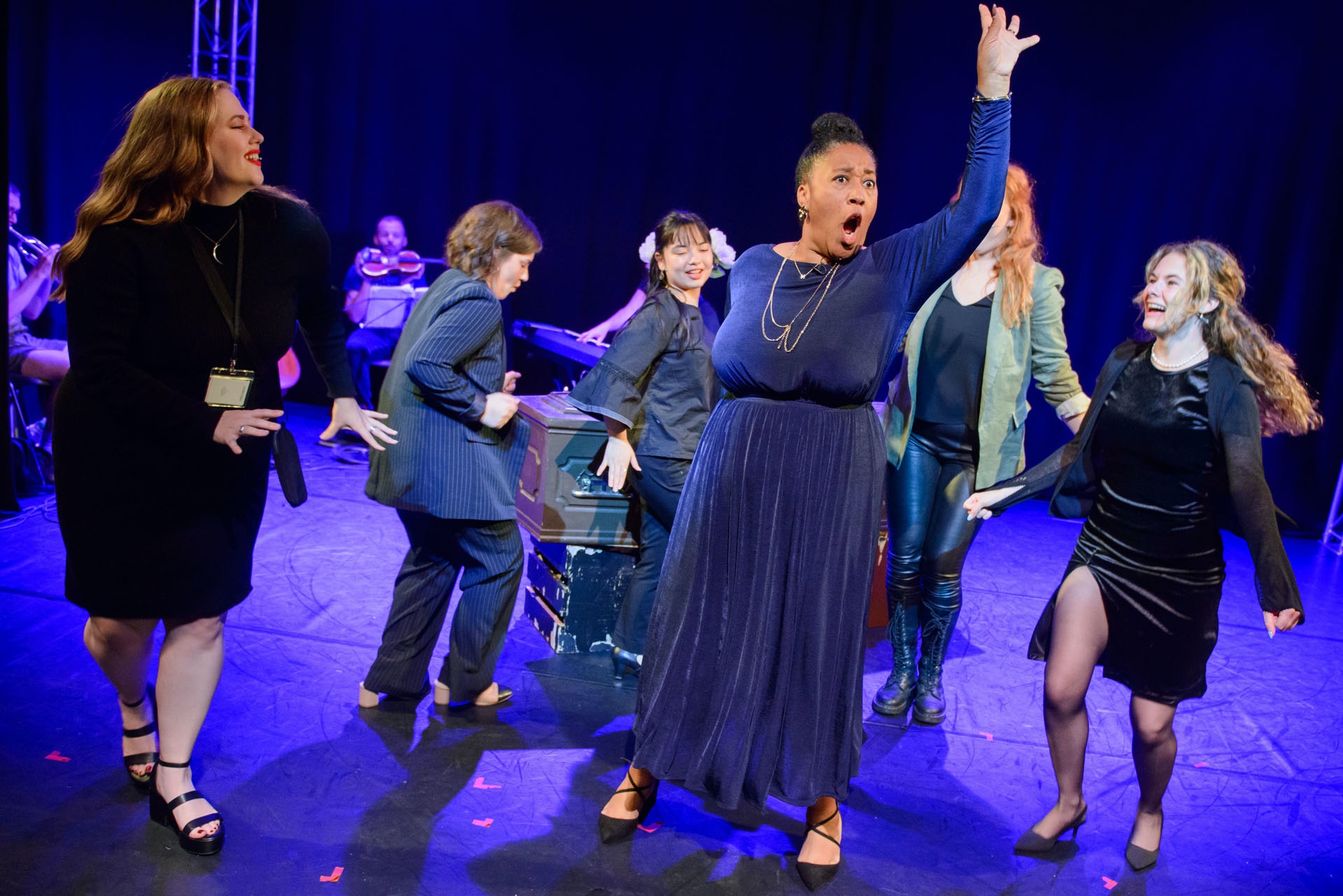
Odysseus himself is never named, and technically never appears – although what is presumed to be his coffin occupies the performance space for almost the entirety of the performance. The story has also been re-situated to be set in an unspecified modern time, and in what appears to be the United States of America.
We are therefore at a wake, and Penelope, the widow, is hosting. A series of women enter the scene, and discuss their relationship with the dead Senator. There’s Cerce, the ‘therapist’, Helen, the mistress, and at one point somehow, Aphrodite, who here is a journalist. It’s never quite clear how she doesn’t get removed from the event – after all, we are clearly in Odysseus and Penelope’s house, and, public figure or not, surely Penelope is entitled to privacy in her grief?
Much like Six, the musical which tells the tale of Henry VIII’s wives, this piece also appears to fail the Bechdel Test – as none of the women here seem to have a conversation that isn’t about either Odysseus, or another man in their respective lives. This musical has been developed by an American creative team, and therefore there is what seems to be a curious choice of language – there seems at times to be a desperate desire to be provocative – but without using what Americans regard as ‘crude language’. It’s a curious artistic choice – these women are angry, and many of them have been betrayed – the occasionally fruity word would be expected.
Throughout the piece there are moments of humour – but these need developing. The script however does make the point that, even in modern times, much has not changed for women – who still are often not afforded the opportunity to work out, for themselves, what they want from life – and are all too often instead made to be secondary to the men in their lives, and the decisions they make. It’s odd therefore that so many of the women in this piece seem to be secondary to the men – and if Penelope is to start making her own choices, then that needs to become the subject of a second act. Perhaps the longevity of the original myths has hampered the ability to create an alternative story here?
Using the traits of the characters from the Greek myths and translating them to a modern environment, is a clever way to use tropes and archetypes, without falling into cliche and stereotype. Worryingly however, a lot of the women appear to solely have the character trait of ‘mistress’, with the difference being their degree of personal self-confidence and self-reliance.
This is a musical, and whilst the songs are fine, the repetitiveness of a character arriving to the wake, introducing themselves, explaining their relationship to Odysseus and then singing about it, becomes predictable, and therefore dull. A song towards the end, sung by Penelope (Jessa Smith Campbell) is by far the stand-out number. For a musical, the gaps between the songs are too long, and this needs attention for the show’s future life – either have more of the story told through song, or significantly tighten the spoken sections, or decide that the show is ‘with songs’ rather than ‘a musical’. At the moment there is also too much tonal dissonance between the various sections of the narrative, and there is a last-moment development between Penelope and Hera that is utterly un-foreshadowed.
At the current time, this piece feels as if it is a part of a bigger story. If the production is to be developed, the creative team needs to determine what story it is trying to tell, and how long that story needs to be. There is potential here, but work is needed if this is going to be the next big ‘off-Broadway’ musical.
Currently enjoyable, but without a strong enough ‘USP’, this is a show that potentially has a strong future.

Woven continues at the Edinburgh Festival Fringe until 26th August